

Sunday service was halfway through when the tow truck rolled into the church lot like it owned the place. Not a polite little pickup either—full-size wrecker, amber lights turning slow and deliberate, the kind of vehicle that makes people instinctively look for a problem. A couple of latecomers paused by the doors, staring, because nobody expects a repo job to happen in the middle of “Amazing Grace.”
Inside, the pastor was in his element: mic clipped on, sleeves rolled to forearms, voice warm and practiced. He’d just transitioned into a story about “storms you don’t see coming,” which, in hindsight, felt less like a sermon illustration and more like foreshadowing. The congregation was settled and quiet, the way they get when they think they’re about to be moved.
Out in the parking lot, the tow driver wasn’t rushing. He walked a slow circle around a newer-looking pickup parked in a spot that said VISITOR, like he was double-checking the plate and VIN, then pulled a small clipboard from the cab. The man had the calm, slightly bored posture of someone doing a job that always makes people mad, and he’d long ago stopped absorbing that energy.
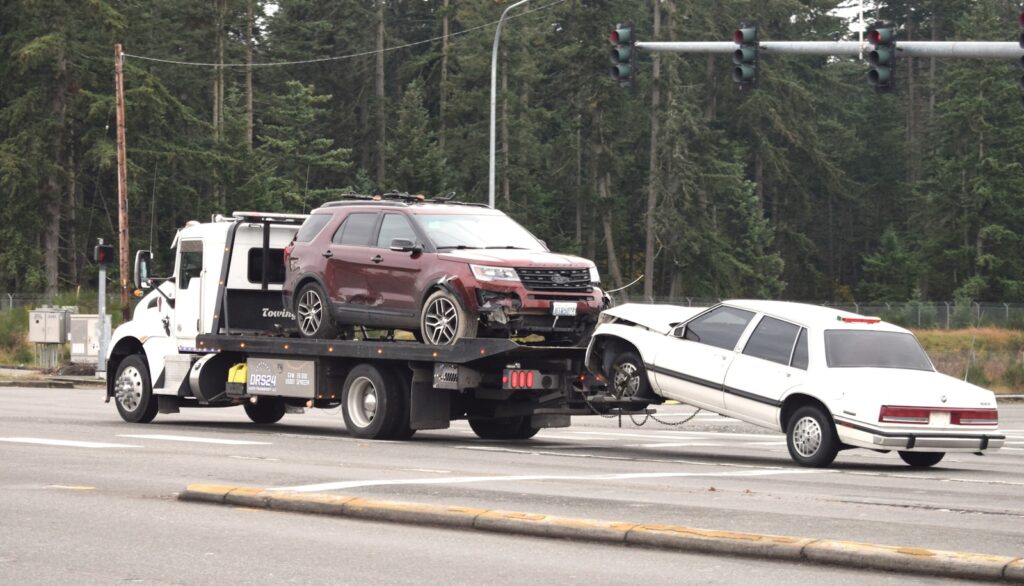
The wrecker in the lot
A teenager in the back row spotted the flashing lights through the narrow windows and nudged his mom, who leaned over to get a look. Then another head turned, then another, and it spread the way distractions do in a room full of humans: subtle at first, then all at once. Someone near the aisle whispered, “Is that… for someone here?” like they couldn’t imagine it being anything else.
The tow driver backed up in clean, practiced movements and dropped the wheel-lift like he’d done it a thousand times in tighter spaces. He didn’t blast the horn or bang on doors or try to create a scene. He just started hooking the front wheels of the pickup while the church sat fifteen yards away, full of people pretending not to stare.
At the side entrance, the church secretary slipped out, the way people do when they’re trying to handle something without disturbing the “moment.” She walked with her hands clasped in front of her, like posture alone could make her look official enough to stop a tow. The driver held up a laminated repo order before she even got close, a move that suggested this wasn’t his first church lot.
She came back inside with a face that was trying to be calm but wasn’t quite landing it. She leaned toward one of the deacons and said something that made him blink hard and look toward the front where the pastor was still preaching, unaware. The deacon stood, smoothed his tie like that would help, and headed out the side door with the heavy walk of someone about to get yelled at by everybody.
The pastor keeps preaching
The pastor didn’t notice at first, or if he did, he didn’t acknowledge it. He kept talking about faith under pressure, about how people put their hope in “things that can be taken away.” That line landed oddly, because people were now fully aware that a very specific thing was actively being taken away outside.
There’s a particular kind of tension when a room full of people knows something the person with the microphone doesn’t. You can feel it in the way nobody clears their throat, the way babies choose that moment not to cry, the way even the squeaky pews go quiet. The pastor’s wife sat in the second row, legs crossed, nodding along, her face open and attentive.
When the deacon came back in, he didn’t head to the pastor. He headed to the pastor’s wife instead, and that choice alone lit up the room with questions. He bent down and spoke into her ear, and her expression changed in three stages: confusion, then irritation, then a kind of focused stillness like she was trying to keep herself from standing up too fast.
She didn’t whisper back. She put one hand on the pew, stood, and walked out with controlled speed, not running, but not the slow “excuse me” church walk either. Two women a few rows back watched her go with faces that said they were about to remember every detail later.
The repossession becomes a spectacle
In the lot, the tow driver had the pickup halfway in the air. The pastor’s wife stepped into view and immediately did what people do when they’re trying not to cause a scene: she stood too straight and spoke too politely at first. The deacon hovered a few feet behind her like an anxious assistant, glancing between her and the driver.
The driver didn’t match her energy. He stayed neutral and pointed to the paperwork, then to the truck, then back to the paperwork, the calm triangle of “I’m not debating you.” When she asked whose name the order was under, he said it like it was nothing—like he was reading a menu item.
That’s when her politeness cracked. She asked, louder, why her husband’s name was on a repo order for a truck she’d never seen before, and why it was being taken from their church lot during service. The driver didn’t take the bait; he just said he couldn’t discuss account details beyond what was on the order and advised her to call the lender.
A couple of men had drifted out of the sanctuary by then, including one guy who always seemed to be on “parking lot duty” even when nobody asked. Someone tried the classic move of standing behind the tow truck like a human barricade, which lasted about four seconds before the driver told him he was welcome to call the police but the truck was leaving either way. The man backed off, offended, as if the laws of secured lending were a personal attack.
The twist: it wasn’t just debt, it was secrecy
By the time the pastor realized service had thinned out near the back, it was too late to pretend nothing was happening. He paused mid-sentence, scanned the room, and saw the empty spot where his wife had been. His face tightened—just a small change—but it read like someone who knows exactly what’s outside and wishes it weren’t.
He handed the microphone to the worship leader with a quick, “Let’s sing,” and walked off the stage. Not hurried, but not relaxed either, and he avoided eye contact with the people watching him go. He pushed through the side door, and within seconds his voice could be heard in the hallway, not shouting, but sharp in that way that means he’s trying not to shout.
Outside, he approached the scene like a man trying to control the narrative. He spoke to the tow driver first, not his wife, and his posture screamed “authority”—chin up, hands out like he was about to negotiate. The driver stayed seated in the cab now, window down, and just listened the way people listen when they’ve already done the paperwork.
Then the pastor’s wife asked the question that actually mattered: why did he have a second truck at all, and why hadn’t she known about it? It came out measured, but the words were clean and direct, the kind you can’t wiggle away from. The pastor’s first answer wasn’t an answer; it was a request to talk “not here,” which was basically a confession in a different font.
The details came out in fragments, the way secrets do under pressure. He’d bought the pickup quietly “for the church,” then “for outreach,” then “for hauling,” shifting the reason as each one fell apart under her stare. But it wasn’t titled to the church, and it wasn’t mentioned in any meeting, and the payments clearly hadn’t been coming out of any transparent account.
Fallout in the parking lot
There’s a specific humiliation to watching your spouse get repossessed in front of people who call you “Pastor.” The tow driver started to pull forward, and the pastor’s wife didn’t try to stop him anymore—she just watched the truck leave like she was watching a door close. The pastor, meanwhile, looked like he wanted to grab the bumper with his bare hands and rewind time.
As the wrecker rolled out, the pastor’s wife turned away from the lot and walked back toward the building with the same controlled speed she’d come out with. She didn’t cry, didn’t yell, didn’t perform. The absence of drama was its own kind of loud.
Inside the sanctuary, the worship leader was still singing with the band, doing their best to keep the room stitched together. People were standing, but half of them were looking toward the side door like they expected someone to burst in and announce what they’d just witnessed. When the pastor came back, he didn’t go to the stage; he went to the front row, sat down, and stared at the floor.
After service, the parking lot turned into clusters—tight circles of quiet voices and wide eyes. Some people were angry on the wife’s behalf, some were defensive on the pastor’s, and some were just addicted to the mess of it. A few folks tried to frame it as “spiritual warfare,” but it landed hollow next to the very human reality of hidden purchases and overdue payments.
What stuck with everyone wasn’t the repossession itself, even though that was plenty. It was the way the pastor had tried to keep preaching while the consequence of his private life was literally clanking a chain around his front tires. And when his wife finally got him alone—no congregation, no deacons, no microphones—the real question hanging in the air wasn’t about a truck at all. It was what else he’d been hiding, and how long she’d been sitting in the second row believing a man who’d been living two versions of the same story.