

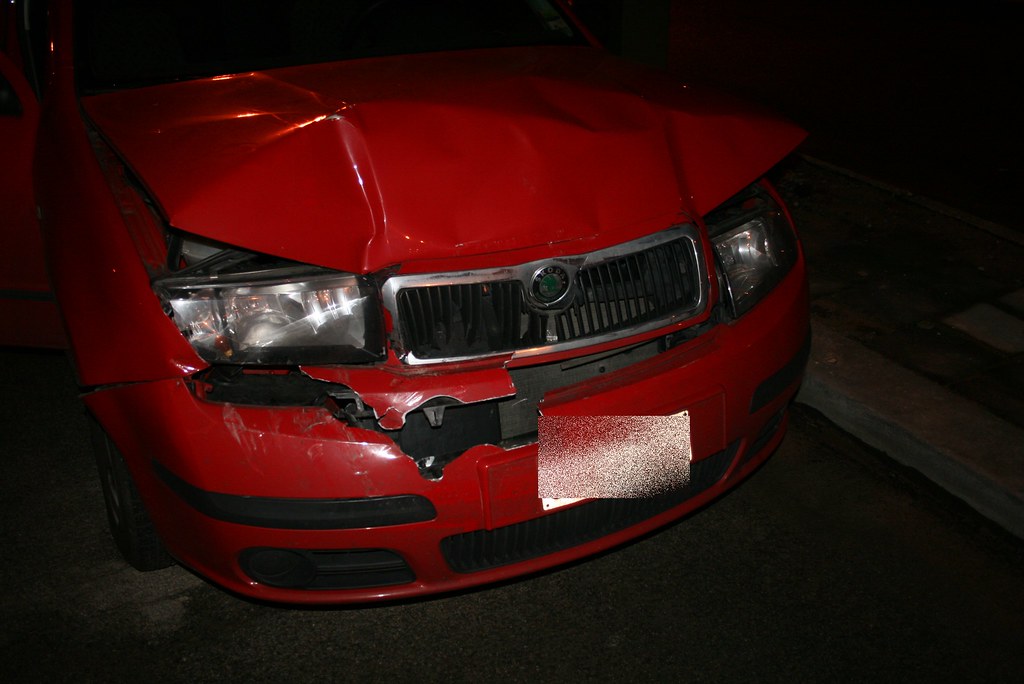
He was doing the most boring, responsible thing a driver can do: sitting still at a red light with both hands on the wheel, waiting for it to change. Morning traffic had that slow, grudging crawl to it, the kind where everyone’s staring straight ahead like the day itself is an inconvenience. Then—without any warning—his whole car lurched forward with a hard thud that made his neck snap and his coffee jump.
For a second he just blinked, trying to process the physics of it. The light was still red. He’d been stopped. But the jolt had that unmistakable “someone just hit you” feel, not a fender tap, more like a clean rear-end that pushed him a few feet. He put on his hazards, pulled to the side as best he could, and got out already annoyed but not yet panicking.
The other driver climbed out too, a little frantic, saying sorry in that rushed way that sounds more like damage control than remorse. She kept glancing at her phone and then at his bumper like she was trying to calculate what this was going to cost her. He took a breath, told himself to stay calm, and did what everyone’s told to do: photos first, talk second.
The stoplight hit and the “sorry, I didn’t see you” routine
Up close, the damage looked exactly like you’d expect from getting rear-ended at low-to-medium speed: scuffed paint, a cracked plastic panel, the bumper slightly popped out of alignment. Nothing catastrophic, but enough that you could already picture the body shop estimate climbing past the “minor inconvenience” range. He filmed a slow walkaround, got shots of both cars, both plates, the intersection, and the skid-less asphalt that screamed “she never braked in time.”
She kept talking while he documented, throwing out explanations that didn’t quite add up. Sun in her eyes. Foot slipped. Looked down for “just a second.” He didn’t argue; he just nodded, asked for her insurance, and exchanged info like they were doing a scripted scene from a driver’s ed video.
There was a weird moment where she tried to steer the conversation into “Let’s not make this a whole thing.” She mentioned paying out of pocket, said she “knew a guy” who could buff it out, and laughed nervously when he didn’t laugh back. He told her he’d be going through insurance, and her whole face did that quick shift from apologetic to guarded, like a door quietly locking.
He does everything right… and still gets punished for it
He called the non-emergency line because the damage wasn’t just a scratch, and because he’d learned the hard way that memories get slippery once people go home. An officer eventually showed up, took statements, and wrote down the basics: he was stopped, she hit him from behind. It was as clean-cut as accidents get.
After that, the guy went home sore and irritated, already dealing with the invisible stress of a wreck that “wasn’t that bad” but still rattled him. He filed the claim with her insurance company the same day, uploaded the photos, included the incident number from the police report, and figured that would be it. Annoying, time-consuming, but straightforward.
The first call with the adjuster even sounded normal. Lots of polite phrasing, lots of “we’ll review the information,” nothing that set off alarms. They asked if he’d been injured, if his car was driveable, whether he had a repair shop in mind. The kind of questions that make you think the gears are turning in the right direction.
The phone call where reality tilts sideways
A few days later, the tone changed. The adjuster called back and, instead of talking about repairs, started talking about “pre-existing damage.” Not in a casual way—more like they’d already decided something and were just informing him. The guy actually laughed at first because it sounded so ridiculous.
Then the adjuster got specific. They said the rear bumper damage he was claiming didn’t match the incident, that some of it “appeared older,” and that there were “indicators” he was trying to have unrelated repairs covered. The guy felt his stomach drop because this wasn’t a misunderstanding; it was an accusation.
He asked how that could possibly be the case when he had timestamped photos from minutes after the crash, plus the police report. The adjuster’s response was basically a shrug made of corporate words: damage analysis, review process, their determination. And then came the part that made him go cold—she was claiming he caused the crash.
How do you cause getting rear-ended while stopped?
The insurer’s version, according to what he was told, leaned on the other driver’s statement. She apparently told them he “stopped short” or “slammed on the brakes,” as if he’d done something unpredictable. Which would almost be funny if it wasn’t happening to him at full financial stakes, because he was stopped at a red light. There was nowhere to “slam” his brakes except in the general concept of stopping.
He pushed back hard, asked if they’d read the police report, and the adjuster said they’d “consider all documentation.” But it was clear he was no longer being treated like a customer or even a neutral party; he was being handled like a problem. Every answer got slower, more measured, and somehow more slippery.
When he asked about the alleged pre-existing damage, the adjuster said something like, “Our inspection suggests some of the bumper deformation is inconsistent with a single event.” That wording is the kind that sounds technical but doesn’t commit to anything. It gives them room to deny and room to imply fraud without ever saying “fraud” out loud.
So the guy dug through his phone to find older photos of his car—random pictures from parking lots, a shot from when he’d washed it, anything showing the rear end intact. He found a couple that were decent, not perfect, but clearly showing the bumper wasn’t cracked before. He sent them in and waited, thinking surely that would shut this down.
The slow-burn escalation: inspections, delays, and circular logic
The next move from the insurance company was to request their own inspection, which sounds reasonable until you realize how it plays out. The inspector came out, took photos, poked around for ten minutes, and left without saying much. A day later, the insurer’s estimate came back insultingly low, carving out chunks of the damage as “unrelated” and “prior.”
It got even messier when the guy’s repair shop weighed in. The shop told him the bumper cover was cracked and the mounting tabs were broken—damage that happens when you get hit and the plastic flexes past its limit. They also flagged that the internal absorber looked compressed. The shop’s vibe was basically: yeah, this is a rear-end impact, no mystery here.
The insurer’s vibe was: we’re not paying for that part. They’d cover a paint blend, maybe a clip, but anything that made the repair actually correct? Suddenly that was “old.” The guy kept asking the obvious question—if the damage was pre-existing, where was it documented before the crash?—and the answer kept drifting back to “based on our assessment.”
Meanwhile, the other driver stopped being apologetic. When he texted once to ask if she’d gotten the police report or if she could clarify her statement, she left him on read. He started to realize the “sorry” at the curb wasn’t the real version of her; the real version was whatever she told her insurer once she got home and saw the consequences.
He considered going through his own insurance just to get his car fixed, but that came with the sour taste of paying a deductible for something that wasn’t his fault. And even if his insurer subrogated later, that could take months, with no guarantee the other company would suddenly become cooperative. The whole thing started to feel less like an accident claim and more like a contest of endurance.
He sent one more organized email—police report number, scene photos, timestamped video, the shop’s write-up, and the older pictures showing no prior damage. The response he got was polite and empty, the kind of message that feels like it was designed to be forwarded to a supervisor without sounding emotional. They’d “review” and “get back to him,” which is what they’d been saying since the day they changed the story.
And that’s where the tension sits: a guy who was rear-ended while stopped, staring down an insurance company that’s treating the cleanest kind of crash like a suspicious narrative. He’s got a damaged car, a paper trail that should be enough, and the creeping sense that the real battle isn’t proving what happened—it’s getting someone on the other side to admit, in writing, that reality still counts when it’s expensive.