

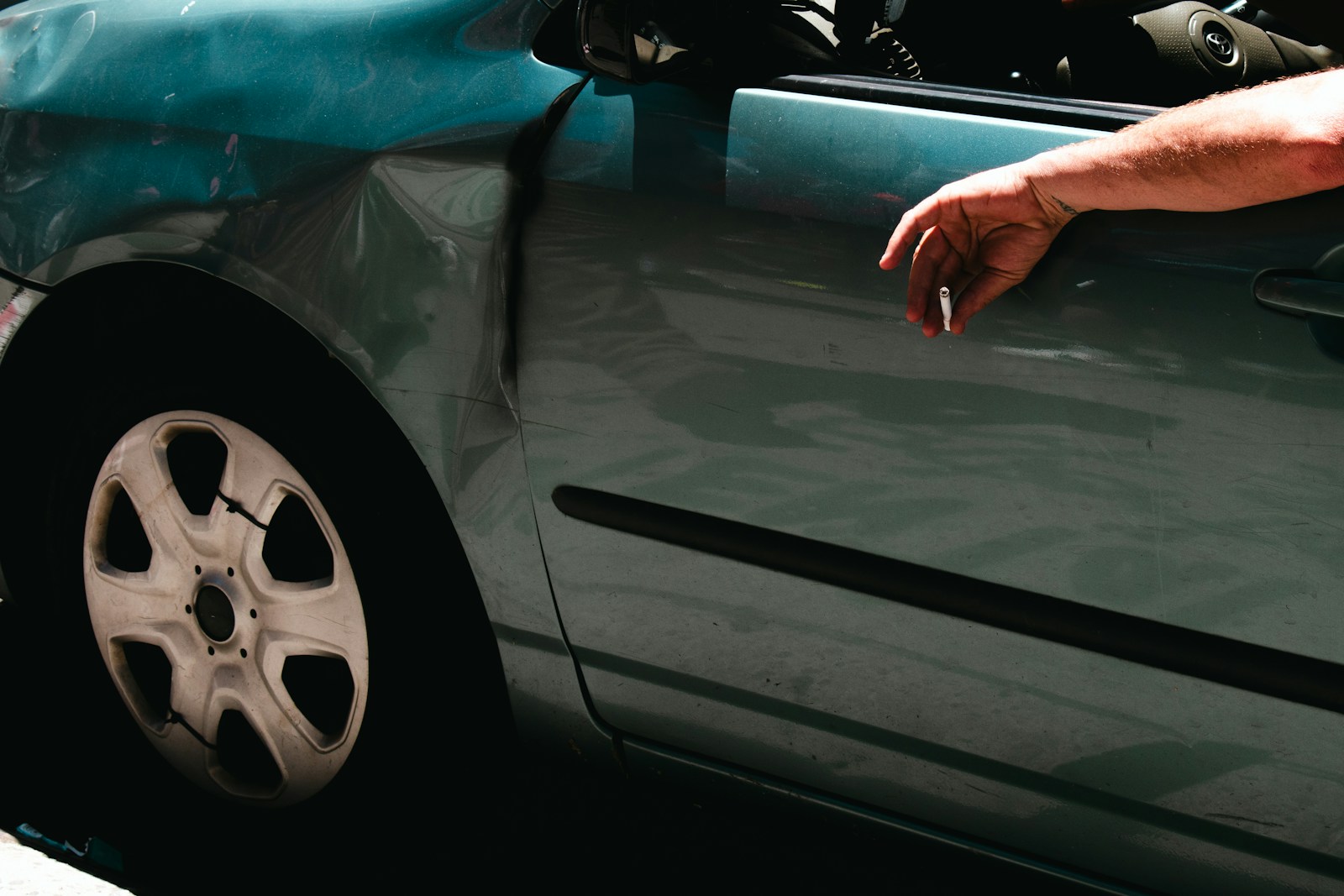
It started as the kind of parking lot mishap most people barely remember by dinner. A man—mid-30s, commute-hardened, the type who keeps a microfiber cloth in the trunk—came out of a big-box store with a couple bags and saw a fresh dent blooming on his rear quarter panel. Not a catastrophic crunch, just a neat little inward punch with a smear of someone else’s paint like a calling card.
He stood there for a second doing that slow scan everyone does: looking for a shopping cart that doesn’t belong, a runaway stroller, anything that could’ve done it without a person involved. Then he spotted the other driver: a woman a few spots over, loading stuff into a compact SUV, glancing over in that way people glance when they’re hoping you’ll leave first. He walked over and asked, calmly, if she’d bumped his car.
She didn’t deny contact exactly. She did that slippery thing where she said, “I might’ve tapped it,” while already aiming for, “But it wasn’t like that when I left it,” and “Are you sure that’s new?” He took a photo of the dent, a photo of her plate, and suggested they swap insurance info and let it be boring. That’s where it stopped being boring.
The parking lot version of “let’s just handle it”
They did the awkward dance right there between the painted lines. He showed her the dent up close; she leaned in, squinted, and immediately started inspecting it like it was a museum exhibit that might be a forgery. He could tell she was doing mental math—deductibles, rates, whether a “tap” could really cost anything.
He offered the most reasonable middle road: they could exchange info, he’d file a claim, and insurance would decide what’s what. She pushed back with, “Could we just do cash?” but in the same breath asked how much it would be, like she expected him to quote a number off the top of his head. When he said he’d need an estimate, she got prickly, the way people do when they feel cornered by a process they can’t control.
He snapped a few more pictures: the dent, the paint transfer, the angle where her bumper lined up with the damage. She saw him doing that and her whole posture changed—shoulders up, chin forward, suddenly defensive. “Don’t take pictures of me,” she said, even though he wasn’t, and he had to clarify he was documenting the cars.
They finally exchanged information, but it wasn’t clean. She hesitated handing over her insurance card, then read her policy number out loud like it was a secret she didn’t want him to possess in writing. He wrote it down, took a photo of her card anyway, and she muttered something about “people running scams” before getting in her car and leaving.
Filing the claim: the moment it became “a thing”
He did what most people do when they don’t feel like playing detective: he filed the claim with his insurance, uploaded the photos, and described it as a low-speed parking lot collision with visible paint transfer. He wasn’t dramatic about it. The claim was basically: this happened, here’s who, here’s where, and here’s what it looks like.
A couple days later, he took the car to a body shop recommended by his insurer. The estimate wasn’t tiny, because it never is anymore—paint blending, panel work, labor rates that feel like surgeon money. The shop pointed out that the dent’s location and shape suggested a bumper corner, not a cart, which matched his original read.
He figured the rest would be paperwork. Then his adjuster called with a tone that said, without saying, “So… weird development.” The other driver wasn’t just disputing the amount or claiming she didn’t notice contact. She was accusing him of staging the crash for money.
Not “I didn’t hit him.” Not “It was already there.” Full-on “This looks like fraud,” like he’d orchestrated a parking lot con. According to the adjuster, she claimed he’d approached her “aggressively,” insisted she hit him, and then produced a dent that “didn’t match” her vehicle. She also alleged he was “overly eager” to involve insurance, which is apparently suspicious now.
“You’re trying to scam me” meets actual documentation
He was irritated, but mostly stunned by the creativity. Staging a crash in a fluorescent-lit lot outside a store, in the middle of the afternoon, by… waiting for her specifically? With a dent placed at exactly her bumper height? It was the kind of accusation that felt less like a belief and more like a tactic, a way to make him back off through sheer unpleasantness.
He went back through everything he’d saved. The photos had timestamps and location data. In the wide shots, her car was clearly parked adjacent, and in one of them you could see a small scuff on her bumper corner that he hadn’t even noticed at the time, because he wasn’t hunting for evidence like a prosecutor.
He sent those to his adjuster, along with a quick explanation: he didn’t know this person, he didn’t ask for cash, he’d offered the normal insurance route, and he’d been taking pictures because he’d been taught—by basically every adult who’s ever dealt with this—that you document everything in a parking lot. The adjuster thanked him and said they’d “handle it,” which is corporate-speak for “we’re now in the part where everyone lies a little.”
What bothered him wasn’t even the threat of the claim being denied. It was the vibe shift from “minor inconvenience” to “someone is calling you a criminal.” He started second-guessing all the small choices: taking extra photos, insisting on insurance, even walking over in the first place instead of just paying out of pocket and hating himself later.
The other driver escalates from defensive to offensive
Then the messages started—not from her directly at first, but through the insurance back-and-forth that somehow kept looping him into her narrative. She alleged he had “pre-existing damage,” that he’d “backed into something,” that he was “targeting women drivers,” which felt like she was throwing whatever words might stick to a wall. It wasn’t a single coherent story so much as a cloud of insinuations.
At one point, she told her insurance that his dent couldn’t have come from her SUV because her bumper was “too high.” He measured it, because of course he did. He stood in the lot with a tape measure like someone filming a DIY alibi, and the numbers lined up uncomfortably well for her argument.
She also claimed she never actually made contact, that she only “thought she might have” because he pressured her in the moment. That was a smart little pivot: make the exchange sound like he bullied her into admitting something. It wasn’t hard for him to imagine how it would read on paper, stripped of the actual scene—two strangers, no video, one saying “I tapped you,” later saying “I only said that because he was intense.”
He tried to stay out of the emotional spiral and stick to facts. He gave the adjuster the store location, suggested they ask about cameras, and forwarded the body shop’s note about paint transfer. The adjuster didn’t promise anything, but did ask for one more thing: a written statement describing exactly what was said and when, like they were building a timeline brick by brick.
When it’s not about the dent anymore
Weeks passed in that limbo where the car is drivable but every time you see the dent you get angry all over again. He debated paying for the repair himself just to make it stop, and then got angry at the idea of paying to make someone else’s accusation easier. The whole point of insurance, in his mind, was that you didn’t have to negotiate with strangers who treated accountability like a personal attack.
He heard, indirectly, that the other driver was telling her friends he was a scammer. It wasn’t official, but it was the kind of thing that leaks through mutual circles, the kind of story people repeat because it has a villain and a lesson: watch out in parking lots. He couldn’t prove she was saying it, but the accusation itself already lived in the claim file, stamped into the narrative whether it was fair or not.
The insurer eventually agreed the damage was consistent with a low-speed impact and moved forward with repairs under his policy while they continued pursuing the other driver’s insurance for reimbursement. That’s a technical win, but it didn’t feel like one. He still had a claim on his record, still had to front a deductible until it was recovered, and still had the weird taste of being accused of running a con because he didn’t want to eat the cost of someone else’s mistake.
And the most aggravating part was that he could see how it happens. People panic about premiums, so they invent a story where they’re the victim of fraud. They say it loudly enough that the other person doubts themselves, and sometimes that doubt does the job. The dent got fixed, eventually, but the unresolved tension wasn’t in the metal—it was in the fact that a simple “I’m sorry, I didn’t see you” had turned into “You’re staging crashes for money,” and he now knew how thin the line is between a routine claim and someone trying to brand you as the bad guy.