

She still had his voicemail saved, the one where he’s laughing because the truck “finally idles like it’s supposed to.” That was the kind of detail her life had shrunk down to after the funeral—tiny proofs he’d existed, stacked up against paperwork that kept arriving like nothing had happened.
The pickup was the biggest piece of that paperwork. It sat in the driveway under a dusty cover, the same one he’d insisted on using even though it never fit right. Her husband had been the sort of guy who could tell you what year a tailgate was from just by the shape of the stamp, and he’d spent years hunting down original parts for this one. She didn’t have that brain, or the energy to fake it.
So when a local dealer offered to “take the headache off her hands,” it sounded like relief. He was polite on the phone, called her “ma’am” in that careful way, and said he could come by that afternoon. It wasn’t even a week after the service, and she was still moving through rooms like her body didn’t quite belong to her.
The truck wasn’t a “project,” and he knew it
The dealer pulled up in a clean SUV with a magnetic logo on the door, the kind that signals, I do this for a living. He shook her hand, looked at the covered truck, and started talking before he’d even unhooked his measuring tape from his belt. He asked how long her husband had owned it and then gave a sympathetic nod that somehow also felt like a countdown clock.
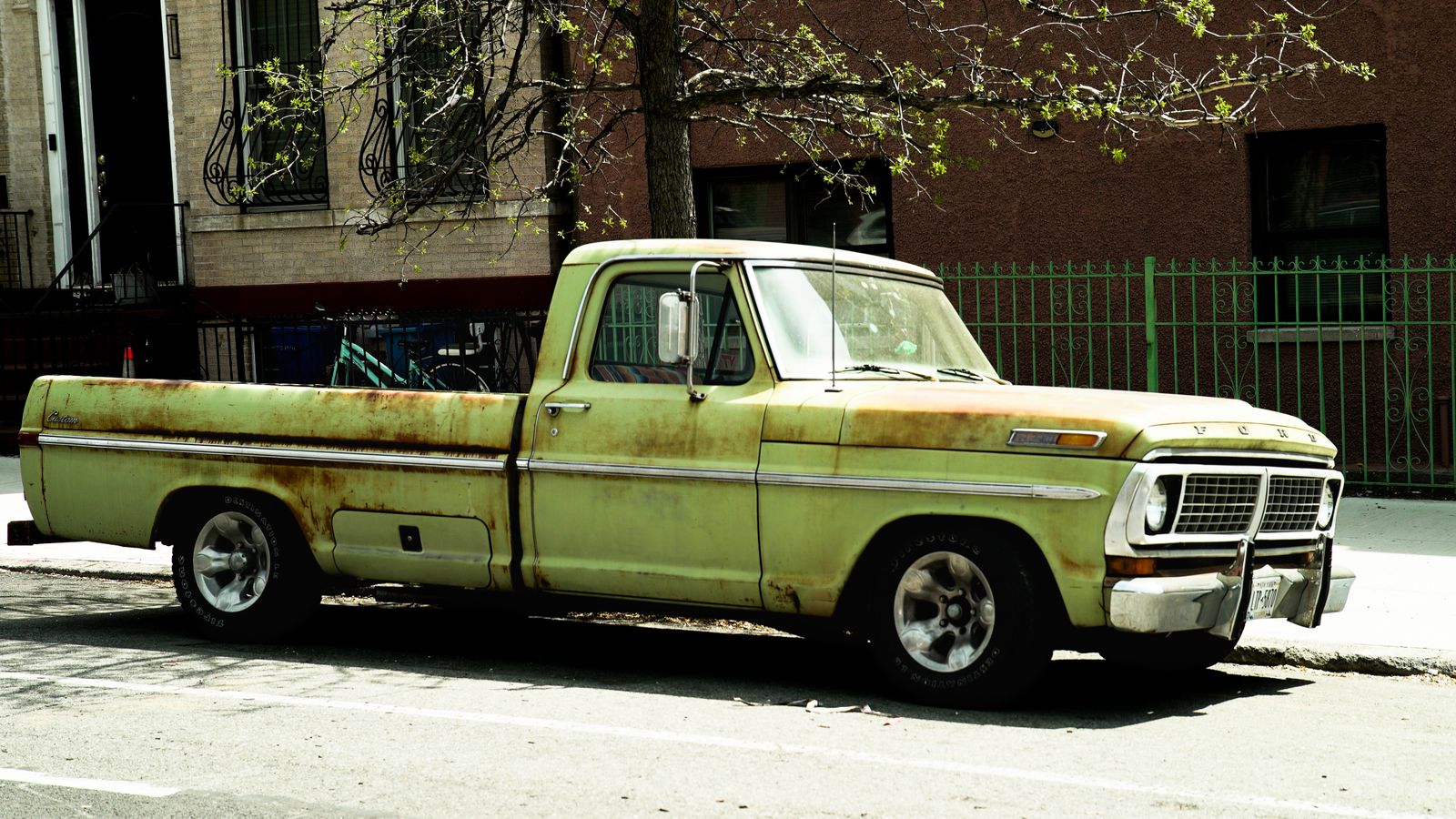
When she pulled the cover off, the truck wasn’t perfect, but it wasn’t junk either. It had that clean, straight look that people notice even from the street—original-looking paint, no obvious rust bubbles, trim that wasn’t pitted to death. The interior smelled like old vinyl and whatever citrus cleaner her husband used, and the engine bay was tidy in that obsessive way that signals someone cared.
The dealer did the classic slow walk around it, crouching to peer at wheel wells, tapping a knuckle on metal like he could hear its bank balance. He asked for the keys, started it, listened for maybe ten seconds, then turned it off like the decision had already been made. “These older trucks are tricky,” he said, with a little shrug that suggested risk, even as he was standing in front of something that clearly wasn’t a beater.
The lowball offer landed when she couldn’t catch it
He told her straight: he could do $6,000. He said it like he was offering a kindness, like he’d just found a way to solve her problem without making her deal with strangers and tire-kickers. He mentioned towing costs, “unknowns,” and how the market was “softening,” even though she hadn’t asked for a market report.
She blinked at him, not because she knew it was wrong, but because she didn’t know what number was right. Her husband had talked about the truck in pieces—rare bed, original drivetrain, matching tags—but never sat her down and said, “If anything happens to me, this is what it’s worth.” She was standing there in an oversized hoodie, trying to do math through grief fog, and the dealer could tell.
He nudged her toward a decision by framing it as closing a chapter. “The sooner you don’t have to look at it every day, the easier,” he said, like the truck was some kind of emotional landmine. She asked if $6,000 was really the best he could do, and he gave her a tight smile and said, “I’m being honest with you.”
There was paperwork—of course there was. He had forms ready in a folder, pen already clicked, and he talked her through the title transfer quickly, like speeding up might keep her from asking too many questions. She signed because signing something felt like doing something, and doing something felt better than sitting in the quiet house with the TV on low.
The goodbye happened in a driveway, fast and wrong
The dealer had a flatbed arrive within an hour. The driver didn’t chat; he just winched the truck up like it was any other vehicle, straps tightening with a ratchet sound that felt way too final. She watched from the porch steps, arms crossed, trying to keep her face neutral, the way people do when they don’t want to give a stranger the satisfaction of seeing them break.
Right before they pulled off, she had a sudden, desperate thought: maybe she should at least keep one thing from it. A keychain, a manual, anything. She jogged down the walkway and asked the driver to wait while she grabbed the spare key from a kitchen drawer, and the dealer—already halfway to his SUV—paused with a look that said, Let’s not make this complicated.
She handed over both keys anyway, because the deal was done, and her brain was running on autopilot rules about being “fair.” The flatbed rolled away, and for a second the driveway looked huge, like it had lost its anchor. The dealer waved once, like a neighbor, then disappeared.
The next morning, the listing showed up like a slap
She didn’t go hunting for trouble that night. She barely ate, and she slept in short, panicky bursts. But in the morning, a friend texted her a screenshot with no context—just a link and, “Is this his truck?”
There it was, bright and glossy, professionally photographed at the dealer’s lot. Same little scuff near the rear bumper, same slightly mismatched bed cover her husband had never gotten around to replacing. The price: $34,995.
What made her stomach drop wasn’t even the number at first—it was the story underneath it. The description talked about a “loving original owner” who “meticulously cared” for it, about how rare it was to find one “this unmolested,” and how it was “ready for the next caretaker.” It read like a tribute, except the tribute was being used to sell her husband’s pride and joy to someone with thirty-five grand and a weekend hobby.
She sat at the kitchen table staring at the screen, feeling heat crawl up her neck. The dealer hadn’t just flipped it; he’d flipped it using her husband’s life as marketing copy. And the worst part was realizing he’d known exactly what it was the entire time he stood in her driveway acting like it was a risky bet.
When she called, he switched voices
She called the dealership first, trying to keep her voice steady, like maybe there was a mistake she could politely correct. The receptionist transferred her, and the moment he picked up, his tone was familiar—smooth, practiced, ready. She told him she’d seen the listing and asked why it was priced nearly six times higher than what he’d paid her.
He didn’t apologize. He didn’t even sound surprised. He said things like “reconditioning,” “overhead,” and “market exposure,” as if she should’ve expected a massive markup because that’s “how the business works.” When she pointed out the listing called her husband the original owner and leaned hard on his care, he laughed a little and said, “That’s just sales language.”
She asked him—directly—whether he’d lied about its value in her driveway. That’s when his voice got colder, less neighborly. He said she’d agreed to the price, she’d signed the paperwork, and he wasn’t obligated to “educate” her on collector markets.
She told him she was considering legal options, not because she had a plan, but because she needed him to hear that she wasn’t just going to swallow it. He responded like someone who’d had that threat before. “You can talk to whoever you want,” he said, “but a deal is a deal.”
By the time she hung up, she was shaking, not in a cinematic way, but in that quiet, humiliating way where your hands won’t stop trembling even though you’re sitting down. She pulled up the listing again and saw it had already been viewed hundreds of times. The truck wasn’t hers anymore, but her husband’s name—his care, his time, his obsession—was suddenly part of a sales pitch she couldn’t control.
The messiest part was what she couldn’t undo: she’d signed it over on the worst week of her life, when “take it off my hands” sounded like mercy. Now the truck was sitting under dealership lights with a price tag that made her feel not just tricked, but used—like her grief had been one more thing the dealer appraised, weighed, and turned into profit. And somewhere out there, a buyer was being invited to imagine a “loving original owner,” without ever knowing the loving part was still sitting at a kitchen table, staring at the listing, wondering how many signatures it takes to give away something you didn’t mean to lose.