
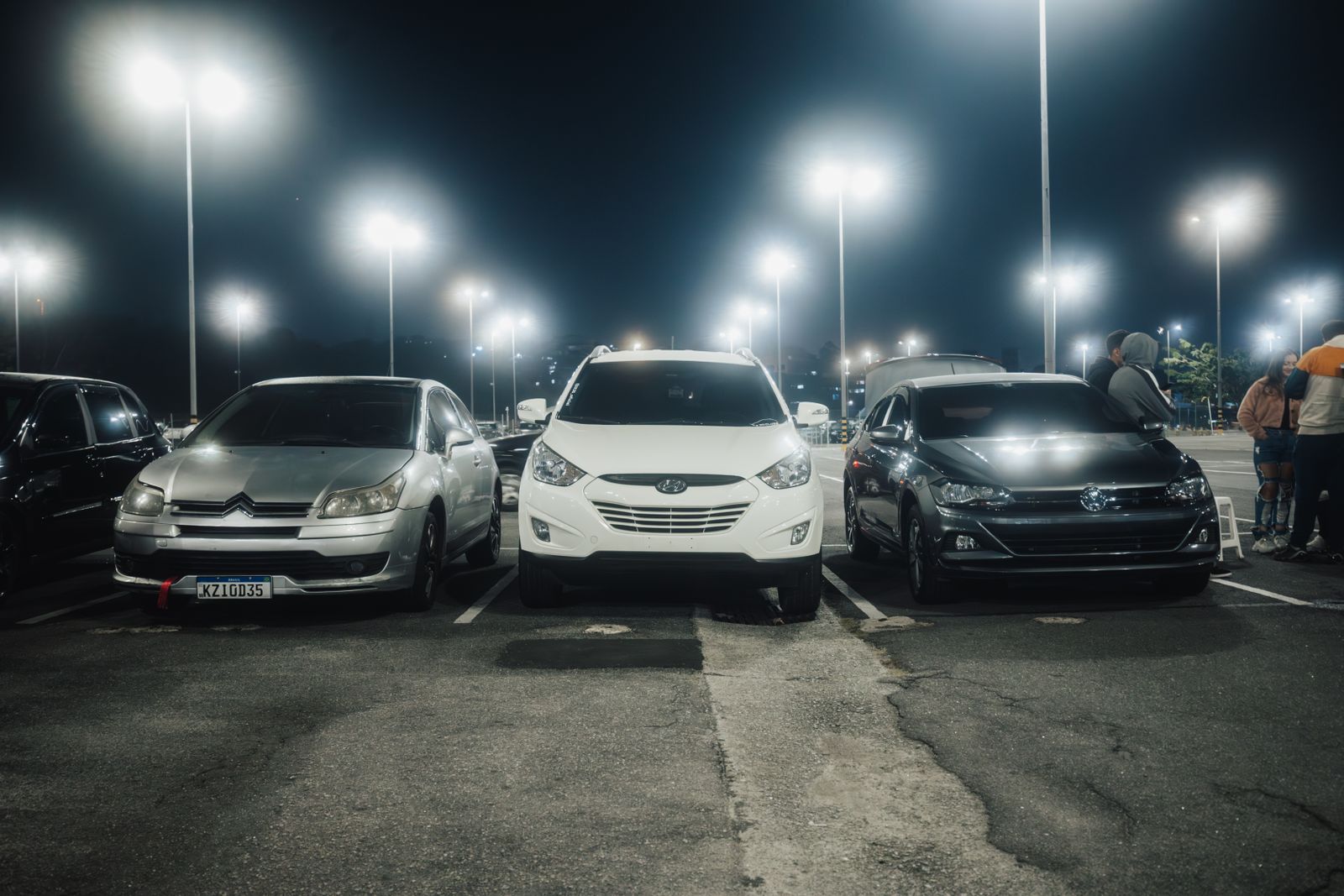

It started the way these things always start: a person walking out to their car expecting nothing more dramatic than a sticky door handle and a parking receipt they’d immediately lose. The car was sitting in a long-term lot near the airport, wedged between a dusty SUV and a sedan with a child’s car seat visible through the rear window.
And then they saw it—front corner crushed in, paint scraped down to the primer, a plastic trim piece hanging at an angle like it was trying to escape. No note under the wiper. No folded paper shoved in the door seam. Just that weird, empty feeling of realizing someone hit you hard enough to leave a dent you can see from twenty feet away, then decided you weren’t worth two seconds of accountability.
The owner did what people do when their brain is half jet lag and half adrenaline: they walked a slow circle around the car, looking for any clue that might explain what happened. Bits of shattered tail light were scattered like candy. On the ground near the impact point, there was a smear of blue paint that didn’t match anything on their vehicle.
The only thing worse than no note is the wrong kind of confidence
First call was the lot’s office, because maybe a security camera caught it or a guard wrote down a plate. The attendant gave the standard shrug in verbal form: “We can check with management,” “We don’t really monitor every section,” “You can file a report.” The owner asked anyway, and the attendant sounded genuinely uninterested, like this was the tenth “my car got hit” conversation of the week.
So the owner pivoted to the more obvious suspect: airport shuttles. The lot had a dedicated shuttle lane, and the shuttles were constantly swinging wide around corners, pulling too close to parked cars, and taking turns like the driver was late for something personal. The damage height and angle looked like something tall clipped them, not a normal sedan backing out.
They called the airport ground transportation line and described the scene. The person on the phone asked if they had a time window, which was almost funny—this happened while the owner was on a flight. Still, the owner gave their best guess based on their boarding time and the last time they’d seen the car intact.
A shuttle company that swears it can’t possibly be them
The airport rep transferred them to the shuttle contractor’s dispatch. Dispatch listened, took the info, and immediately went into “we take this seriously” mode, the tone that sounds professional but also pre-loaded with the assumption you’re wrong. They asked for the car’s make and model, where it was parked, and what the damage looked like.
Then came the soft denial: their drivers are trained, they have protocols, they do inspections, nobody reported an incident. The owner described the blue paint again, because it didn’t come from nowhere. Dispatch suggested maybe another car did it and left blue paint, which is the kind of logic that only works if you’re saying it out loud fast enough.
The owner asked if any of their shuttles were blue. Dispatch hesitated, then said they had branding colors and wraps, but that didn’t mean a shuttle hit anything. It was a weird little word game—yes, their vehicles have blue on them, but that’s not evidence, and anyway, no driver “reported” anything.
They almost gave up, and then the paint started telling on someone
Most people would stop there and just go straight to insurance, because the energy required to prove a hit-and-run from a shuttle in an airport lot is ridiculous. But the owner kept staring at the damaged area like it might explain itself. The blue smear wasn’t just a smear; it had edges, like something pressed and dragged.
They took photos from every angle. They used their phone flashlight and leaned in close, the way you do when you’re trying to convince yourself you’re seeing what you’re seeing. Under the broken clear coat and flaked paint, there were faint shapes—letters, almost, like a stamp.
It wasn’t immediately legible at first. It looked like the kind of ghost imprint you get when a rubber bumper hits a painted surface and transfers a layer, then peels away. The owner did the most normal modern thing: they zoomed in on their phone and adjusted the contrast until the shapes popped.
That’s when it became hard to dismiss. The imprint wasn’t random. It was clean enough that you could make out an airport logo—one of those stylized icons you see on signs and shuttles and employee badges—and next to it, a vehicle number in blocky digits, like the kind fleet vehicles wear so dispatch can tell drivers apart.
The awkward phone call where the story changes in real time
The owner called dispatch back, and the second call felt different, because now it wasn’t “my car got hit and I think it might’ve been you.” It was “your logo and vehicle number are literally printed into my paint.” You can almost hear the moment the person on the other end realizes this is no longer a vague complaint they can park in a folder.
Dispatch asked for the number. The owner read it off slowly, making sure they didn’t mis-speak, because this was the kind of detail that would get “misunderstood” later if it wasn’t delivered cleanly. There was a pause, typing sounds, and then that careful tone people use when they’re trying to stay calm while rearranging reality.
Now dispatch said, okay, they’d “look into it.” Now they asked for photos. Now they asked where to send them. The owner emailed a set of pictures, including close-ups where you could clearly see the logo shape and the fleet digits like a cheap tattoo on the broken paint.
The next part was almost comical: dispatch still didn’t admit anything outright. They said they’d need to “verify” the number corresponded to one of their vehicles. Which, sure—except the number was formatted exactly like their fleet numbers, and the logo wasn’t a generic swoosh. It was the airport’s specific mark, stamped like the shuttle had leaned in and signed its name.
The driver denies it, and the company tries to keep it small
Once the company identified the shuttle, they said they’d speak to the driver. The owner expected a sheepish apology or at least a “we’re investigating.” Instead, what came back was a flat denial: the driver claimed they didn’t hit anything, didn’t notice anything, and completed their route as normal.
That denial landed differently when paired with the fact that a logo and vehicle number had been transferred onto the damaged area like a forensic calling card. It wasn’t like someone could’ve walked by and carefully pressed a decal into the car to frame them. The imprint was in the broken paint where the impact happened, surrounded by scrapes and fractures.
The company’s tone shifted into something else—containment. They didn’t want to say “hit-and-run,” and they definitely didn’t want to say “our driver lied.” They talked about “an incident” and “possible contact” and “next steps,” the kind of vague phrasing that sounds neutral until you realize it’s designed to avoid responsibility.
The owner filed a police report anyway, because insurance companies love paperwork and because leaving the scene without a note isn’t a misunderstanding. They also requested any available footage from the lot or airport cameras, which came with its own bureaucratic maze: forms, time windows, who owns what camera, and which department is allowed to release what.
Now the damage isn’t just to the car
By the time the owner was done making calls, it wasn’t even about the dent anymore. It was about the feeling of being treated like a nuisance for asking someone to admit to something that was basically autographed into their vehicle. The owner had that brittle kind of anger that comes from being forced to do detective work just to get basic honesty.
The shuttle company offered to “handle it through insurance,” but didn’t say whose insurance until pressed. They asked the owner to get repair estimates, which sounded reasonable on paper and exhausting in reality—more time off work, more driving around with a damaged car, more conversations where the burden stays on the person who got hit.
And the driver’s denial hung there like a bad smell. Even if the company paid, the owner couldn’t shake the idea that this wasn’t an accident followed by confusion; it was an accident followed by a choice. Someone hit a parked car hard enough to leave a clean imprint, didn’t leave a note, and then looked their employer in the eye and said it never happened.
That’s the part that sticks: the car didn’t just get clipped. It got branded. The owner could stand in their driveway and point to the proof—logo, number, all of it—yet the situation still dragged on in phone calls and “verification” and careful language, like reality itself needed approval from dispatch before it counted.
More from Steel Horse Rides: