

Every car built in 2002 turns 25 in 2027, and it’s the manufacture date stamped on the door jamb, not the model-year badge on the trunk, that U.S. Customs and NHTSA actually check under 49 CFR Part 591’s federal safety exemption. That distinction matters more than usual for the incoming class, because Japan’s 2002 lineup landed at a genuine inflection point: it’s the year the R34 Skyline GT-R died, the NSX-R got resurrected, and the last rotary-powered RX-7 rolled off Mazda’s line. These eight cars are the specific wave of homologation specials and swan-song variants that become legally federalizable next year, provided their compliance plates actually read 2002.
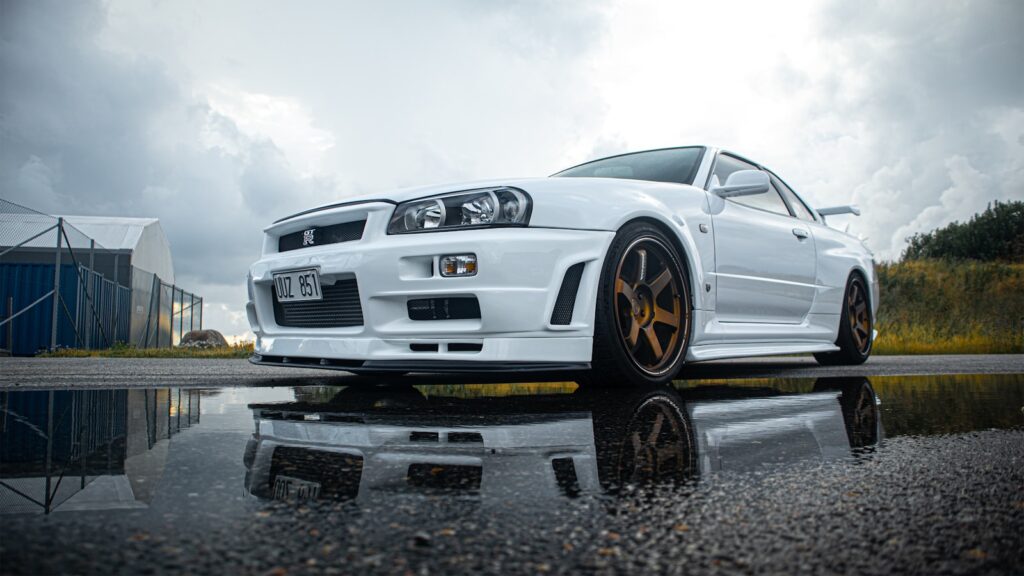
1. Nissan Skyline GT-R V-Spec II Nür (R34)
Nissan built just 1,000 examples of the Nür in 2002, the final year of R34 production, fitting each with an RB26DETT twin-turbo inline-six carrying parts derived from Nürburgring endurance testing. Official output was capped at 280 PS (276 hp) at 6,800 rpm with 289 lb-ft of torque, a figure nobody in tuning circles believed given the engine’s documented headroom past 320 hp. It’s the last GT-R built around a mechanical center diff rather than a computer, and demand for clean Nürs already reflects that.
2. Honda NSX-R (NA2)
Roughly 140 units of the second-generation NSX-R left Honda’s line in 2002, reviving the Type R badge on the NSX for the first time since 1995. Chief engineer Shigeru Uehara’s team stripped 220 pounds from the standard car using carbon-fiber panels, thinner glass, and a deleted power-steering pump, leaving the naturally aspirated 3.2-liter V6 to send 290 hp at 7,300 rpm and 224 lb-ft through a close-ratio manual. Few cars here are rarer, and none better capture Honda’s analog mid-engine era.
3. Mazda RX-7 Spirit R Type A
Mazda went on sale with the Spirit R on April 22, 2002, closing out the FD3S RX-7’s 12-year run with production ending that August. The twin-turbo 13B-REW rotary made 280 PS (276 hp) at 6,500 rpm and 231 lb-ft, mated exclusively to a 5-speed manual and riding on 235/45R17 rubber with four-wheel vented discs. Type A cars added red Recaro buckets that shaved roughly 10 kg off the chassis. No RX-7 has been built since.
4. Subaru Impreza WRX STI Spec C Type RA
Subaru’s engineers stripped the GDB-chassis Impreza down for the Spec C Type RA, swapping in thinner glass, a lighter hood, and reworked roof panels while fitting a mechanical DCCD center differential in place of the standard viscous unit. The EJ207 turbo flat-four carried an official 276 hp rating that owners have long treated as conservative, with 283 lb-ft of torque and a close-ratio gearbox pulled straight from the rally program. It never had a U.S. counterpart, which is why STI collectors are already circling 2027.
5. Mitsubishi Lancer Evolution VII GSR
Built in Japan through December 2002, the Evolution VII GSR paired a 2.0-liter 4G63 turbo-four rated at 280 PS (276 hp) with Mitsubishi’s first Active Yaw Control system on a road car, giving it torque-vectoring capability years before that phrase became a spec-sheet cliche. It was also the first Evo built on the wider, heavier Lancer Cedia platform instead of the compact economy chassis underneath Evos IV through VI, trading some razor edge for real usability. Every rally-bred Evo since has been measured against it.
6. Nissan Silvia Spec R (S15)
The final S15 Silvias left Nissan showrooms in 2002, closing out a nameplate that began in 1965. Spec R models used the SR20DET turbo four rated at 247 hp at 6,400 rpm with 203 lb-ft, backed by a close-ratio 6-speed manual, larger anti-roll bars, four-piston front brakes, and a helical limited-slip differential absent from the base Spec S. Nissan never federalized the S15 for American showrooms, so 2027 is the first legal path U.S. enthusiasts have ever had to one of the chassis that built modern drift culture.
7. Toyota Supra RZ (JZA80)
Toyota kept building the JZA80 Supra in Japan until 2002, four years after North American sales stopped in 1998, so the final domestic-market twin-turbos are only now nearing eligibility. The 2JZ-GTE inline-six was officially capped at 276 hp under Japan’s horsepower gentlemen’s agreement, though its factory headroom was famously underrated. Paired with a 6-speed Getrag manual, the RZ closes out a platform American buyers can already import in earlier form; 2002 cars simply complete the run.
8. Toyota Altezza RS200
The sedan that became the Lexus IS300 overseas kept its high-strung 2.0-liter BEAMS four for Japan, where the naturally aspirated 3S-GE in the RS200 made 207 hp at 7,600 rpm and 159 lb-ft on an 11.5:1 compression ratio, revving to 7,800 rpm in a way four-cylinder sedans rarely do anymore. Japanese buyers could option a 6-speed manual, a gearbox Lexus never offered on the IS300 in the States, which is the entire reason RS200 imports draw a premium over the car Americans could already buy new. The rule isn’t just resurrecting halo cars; it’s unlocking the trims Toyota kept for itself.
What ties this cohort together isn’t nostalgia. It’s that 2002 landed at the exact moment Japan’s automakers stopped chasing bigger horsepower numbers and started refining the ones they already had, which is why so many of these cars are the last, lightest, or most mechanically honest version of their names before turbos shrank and electronics took over the job of talent.