
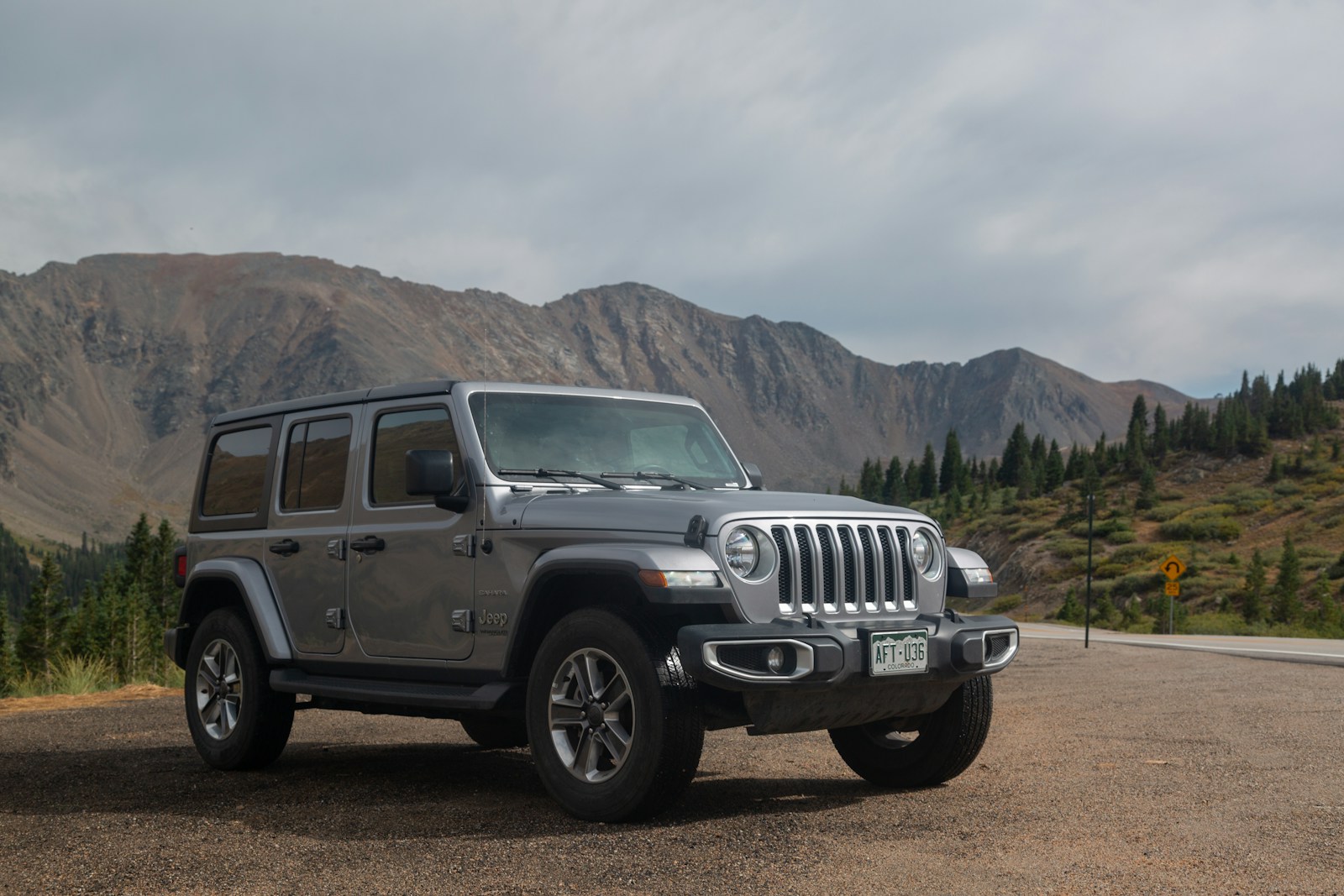

A Jeep Compass Trailhawk and a Jeep Wrangler Rubicon 392 both wear the exact same “Trail Rated” badge on their fenders. The Compass Trailhawk offers 8.6 inches of ground clearance and can ford 19 inches of water; the Rubicon 392 offers 12.9 inches of clearance and fords 33.6 inches, according to Jeep’s own Trail Rated specification page. That’s a 50 percent difference in clearance and nearly double the fording depth, on two vehicles carrying identical certification. The badge tells you a Jeep passed a real test. It does not tell you which Jeep you’re looking at.
What Trail Rated actually certifies
According to Jeep’s own materials, every Trail Rated vehicle is evaluated across five categories: traction, water fording, articulation, maneuverability, and ground clearance, with clearance itself broken down into approach, breakover, and departure angles. Testing runs through what Jeep describes as its own facilities before moving to real terrain, including the Rubicon Trail itself. It’s a legitimate, structured evaluation, and the badge isn’t marketing fluff bolted on at the dealership. The catch is that the five-category test gets applied relative to each vehicle’s own segment and platform, not against a single fixed bar every Trail Rated Jeep has to clear equally.

The spread exists even inside a single model
You don’t have to compare different vehicles to see how wide the range gets. A single Wrangler lineup does it. Jeep’s own 2024 spec sheet lists the Wrangler Sport at a 41.4-degree approach angle, 9.7 inches of ground clearance, and 30 inches of water fording. Step up to the Rubicon and you get a 44-degree approach angle and 10.8 inches of clearance. Go all the way to the Rubicon 392 and the numbers jump to a 47.5-degree approach angle, 11.6 inches of clearance, and 34 inches of fording depth. Every one of those trims carries the Trail Rated badge. If you’re shopping by logo alone, you’d never know the 392 clears nearly two more inches of clearance than the base Sport trim sitting next to it on the lot. Add the available Xtreme 35 package and the same 2024 spec sheet lists a 47.2-degree approach angle and 12.6 inches of clearance on the two-door, or 47.4 degrees and 12.9 inches on the four-door, pushing the range within one nameplate even wider before you’ve left the Wrangler family at all.
Crossover SUVs earn the badge on a much lower bar
The gap gets more dramatic once you leave the Wrangler family. A Jeep Grand Cherokee Trailhawk posts a 29.8-degree approach angle (36.1 degrees with its lower front fascia removed for severe off-roading), a 27.1-degree breakover angle, a 22.8-degree departure angle, and up to 10.8 inches of clearance, based on Jeep’s own press materials for the model. Those are genuinely good numbers for a mid-size crossover-based SUV, and the Grand Cherokee Trailhawk earns its certification honestly. But they’re also numbers a Wrangler Rubicon simply outclasses across almost every category, while both vehicles wear identical fender badges implying comparable off-road pedigree. The Grand Cherokee’s removable fascia trick is itself a tell: Jeep’s own engineers needed a field modification just to close part of the gap to the body-on-frame Wrangler platform, and even with it removed the crossover still trails the Rubicon’s stock departure and breakover figures.
Read the spec sheet, not the fender
None of this makes Trail Rated a meaningless certification. Every vehicle carrying it genuinely cleared Jeep’s five-pillar internal test, and that’s more rigor than most manufacturers apply to any trim, let alone their family crossovers. What the badge can’t do is function as a cross-shopping tool between models, because it’s calibrated to what’s reasonable for each vehicle’s size, platform, and mission rather than to one universal off-road standard. A buyer cross-shopping a Compass Trailhawk against a Wrangler Rubicon because “they’re both Trail Rated” is comparing two vehicles that cleared entirely different bars.
The badge answers one question honestly: did this specific trim pass Jeep’s own five-category test relative to its own class. It was never built to answer the question buyers actually bring to it, which is how this Jeep stacks up against that one, and the only way to answer that is to skip the fender altogether and go straight to the approach angle printed in the spec sheet.