
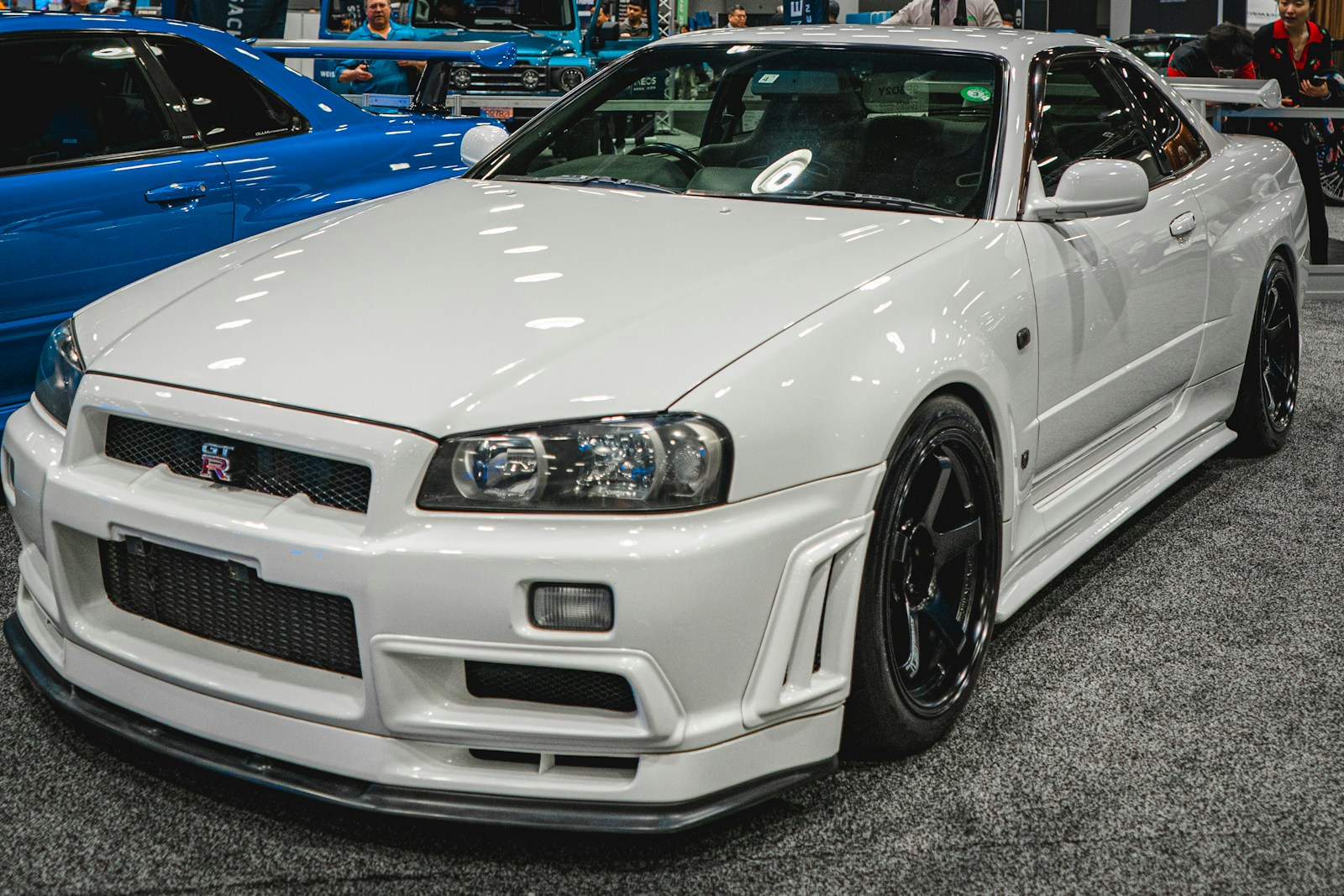

Six of Japan’s most obsessed-over performance cars from the 2001 model year are now legal to bring into the United States and title for street use — no compliance shop workaround, no “show or display” paperwork, no gray-market gamble. The switch flips automatically under federal regulation 49 CFR 591.5(i)(1), which exempts any vehicle that has reached 25 years of age from having to meet U.S. Federal Motor Vehicle Safety Standards at all. A car doesn’t need a waiver, a lawsuit, or a sympathetic customs agent. It just needs to get old enough, and as of this year, the entire 2001 production run of Japan’s home-market performance catalog crossed that line.
That quarter-century rule is the same mechanism that let the Nissan Skyline GT-R R34 — arguably the most memorized VIN-plate in enthusiast culture — start trickling into U.S. garages beginning with 1999 models in 2024. Now the wave catches up to the years when Nissan actually built the most of them. Hagerty’s own market data on the R34 places its production run at 1999 through 2002, meaning 2001 cars represent a meaningfully larger slice of available inventory than the earliest, most hyped 1999 examples that crossed over two years ago.

What Actually Qualifies
Here’s what changes hands legally as of this year, based on 2001 production dates:
- Nissan Skyline GT-R R34 (BNR34) — the twin-turbo RB26DETT inline-six that spawned a decade of video-game and movie mythology, now importable in numbers instead of one-off exceptions.
- Mitsubishi Lancer Evolution VII (CT9A) — the first Evo built on the CT9A platform, introduced in Japan in January 2001 with Mitsubishi’s Active Center Differential for the first time.
- Honda S2000 (AP1) — the high-revving, 9,000-rpm F20C-powered roadster that Honda built with zero turbocharging and zero apology.
- Subaru Impreza WRX STI (GDB), Version 7 — the “bugeye” facelift generation, all-wheel-drive rally homologation in a compact sedan body.
- Nissan Silvia S15 Spec-R — the final Silvia generation before Nissan discontinued the nameplate, a lightweight rear-drive coupe built for the drift scene that grew up around it.
- Toyota Crown Athlete V (JZS171) — a twin-turbo 1JZ-GTE sedan that never officially came stateside, built for buyers who wanted GT-R power delivered with four doors and a business suit.
None of these were ever federalized for U.S. sale when new. Toyota, Nissan, Honda, Mitsubishi and Subaru all sold different, detuned, or nonexistent versions of these cars in American showrooms in 2001 — if they sold anything comparable at all. The Crown Athlete never had a U.S. counterpart whatsoever.
Why This Isn’t Just Enthusiast Trivia
The 25-year rule matters because it’s the only door into the U.S. market these cars have ever had. Japan’s domestic emissions and inspection regime (shaken) pushes older cars toward scrappage well before the American exemption window opens, which is part of why clean, low-mileage examples get more expensive, not less, the longer owners wait to export them. Import specialists and shipping brokers have watched this play out with every prior model year: demand spikes the moment a car clears the line, and prices in Japan’s domestic auction system respond almost immediately once American buyers start bidding by proxy.
It also matters because the federal government’s own import declaration process, administered jointly by NHTSA’s importation compliance office and enforced at the border by Customs and Border Protection, doesn’t distinguish between a forgotten commuter sedan and a legend. The paperwork is identical whether the car crossing into eligibility is a Crown Athlete or an R34 GT-R. Age is the only qualifier that counts.
What Owners Should Know Before Buying
- The 25-year clock runs off the vehicle’s actual manufacture date, not the calendar model year printed on paperwork — a car titled as a “2001” built in late 2000 may already have qualified last year, while one built in late 2001 won’t clear until later this year.
- Importing doesn’t waive state-level requirements. Emissions testing, safety inspection, and registration rules still vary widely, and several states have their own additional hoops for federally-exempt imports.
- Right-hand-drive doesn’t disqualify a vehicle from U.S. roads under this exemption — steering-wheel placement has never been part of the FMVSS exemption calculus.
What happened this year isn’t a policy change. It’s the same rule that’s been on the books for decades finally catching up to the specific years Japanese manufacturers built their most desirable performance cars in real volume — which is exactly why 2001 stands out as a bigger unlock than the model years that came before it.