
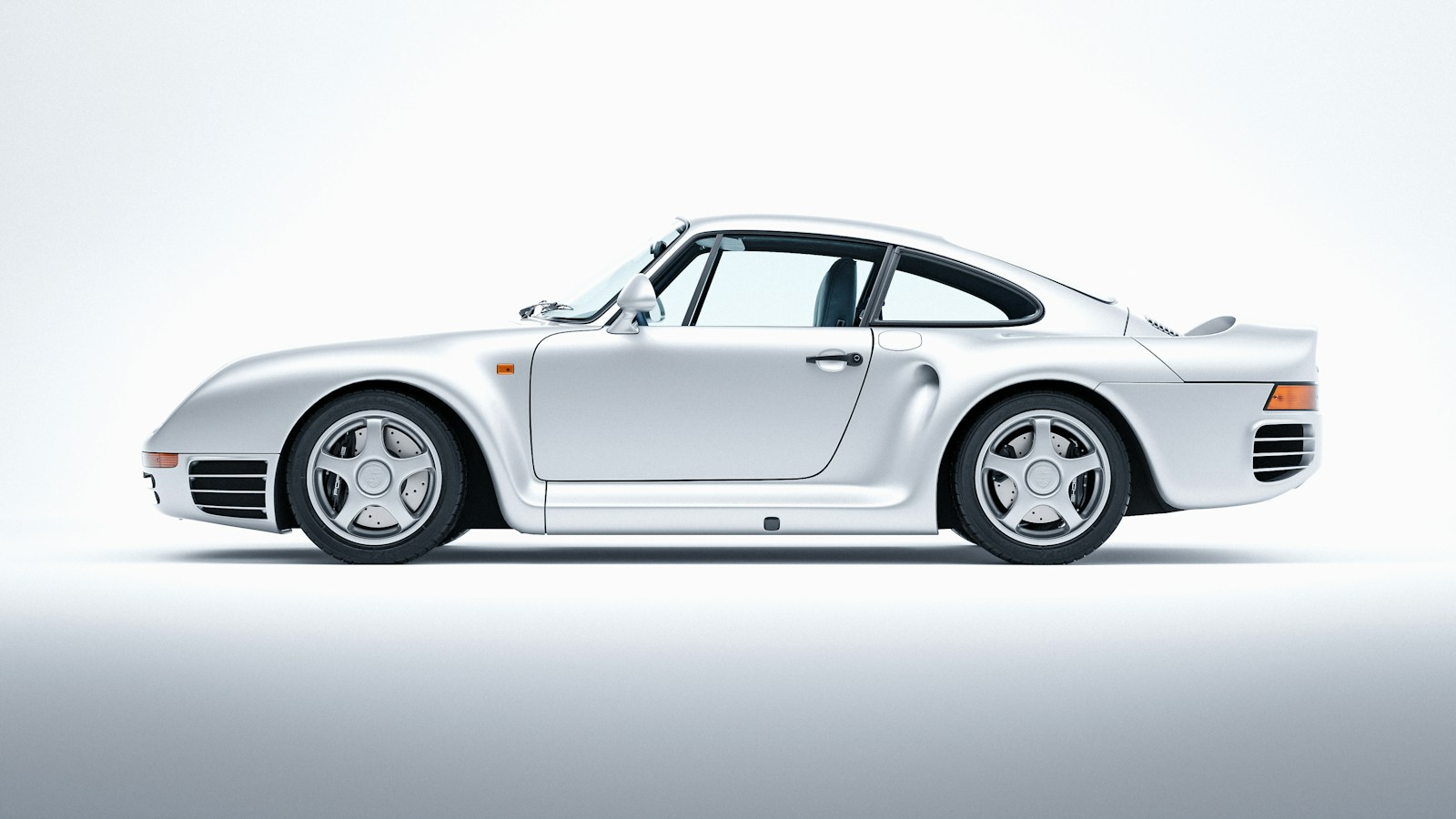

$2,040,000. That’s what a 1987 Porsche 959 “Komfort” sold for at RM Sotheby’s Monterey auction in August 2025 — roughly nine times its original sticker price, and enough to buy several median-priced houses in most American metro areas outright. Porsche built just 292 examples of the 959 between 1986 and 1988, priced them at around $225,000 each, and reportedly lost money on every single one. Four decades later, the car hasn’t just held value. It has never stopped climbing, and the reasons trace directly back to what Porsche actually built.
A Car That Cost More to Build Than to Buy
Porsche’s own numbers on the 959 are almost absurd by modern standards. According to RM Sotheby’s auction documentation, the company charged buyers around $225,000 for a new 959, while the actual cost to build each car exceeded $450,000 — meaning Porsche subsidized every unit by roughly double what it charged. That kind of spending only made sense as a homologation exercise: Porsche needed 200 road-legal 959s built to qualify a rally and race version for Group B competition, and it used the road car as a rolling showcase for technology the brand wanted the world to see.
That technology is why the 959 still matters. It was the first road car to use sequential twin-turbocharging, staging two turbochargers to minimize lag at low RPM while still delivering big power up top. It paired that with a computer-controlled all-wheel-drive system that could vary torque distribution between the axles on the fly, a magnesium wheel and Kevlar-reinforced body construction to cut weight, and a top speed around 197 mph that made it the fastest production car in the world when it launched. Nothing else sold to the public in 1986 came close to that combination.

The Auction Record Keeps Getting Rewritten
The price trajectory isn’t a single spike — it’s a decade-long climb with each sale resetting the bar. In 2016, a silver 1988 959 Komfort came up for sale on Bring a Trailer and drew a high bid of $810,000, but the reserve wasn’t met and the car went unsold. Six years later, a red 1987 Komfort on the same platform actually closed the sale, and according to Hagerty’s own market reporting, it sold for $2,125,000 — becoming the second-most expensive car ever sold on Bring a Trailer at the time, and blowing past the Hagerty Price Guide estimate by roughly $575,000. That gap between what the price guide predicted and what a real buyer actually paid is itself a signal: demand for the 959 was outrunning even the people paid to track it.
The 2025 RM Sotheby’s sale extended the pattern rather than breaking it. That $2,040,000 Komfort carried a matching-numbers engine, Canepa Design upgrades pushing output to roughly 600 horsepower, and just 14,702 miles on the odometer — the kind of low-mileage, well-documented example that commands a premium even within an already-scarce model. And the ceiling for the nameplate sits even higher: a rarer 959 Paris-Dakar variant, built for the rally version of the car, sold for $5.9 million at RM Sotheby’s in 2018, according to the same Hagerty reporting on the model’s sales history.
Why the Money Keeps Chasing This One Car
Part of the answer is simple scarcity. With only 292 units built and most of them accounted for by collectors and museums, a 959 changing hands at all is an event, let alone one in exceptional condition. But scarcity alone doesn’t explain sustained appreciation — plenty of rare cars stay flat for years. What keeps pushing 959 prices upward is that the car’s engineering case has only gotten stronger with time: everything from Porsche’s later Turbo models to modern all-wheel-drive supercars from other manufacturers traces a direct line back to systems the 959 debuted first, in a road car, four decades ago.
Hagerty’s own market commentary points to something else driving recent momentum too — as prices for benchmark 1980s and 1990s Porsches like the Carrera GT have climbed into eight figures, buyers have started looking sideways at cars like the 959 that were, by comparison, considered relatively undervalued for years. That reappraisal is still working its way through the market, which is part of why a car that cost Porsche $450,000 to build in 1986 dollars is now worth roughly four to nine times its original window sticker, depending on which sale you use as the benchmark — and why nobody in the collector world expects that number to be the ceiling.