
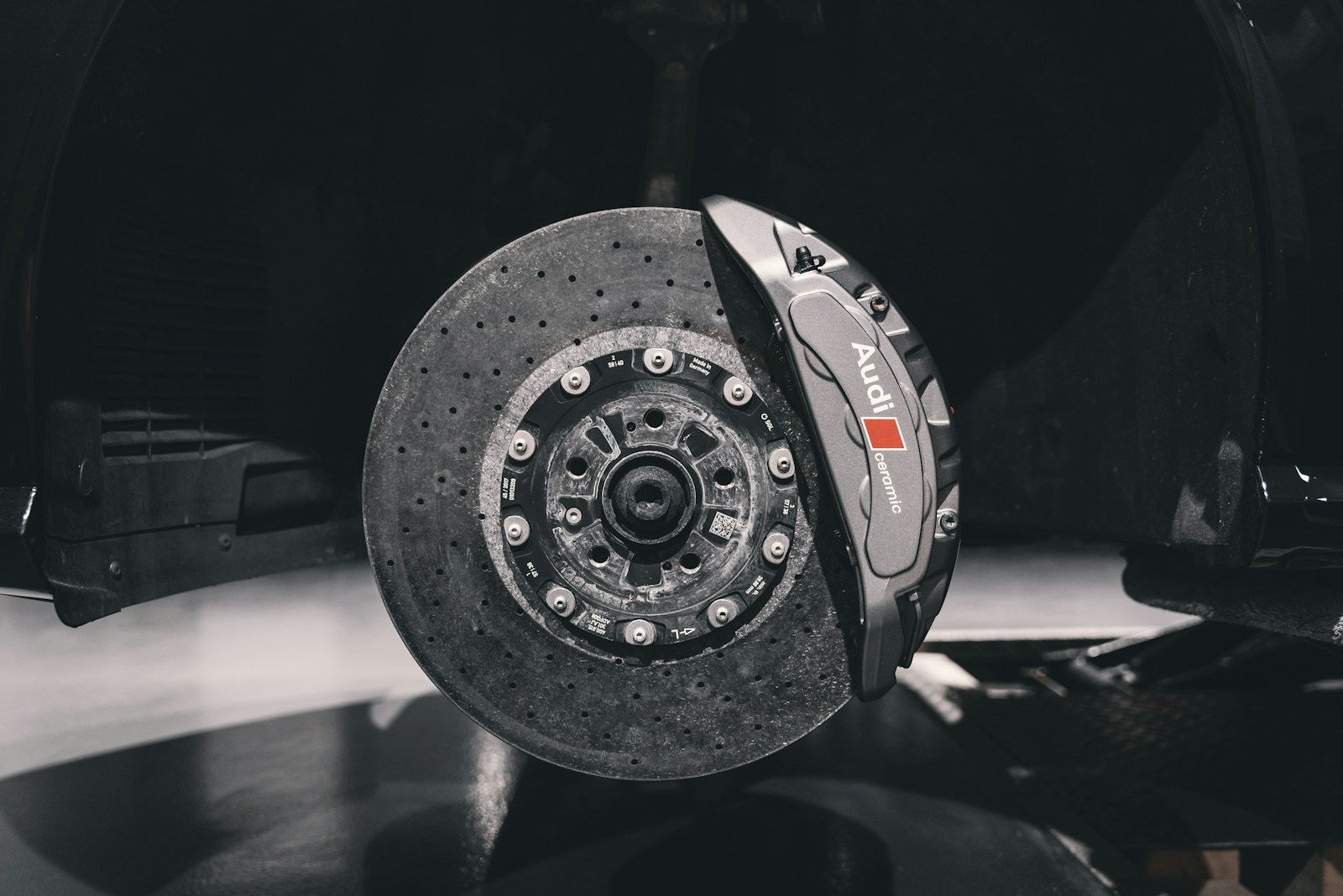

A brake job on a compact sedan can run as little as $150. The same basic service on a carbon-ceramic-equipped BMW M3 has been quoted as high as $16,931 for a single axle. That’s not a typo — it’s the actual spread nationwide shop data shows between the cheapest and most expensive segments, and the gap between an ordinary crossover and a full-size pickup alone can run close to $400.
Compact and Midsize Sedans: The Floor
Economy and compact sedans sit at the bottom of the cost curve, and it isn’t close. According to shop-invoice data compiled from AAA, Kelley Blue Book, and RepairPal, a pads-only job on an economy or compact sedan runs $150 to $250, while adding rotors pushes the total to $250 to $450. RepairPal’s own vehicle-specific estimator data backs that up at the model level: a 2026 Honda Civic runs $271 to $328 for a pads job, and a Toyota Corolla comes in at $297 to $355 — both comfortably under the national average of $335 to $394 that RepairPal calculates across all vehicle types.
Midsize sedans creep up modestly from there. A Honda Accord runs $291 to $349 and a Toyota Camry runs $304 to $368, according to the same RepairPal data — proof that even stepping up a full vehicle class barely moves the needle when you’re still dealing with a small, light car and simple single-piston calipers.

SUVs and Trucks: Where the Real Jump Happens
The bigger break in pricing shows up once you cross into SUVs and full-size trucks. RepairPal’s data puts a Chevrolet Silverado 1500’s brake pad job at $373 to $430 — already roughly $100 more than a Civic before you even touch rotors. Once rotors enter the picture, the gap widens further: ConsumerAffairs’ cost breakdown, updated August 2026, puts a combined pads-and-rotors job at $901 to $1,084 per axle nationally, with all four corners running $1,802 to $2,168 — figures skewed upward by the heavier rotors, larger calipers, and higher-torque hardware that trucks and three-row SUVs require to stop more mass. A same-brand comparison makes the point cleanly: ConsumerAffairs quotes a Honda Civic Sport at $645 to $822 for one axle of pads and rotors, while a Kia Sorento SUV on the same platform family of pricing runs $867 to $1,138 for the identical service.
The labor side compounds the parts difference. Independent shops nationally charge roughly $80 to $130 an hour, while dealerships run $120 to $180 an hour, and heavier vehicles simply take more time on the lift — bigger wheels to pull, heavier calipers to bracket, and often more fasteners torqued to spec.
Luxury and Performance: The Outlier Numbers
Luxury and performance vehicles blow the curve up entirely, and not just because of badge markup. RepairMyBrakes’ segment data puts a standard luxury or performance brake job (BMW, Audi, Porsche, Tesla) at $300 to $700 for pads alone and $450 to $1,500 with rotors — multiples of the compact-sedan price for what’s mechanically a similar job, just with pricier OEM parts and dealer-only labor rates that can hit $180 an hour or more.
Then there’s the true outlier: cars factory-equipped with carbon-ceramic brakes. ConsumerAffairs’ quoted range for a BMW M3 — a model that can be optioned with carbon-ceramic rotors — was $10,690 to $16,931 for one axle, an amount that exceeds what most economy cars cost to buy outright. Carbon-ceramic rotors are made from a woven carbon-fiber-reinforced silicon carbide compound rather than cast iron, and that manufacturing process, plus the fact that most shops can’t touch them and owners get routed straight to the dealer, is what turns a routine maintenance item into a five-figure invoice.
The Segment Breakdown at a Glance
- Compact/economy sedan: $150-$250 pads only; $250-$450 with rotors.
- Midsize sedan: roughly $290-$370 for pads, similar proportional increase with rotors.
- SUV/crossover: $200-$400 pads only; $500-$850 with rotors.
- Full-size pickup truck: $250-$500 pads only; $550-$950 with rotors.
- Luxury/performance: $300-$700 pads only; $450-$1,500 with rotors on standard steel setups.
- Carbon-ceramic-equipped performance cars: can exceed $10,000 per axle.
What the segment-by-segment numbers really show is that brake cost scales with two things buyers rarely think about at purchase time: the mass a vehicle has to stop and the exclusivity of the parts bin its manufacturer chose. A three-row SUV costs more to stop than a sedan because physics demands bigger rotors and more clamping force, full stop — but a carbon-ceramic sports car costs more because the manufacturer opted into a niche materials supply chain that most independent shops can’t even service. Anyone shopping across those categories should price a full brake service, not just the sticker, before assuming a $400 gap between two vehicles is the end of the story.