
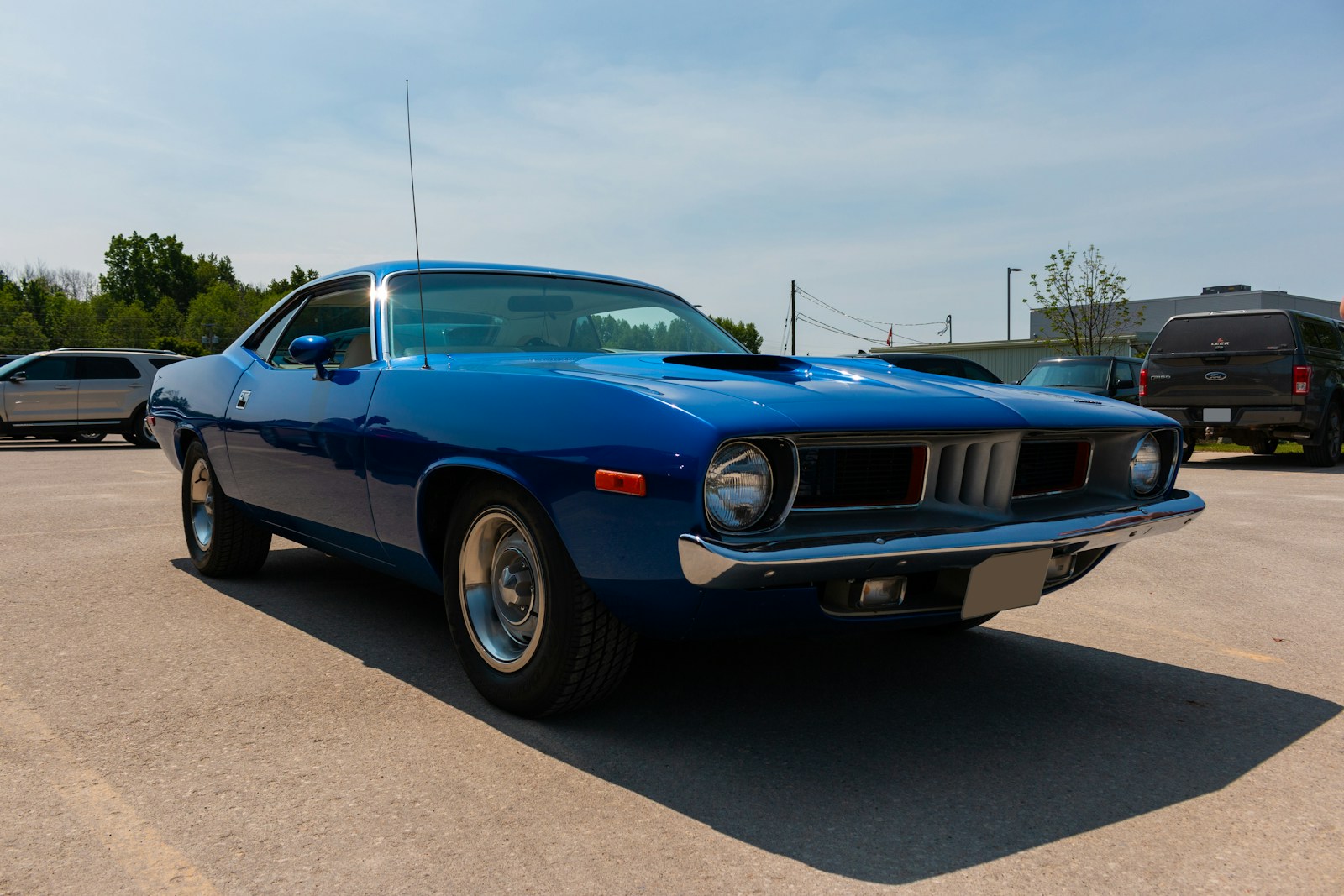

A Bright Blue 1971 Plymouth Hemi ‘Cuda convertible crossed the block at Mecum’s inaugural Seattle auction in June 2014 and stopped at a $3.5 million winning bid, a number that Mecum itself called the highest price ever paid for a Mopar at the time. More than a decade later, that sale still stands as the benchmark for what a factory muscle car can bring at auction, and the specific build sheet behind it explains why almost nobody expects to see it matched by a random Hemi ‘Cuda pulled out of a barn.
The combination nobody else has
Plymouth built the ‘Cuda convertible in genuinely tiny numbers to begin with, and the Hemi option narrowed that pool further. According to auction reporting on the sale, this specific car was one of just two 1971 ‘Cuda convertibles built for the U.S. market with the 426 Hemi V8 paired to a four-speed manual transmission, and the only one of those two still in existence. Plymouth built only eleven ‘Cuda convertibles with the 425-horsepower Hemi engine that year in any transmission configuration, which puts the four-speed pair at the extreme edge of an already microscopic production run.

The options sheet compounds the rarity rather than simply adding to it. The car left the factory with a Dana 60 rear end and 4.10 gears through the Super Track Pak, a 26-inch radiator sized for serious track use, power brakes, the Rallye instrument cluster, and a Shaker hood scoop that bolted directly to the air cleaner. Every one of those boxes had to be checked by the original buyer, in the exact combination that survives on this particular car, for it to exist at all. Reproducing that build today isn’t a question of writing a bigger check. Plymouth stopped making 426 Hemi engines for street cars decades ago, and no amount of restoration work turns a numbers-matching original into something a shop can manufacture from scratch.
What actually made it a record, not just a rarity
Rarity alone doesn’t set records; matching-numbers originality does the rest of the work. Auction reporting on the sale noted the car retained its original drivetrain, making it the only surviving example of the two four-speed convertibles with its factory engine and transmission still in place rather than swapped or replaced. Comparable pristine 1971 Hemi ‘Cuda convertibles built with the more common automatic transmission were trading in the neighborhood of $2 million around the same period, which means the four-speed, matching-numbers combination alone accounted for roughly $1.5 million of the final price. That gap is the clearest evidence that bidders were paying for the specific configuration, not just the nameplate or the color.
The record has also survived a real challenge. At Mecum’s Indianapolis sale in May 2021, a different 1971 Hemi ‘Cuda convertible, one of only three built with the Hemi and a four-speed that year and originally exported to France, drew a $4.8 million high bid that would have shattered the 2014 result. The seller’s reserve wasn’t met, the bid was withdrawn, and the car went home unsold, leaving the Bright Blue Seattle car as the only completed transaction on record above the $3 million mark for this specific body style and engine.
The 2014 sale didn’t happen in a vacuum, either. Auction coverage from the time noted the $3.5 million bid eclipsed a modified 1971 Hemi ‘Cuda that had sold for $2.42 million in 2007, as well as a private sale reportedly worth $3 million in 2004. Each of those prior benchmarks involved cars with some combination of engine swaps, non-original drivetrains, or incomplete documentation, which is exactly the gap the Bright Blue car closed. It wasn’t simply the newest record in a steadily climbing market. It was the first time a buyer could point to a surviving example with its original numbers-matching Hemi and four-speed still bolted in place, and pay accordingly.
Why the combination is effectively frozen in time
What keeps this particular Hemi ‘Cuda ahead of every pretender isn’t mystique. It’s arithmetic. Plymouth built the car once, with a specific engine, a specific transmission, and a specific rear end, and sold it to one original owner who happened to order every performance option Chrysler offered that year. No restoration shop can retroactively create a second matching-numbers example, and no amount of documentation on a different car substitutes for the drivetrain this one still carries. Collectors chasing similar money with a different ‘Cuda are, in practical terms, chasing a spec sheet that Plymouth only wrote once.