
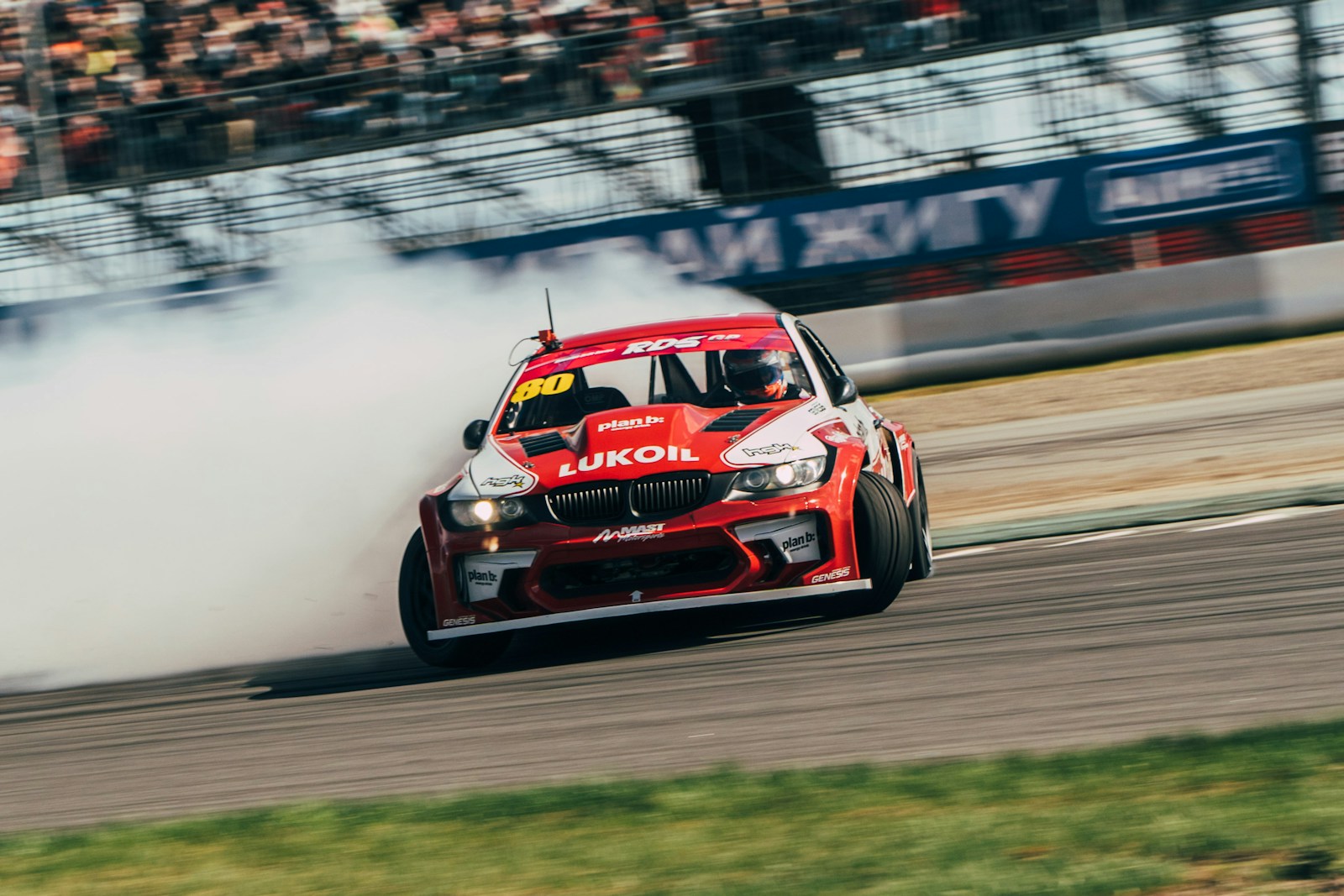

Every Formula Drift PRO car lines up at the start of a run sharing the same floorpan, frame rails, and suspension mounting points as the street car it was built from, because the series’ 2026 PRO Technical Regulations forbid moving any of those points at all. That single restriction, buried in a rulebook most fans never open, is a big part of why a purpose-built drift car handles nothing like a modified street sports car even when both cars started out as the exact same chassis code. Formula Drift’s technical staff didn’t leave suspension geometry to each team’s imagination. They wrote down, to the fraction of an inch, where a control arm can bolt, how far a subframe is allowed to drop, and how much ballast a car can carry, while leaving one major system nearly wide open.
The Unibody Itself Cannot Move
Section 2.1 of the PRO Technical Regulations states that the “original OEM floorpan, frame and or unibody must remain unmodified between the vertical planes created by the original forward most and rearward most suspension point.” On a street car, an owner chasing better handling can cut, notch, or reinforce a subframe however a shop sees fit. In Formula Drift, that same structure is treated as a fixed reference point the rest of the car has to work around. The rulebook does carve out ten vehicle-specific exceptions, listed in section 2.1.1 A through J, that allow particular reinforcement kits on chassis codes the series sees constantly, including the Nissan S-chassis, BMW’s E36, E46 and E92, and the Toyota FR-S and Supra platforms, but every other car follows the unmodified-unibody rule with no exceptions.
Suspension Mounting Points Are Locked to the Factory Bolt Pattern
The front suspension rules go further than most street-car builders would ever expect. For MacPherson strut cars, the regulations require that the upper mount pivot “remain within the centerline dimension of the OEM unaltered factory bolt pattern,” and front subframes cannot be relocated at all. Mounting tabs have to stay exactly where the factory welded them, with no cutting, welding, bending, or drilling permitted. A street car owner installing coilovers or a camber plate kit faces no such restriction and can move a strut tower mount wherever a tuning shop recommends. A Formula Drift car cannot.

Rear Suspension Follows a Vehicle-by-Vehicle Formula
Independent rear suspension setups have their own separate section. The rules mandate that “suspension modifications must maintain the same link count as the factory hub,” so a team cannot swap a multi-link rear end for a simpler design just to make drift setup easier. Subframe height is regulated with specific clearance measurements that vary by model, ranging from as little as 0.200 inches to as much as 1.750 inches depending on the platform, and any additional mounting tabs a team welds in can only shift a suspension point by a maximum of two inches on any plane from where the factory originally placed it. It is the opposite of a street build, where an aftermarket subframe brace or relocation kit is often the first suspension upgrade a drift hobbyist buys for a daily driver.
Steering Angle Has No Rulebook Limit at All
Given how central steering angle is to drifting, it is notable that the PRO regulations impose no numeric limit on it whatsoever. Section 3.2 states simply that steering modifications are “free,” with teams given open flexibility on the steering rack, tie rods, and mounting hardware. That is the inverse of the suspension geometry rules. A street sports car ships with a steering rack tuned for stability at highway speed, typically allowing somewhere around 30 to 35 degrees of front wheel angle before hitting a mechanical stop. Formula Drift cars run steering angle kits that push well past 60 degrees, and because the rulebook does not cap that number, the ceiling is whatever a team’s geometry and CV joints can physically survive.
Ballast Rules Exist to Stop Teams From Gaming Weight Distribution
Weight distribution cannot be freely engineered either. Section 2.3 caps added ballast at 50 pounds and specifies it must be “mounted ahead of the rear axle,” which closes off the obvious shortcut of loading up the back of the car to help it rotate into a drift more easily. Separately, the tire regulations in sections 9.1 and 9.2 set a minimum competition weight of 2,700 pounds and a maximum of 3,400 pounds, measured with the driver in full race gear, so builders cannot simply strip a car down to featherweight either.
Nearly Everything Else Inside the Car Is Mandated, Not Optional
Beyond suspension and chassis geometry, the interior of a PRO car bears almost no resemblance to the street car underneath it. The regulations require FIA-homologated racing seats with a five-year service life, five- or six-point harnesses meeting SFI 16.1/16.5 or FIA 8853 specifications, and a roll cage built from seamless SAE 1020/1025 mild steel or chromoly tubing at a minimum 1.5-inch diameter with .095-inch wall thickness, welded to the chassis at eight attachment points. Factory airbags and supplemental restraint systems have to come out entirely, a single master cylinder is banned in favor of a dual setup, and automatic transmissions, dual-clutch gearboxes, and paddle shifters are all prohibited outright, leaving manual transmissions as the only legal option. An onboard fire suppression system holding at least 10 pounds of extinguishing agent, with a manual pull handle, rounds out the safety mandate, according to the same PRO Technical Regulations that govern the suspension geometry.
The Lower Tiers Show How Deliberate These Choices Are
Formula Drift’s own 2026 PROSPEC Technical Regulations, written for the series’ developmental tier, relax several of these same rules while still holding to the same core philosophy of tightly controlling chassis and suspension geometry and leaving steering setup comparatively open. Seeing the same sanctioning body write two different rulebooks with the same structural bones makes clear that the tight suspension restrictions in PRO are not arbitrary. They exist specifically to keep competition close by controlling geometry, while every other system, especially steering, stays open for teams to engineer their own advantage.
Rules like these are why watching two drift cars battle through a corner is not really watching two modified street cars at all. It is watching two engineering teams solve the exact same geometric puzzle within an intentionally narrow box, then compete entirely on driver skill and the wide-open systems the rulebook chose to leave alone.