
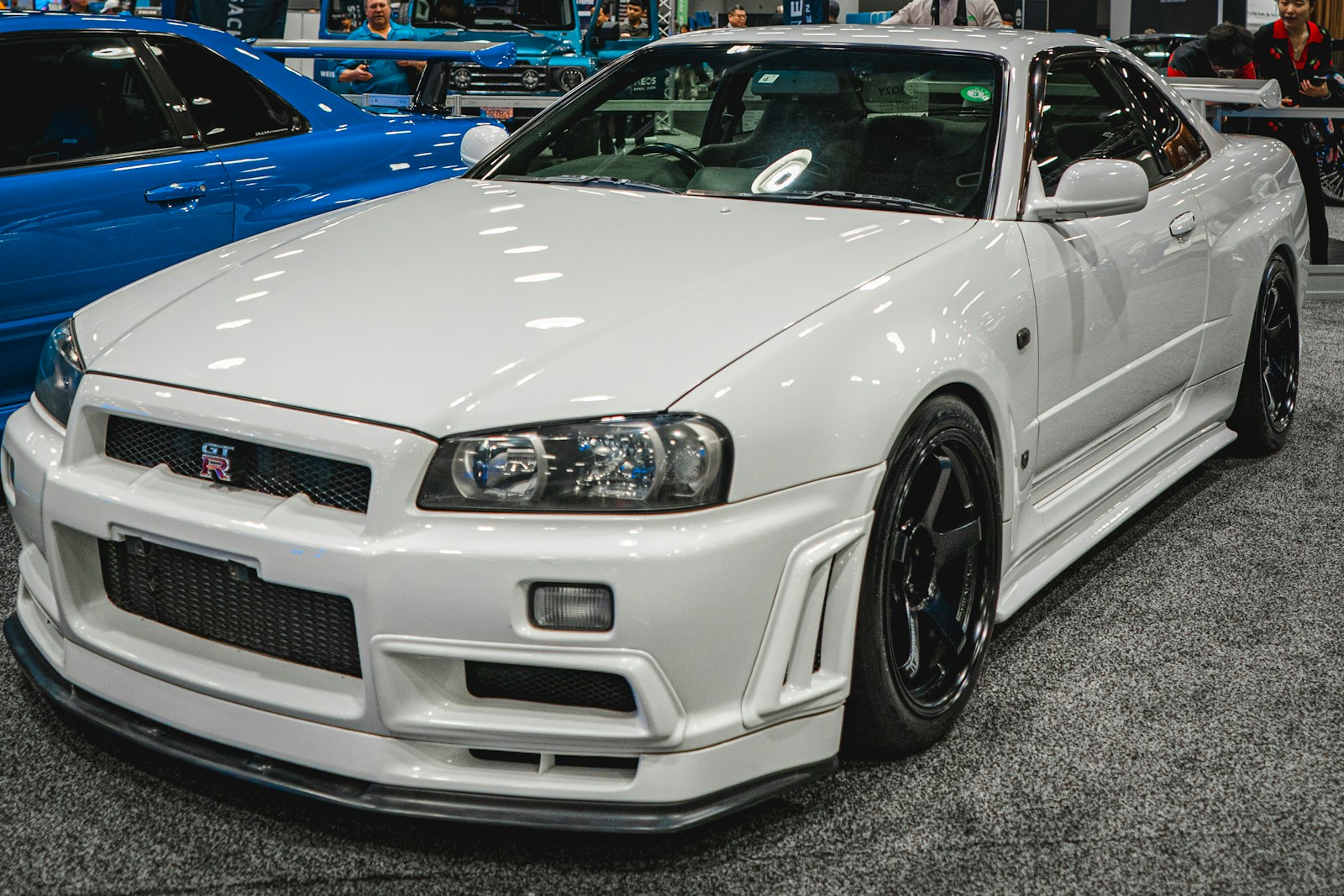

A road-legal Nissan Skyline GT-R that most fans only ever watched from a theater seat just became the most expensive Nissan ever sold at auction, and the number attached to it stops people mid-scroll. Bonhams hammered the car down at $1.18 million, with buyer’s premium pushing the final total to roughly $1.36 million once the paperwork was signed. This car carries actual screen time behind Paul Walker in the franchise that turned import tuning into a global obsession.

A Hero Car With a Legal Headache
The vehicle is a 2000 Nissan Skyline R34 GT-R finished in factory Bayside Blue, built up by a company called Kaizo Industries specifically to appear in 2009’s “Fast & Furious,” the fourth film in the series. According to Hagerty’s own market reporting, Kaizo imported the car into the United States without an engine, then planned to retrofit an RB26 powerplant afterward and register the finished product as a kit car, a workaround aimed at sidestepping the federal 25-year import rule that normally keeps Skylines of this era off American roads entirely. The scheme did not hold up. Customs officials impounded the GT-R after filming wrapped, and it sat tied up in litigation for years before the case resolved. The car was eventually exported out of the country, and its VIN was permanently blacklisted, meaning it can never legally return to the United States as a road vehicle again.
That backstory, oddly enough, is part of what makes the car so collectible. It is not a replica or a tribute build assembled after the fact. It is the actual hero unit that spent time in front of the cameras, complete with the legal scar tissue to prove it.
What $1.18 Million Actually Bought
Bonhams sold the car through its Amelia Island sale, and the auction house’s own listing details a car that was modestly but meaningfully worked over for its on-screen role. The R34 runs a tuned inline-six making roughly 550 horsepower, backed by a large front-mount intercooler and a Nismo exhaust system. Cosmetically, the production crew fitted a new hood, a Nismo front bumper and matching side skirts, and swapped the rear fog light from its factory red lens to a white one, small details that separate this specific car from the dozens of Skylines that never made it near a soundstage.
The Paul Walker Premium
Walker died in a car accident in November 2013, and in the years since, anything connected to his on-screen career has traded at a premium that has only grown. Hagerty’s own valuation data places him second on its list of celebrity connections that measurably move a car’s price at auction, behind only Steve McQueen. This particular GT-R’s $1.18 million result made it, at the time, the most expensive Nissan of any kind ever sold publicly, surpassing even the Italdesign-bodied GT-R50 concept’s roughly $1.1 million result.
What the sale really demonstrates is how thoroughly screen provenance has reshuffled the pecking order in Japanese performance car collecting. A decade ago, the R34 GT-R’s value came almost entirely from its reputation on the street and in video games. Now the cars carrying the highest price tags are the ones with a documented moment in front of a camera, driven by an actor whose fan base treats ownership as something closer to preserving a piece of film history than buying a fast car.
The market for film and television-used vehicles has grown into its own distinct collecting category over the past decade, separate from and often more volatile than the broader classic car market. Cars with documented screen time can swing wildly in value based on factors that have nothing to do with mechanical condition, including how prominently the vehicle featured in its respective film, whether the actor associated with it is still alive, and how actively that franchise’s fanbase continues to engage with the property years after its theatrical release. For the Fast and Furious franchise specifically, that fanbase has proven unusually durable, with new installments continuing to draw large audiences more than two decades after the original film introduced global audiences to the underground street racing scene the series built its identity around.
Whether the car ever surfaces publicly again is an open question; buyers at this level of the market often keep high-profile acquisitions in private collections for years before any future resale.