

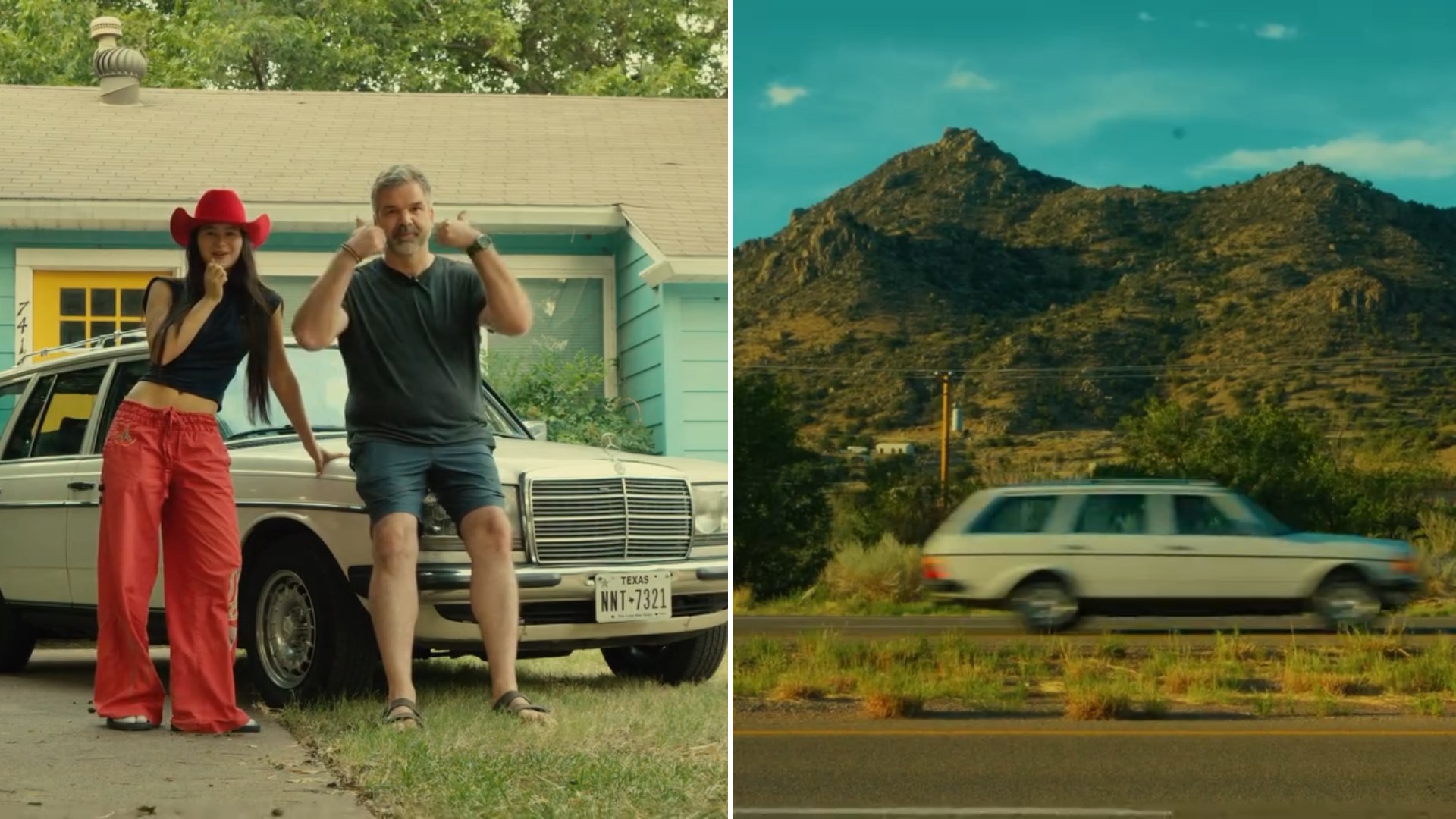
For six months, it was just a running joke between them. An Instagram couple known as @marielou_inc kept floating the idea of driving a vintage Mercedes from Texas all the way to California, and kept not quite committing to it. Then, finally, the joke became a plan, and the plan became a 28-hour cross-country drive that the couple documented from start to finish.
According to their own account of the trip, the drive took 28 hours total, with stops made only for gas. No detours for sightseeing, no overnight stays to break up the monotony of the highway — just a straight shot across several states, powered by whatever combination of determination, playlists, and gas station coffee it takes to keep two people awake and alert behind the wheel of a decades-old car for well over a full day.
“It took 28 hours total only stopping for gas. After 6 months of joking about this challenge, we finally did it,” the caption reads, capturing both the payoff and the long runway of hesitation that preceded it. Anyone who has ever talked themselves into and out of a big trip a dozen times over knows that particular feeling — the idea sounds exciting in the abstract, but committing to an actual date, actual route, and actual vehicle is where most road trip fantasies quietly die. This one didn’t.
Doing a trip of this length in a vintage Mercedes rather than a modern vehicle adds a layer of both charm and risk that a newer car simply wouldn’t carry. Older Mercedes models built in the era this vehicle likely comes from were engineered with a reputation for mechanical durability, but decades-old vehicles still lack the modern conveniences — adaptive cruise control, advanced climate systems, contemporary suspension tuning — that make long highway stretches easier on the body. A drive that would be merely tiring in a new sedan becomes a genuine endurance test in a car built before many of today’s comfort features existed.
There’s also the simple logistics of covering that much ground in one continuous push. Texas to California spans roughly 1,500 to 1,700 miles depending on the specific route chosen, cutting through wildly different terrain — flat highway, desert heat, mountain passes — all of which puts different kinds of stress on both a vehicle and its occupants. Doing it in under 30 hours with only gas stops means averaging highway speeds for nearly the entire drive, trading off who’s behind the wheel, and trusting that a car built decades before either of them was likely born would hold up mile after mile without a serious mechanical hiccup.
What makes the story resonate beyond the logistics is the relationship at its center. Six months of joking about a challenge before finally acting on it is a distinctly relatable arc — the kind of shared, half-serious dream that couples talk themselves into over dinner, then let sit untouched for months, until one day the stars align and someone says, “let’s actually do this.” That the couple chose to document the entire drive, rather than just posting a highlight reel from the destination, suggests they understood that the real story wasn’t the arrival in California so much as the accumulated hours, fatigue, and small victories along the way.
Road trips built around a vintage car carry their own particular tension throughout: every strange noise from the engine, every gauge reading that looks slightly off, becomes a small drama in a drive that otherwise consists of long, flat stretches of highway. Making it the full distance without major incident, in a car old enough to be considered a classic, is itself a kind of quiet triumph — one earned as much by preparation and nerve as by the car’s own mechanical resilience.
Takeaway: Planning a Long-Distance Drive in a Classic Car
Anyone considering a long-distance trip in a vintage vehicle should have it thoroughly inspected and serviced beforehand — fluids, belts, hoses, tires, and cooling system all deserve a close look, since a small issue that’s manageable on a short local drive can become a serious problem hundreds of miles from home. Pack basic tools, spare fluids, and know the location of service shops familiar with older vehicles along the route. Build in buffer time rather than racing a fixed schedule, and never underestimate how much longer fatigue makes a drive feel in a car without modern comfort features. Done right, a cross-country trip in a classic car isn’t just a way to get somewhere — it’s an adventure that tests both the vehicle and the people inside it in equal measure.