

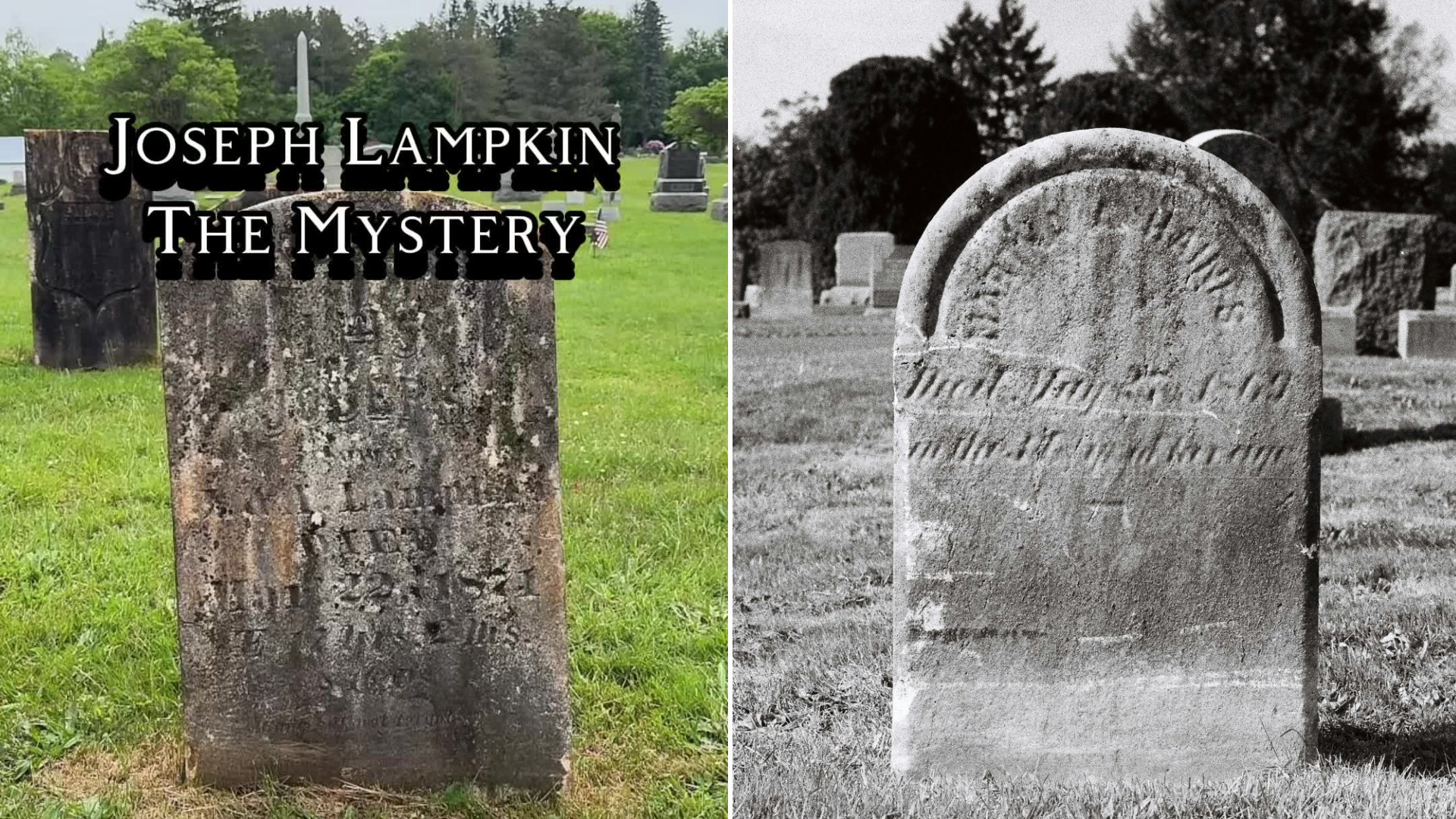
Not every restoration project involves an engine. For the TikTok creator behind @crazycemeterylady, the subject of a recent “Mystery Monday” installment was a weathered gravestone, cleaned carefully by hand as part of an ongoing series dedicated to uncovering the stories behind forgotten graves — and this time, she’s asking her followers for help.
The caption lays out the mystery directly: “Mystery Monday needs your help researching Joseph Lampkin! He died on March 22, 1871, at only 16.” According to her account, the gravestone belongs to a teenager who died at just sixteen years old, more than a century and a half ago — a life cut short young enough that the stone marking it has likely outlasted any living memory of who he actually was, what he looked like, or how he spent whatever years he had.
Cleaning a weathered gravestone is a slower, more deliberate process than it might appear at first glance. Headstones that have sat exposed to weather for over 150 years accumulate layers of lichen, moss, mineral staining, and grime that can obscure engraved names, dates, and epitaphs almost entirely. Cemetery preservationists and hobbyists alike generally rely on gentle, non-abrasive techniques — soft brushes, specialized cleaning solutions designed not to damage porous stone, and a lot of patience — specifically because aggressive cleaning methods can permanently damage fragile, aging stone rather than preserve it. The care taken in this kind of work reflects a broader ethic among the online “gravetok” and cemetery research community: these are historical artifacts and resting places, not just curiosities, and they deserve to be treated that way.
The hashtags attached to the post — including references to “gravegeeks,” “gravetok,” and “mysterymonday” — point to a recurring format built around this exact premise: clean a stone, surface whatever details are legible, and turn the audience into an ad hoc research team. Genealogy and historical research has increasingly moved into this kind of crowdsourced, community-driven space, where creators with access to a specific cemetery or headstone effectively deputize thousands of followers, some of whom bring genealogical research skills, access to historical archives, or simply enough curiosity to start digging through old newspaper records and census data.
A death in 1871 at sixteen years old raises immediate questions that a gravestone alone typically can’t answer. Was it illness, given how common outbreaks of diseases like diphtheria, scarlet fever, or tuberculosis were in that era, especially among children and teenagers? Was it an accident, tied to the physically demanding labor that often fell to teenagers in the 19th century? Or something else entirely, lost to time along with most other details of Joseph Lampkin’s short life? Without further documentation, any of these remain open possibilities rather than established fact — which is precisely the gap the creator is hoping her audience can help close.
What gives this kind of content its emotional pull is the quiet dignity of the act itself. A teenager who died a century and a half ago, buried under a stone that time had nearly erased, is briefly given renewed attention — not because of fame or notoriety, but simply because someone with a camera and a following decided his name was worth remembering, and his story worth trying to piece back together.
Takeaway: Researching and Preserving Historical Graves
If you want to help research a historical gravesite like this one, start with publicly available resources: digitized newspaper archives, county death and burial records, and genealogy databases like FamilySearch or Findagrave often hold clues that never made it onto the stone itself. If you’re inclined to clean an old headstone yourself, use only water and soft-bristled brushes, and avoid bleach, wire brushes, or pressure washing, all of which can cause irreversible damage to fragile, aging stone — many cemetery associations offer specific guidance before you start. Beyond the practical steps, projects like this are a reminder that history isn’t only preserved in museums and textbooks; sometimes it’s kept alive one gravestone, and one curious community, at a time.