

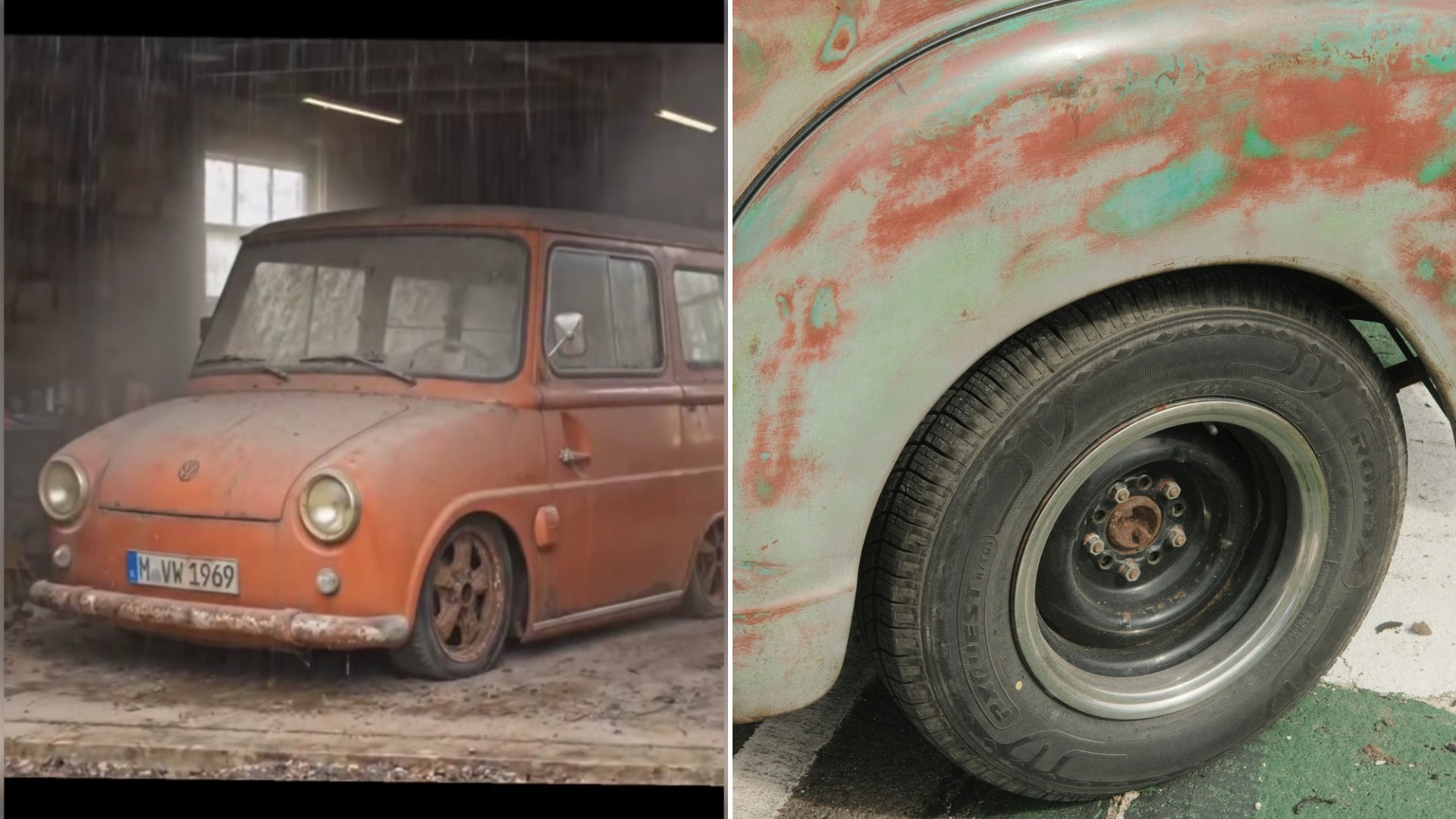
Most people have never heard of a Volkswagen Fridolin, let alone a six-wheel version of one, which is part of what makes the restoration project documented by the TikTok creator behind @fixmyclassic24 so unusual. According to the creator’s own restoration account, the vehicle in question is a 1969 Volkswagen Fridolin, a rare six-wheeler, and early into the project he uncovered perforated rust around one of the wheel arches — a discovery that, in classic car restoration circles, tends to set the tone for everything that follows.
“Germany’s Rarest VW 1969 Volkswagen Fridolin 6 Wheeler Van,” the caption declares, and by most accounts of the model’s production history, that claim isn’t much of an exaggeration. The Fridolin was a small, boxy delivery van Volkswagen built in limited numbers primarily for use by the German postal service and other utility functions, never intended for mass consumer sale and never produced in anything close to the volumes of the Beetle or the Type 2 van that share its underlying mechanical DNA. A six-wheel variant pushes that rarity even further into niche territory, making this less a typical restoration and more something closer to an archaeological project on wheels.
Finding perforated rust — rust that has eaten completely through the metal rather than just surface corrosion — around a wheel arch is one of the more consequential discoveries a restorer can make early in a project. Wheel arches take a constant beating from road debris, moisture, and salt over the decades, making them one of the most common failure points on old vehicles, but perforation specifically means the metal has lost its structural integrity in that spot, not just its appearance. According to the creator’s account of the vehicle’s condition, this finding came early enough in the process that it likely reshaped the entire scope of the project going forward, since perforated sections typically can’t simply be sanded and painted over — they require cutting out the compromised metal and welding in new panel sections to restore both strength and structure.
Restoring a vehicle this obscure comes with challenges that a more common classic car simply doesn’t present. Parts availability for something as rare as a Fridolin, particularly a six-wheel configuration, is virtually nonexistent through normal channels, meaning a restorer taking on this kind of project often has to fabricate replacement components by hand, source parts from other Volkswagen models that happen to share compatible dimensions, or hunt through specialist networks and overseas suppliers for anything resembling an original part. Every decision along the way carries more weight than it would on a mass-produced classic, precisely because getting it wrong on a vehicle this scarce means potentially compromising one of the few surviving examples still in existence.
The accelerated, step-by-step format the restoration is reportedly presented in — compressing what is likely a lengthy, meticulous process into a fast-paced viewing experience — has become a familiar structure across restoration content generally, allowing viewers to watch a vehicle transform from rusted and neglected to functional and presentable without sitting through every individual hour the work actually required. For a vehicle this rare, though, even the abbreviated version carries extra weight: every cut, weld, and patch is being applied to one of the last remaining examples of a van most people will never see in person, in any condition.
Whether the rust around the wheel arch turns out to be an isolated issue or the first sign of more widespread corrosion elsewhere on the body remains to be seen as the restoration continues, but for a vehicle this uncommon, uncovering the full extent of the damage is often just as important as fixing it.
Takeaway: Restoring a Rare or Unusual Vehicle
When restoring an uncommon vehicle with little parts support, invest time upfront in thoroughly documenting the car’s original specifications and dimensions before cutting or replacing anything — photographs, measurements, and research into sister models can prevent irreversible mistakes on parts that can’t simply be reordered. Address perforated rust immediately rather than delaying, since compromised metal only spreads with continued exposure, and always prioritize structural repairs over cosmetic ones. For rare vehicles especially, connecting with specialist owner communities and marque-specific forums can be invaluable, since fellow enthusiasts are often the best — and sometimes only — source for guidance, parts leads, or historical reference photos that keep a restoration faithful to the original.