

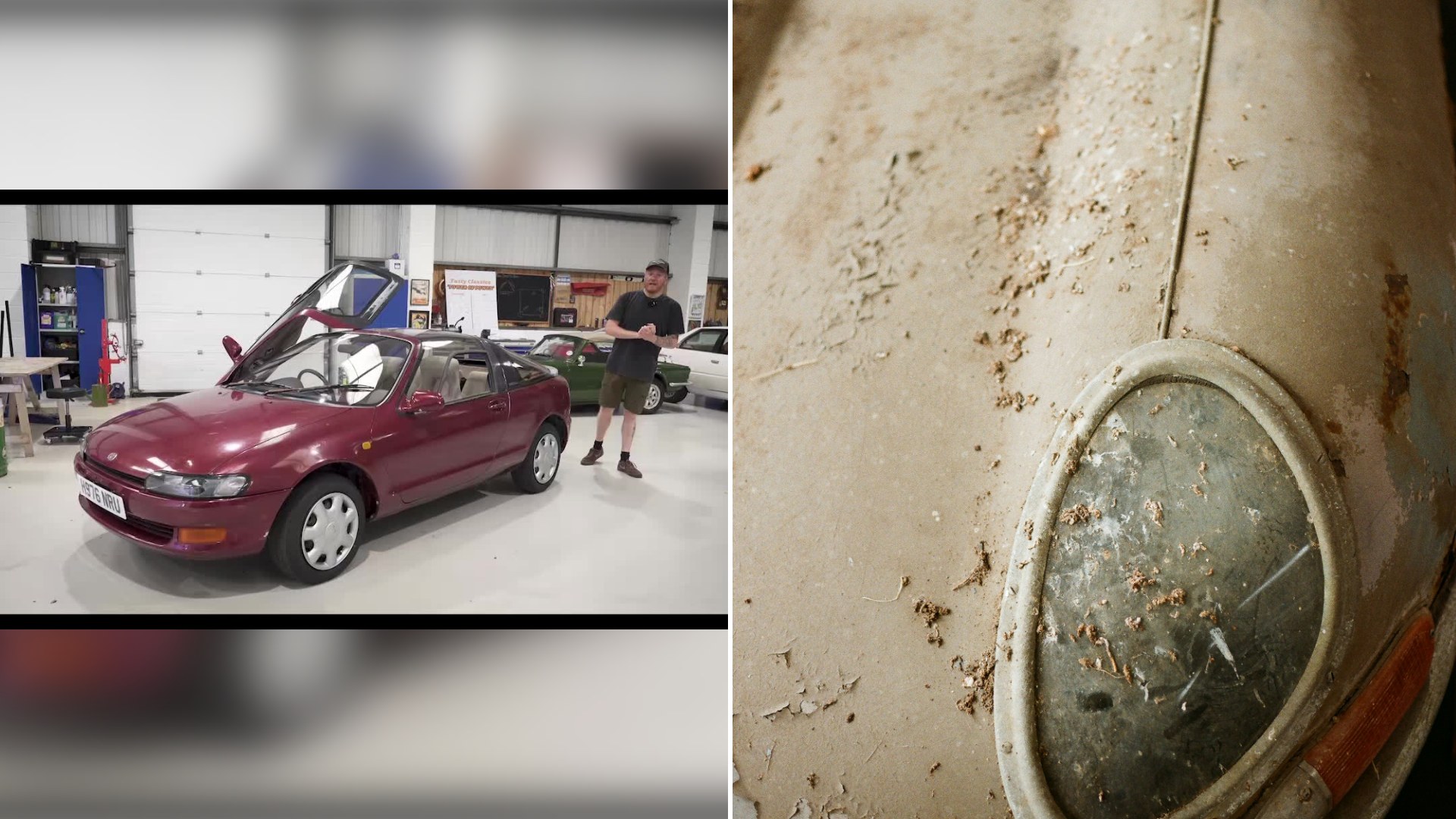
Plenty of project car videos end with bigger wheels and a louder exhaust. The second episode of a Toyota Sera build from the UK restoration channel @tastyclassicsuk heads the other way. Standing beside a maroon Sera in a bright workshop, the presenter says the plan is to “return this thing to completely factory standard.”
His reason is simple. Every Sera he has ever seen, he says, “has been modified in some way and I think it’d be really nice to keep one properly standard.” The caption puts the goal in a few words: “Restoring my Toyota Sera from Barn Find to Beautiful.”
He does not pretend the car is in good shape. “As you can see, this thing is covered in dents, dings, scrapes, scratches, some rusty bits on the black bits,” he says, while the camera runs across marked maroon paint and down to the rear number plate. “In general it looks super untidy.” Before the car can go “back out on the open road and hopefully down to a little car show,” it needs paint, and he is clear about what that means. It “involves completely stripping it down.”
The video jumps to the result of that first job. The bonnet is up, the front bumper is off and parts are laid out on the workshop floor. “Wow, would you look at that,” he says.
From there the Sera goes to a body shop, and the pace of the story changes. “Over the next couple of months while we were rescuing other cars,” he explains, a painter there “got stuck into a big job.” That meant getting all of the dents taken out, “doing lots of expert filler work,” putting the car in primer and paint, “and then painting the black bits on the car as well to really finish it off.” The footage shows the car as a patchwork of grey primer and sanded panels, then glowing under spray booth lights in fresh maroon.
Two of the team are in a car on the road when the next update arrives. “We’ve just had the phone call saying that the Sera is kind of ready,” the presenter says. Back at the workshop, the reassembly comes with banter. One of them is on the floor beside the car, underneath a raised butterfly door, when somebody asks, “Was it Anne Boleyn who was decapitated?”
A countdown follows, “3, 2, 1,” and the painted car is shown from the front with both doors up. “How good is that?” he says. “Manufactured by the Japanese, perfected by the British.”
There is still work to do after the reveal. One of the team leans into the back of the car to deal with the tan interior trim, a vacuum parked beside him. Then the Sera is out on the road under a blue sky, and the final shot has it parked with its doors raised among other enthusiast cars. “This thing has just come up like a dream,” he says. “I’m so pleased with it. What a result.”
For any owner thinking about a respray, the most useful line in the video is the one about stripping the car down. Paint applied around bumpers, lights and trim that were left in place leaves tape edges and old color hiding in the gaps. Taking those parts off costs labor, but it is what separates a repaint that looks factory from one that looks like a repaint. When you get an estimate, ask which parts come off and which get masked, and have that written on the paperwork.
The timeline deserves attention too. This job took “the next couple of months,” and it covered dent removal, filler, primer and color as separate stages. Ask the body shop for photos at each stage, because once the color is on, nobody can see what is underneath it. Ask what will be done about rust as well. The presenter pointed out rusty areas before the work started, and rust that is painted over instead of repaired tends to bubble back through.
If you plan to strip the car yourself to save on labor, as this team did, slow down and document it. Photograph each part before it comes off. Bag and label the fasteners and clips by panel. Store trim flat and off the floor. On an unusual car, one broken clip or cracked piece of trim can take longer to replace than the paint took to dry. Doors that swing up and large pieces of glass are also a two person job, which is how the workshop in the video handles it.
When the car comes back, look it over in daylight before you settle the bill. Check that the panel gaps are even, that the doors open and close the way they did before, and that every light and switch disturbed during reassembly still works. Ask the painter how long to wait before washing, polishing or waxing, since fresh paint needs time to cure.
The presenter’s case for keeping the car standard applies well beyond one rare Toyota. If you do modify a car, keep the original parts and choose changes that can be reversed. If you are restoring one, resist the upgrades for a while and see what the car was meant to be. When every other example has been changed, the untouched one is the car people walk over to look at.
More from Steel Horse Rides
- Stock vs. Modified: Which JDM Classics Actually Sell for More at Auction
- Mechanic Begins Restoring a Rare, Six-Wheel 1969 Volkswagen Fridolin and Finds Perforated Rust Around the Wheel Arch Early in the Restoration Project
- Why Unrestored ‘Survivor’ Condition Classic Cars Now Out-Auction Perfectly Restored Examples of the Exact Same Model and Model Year