

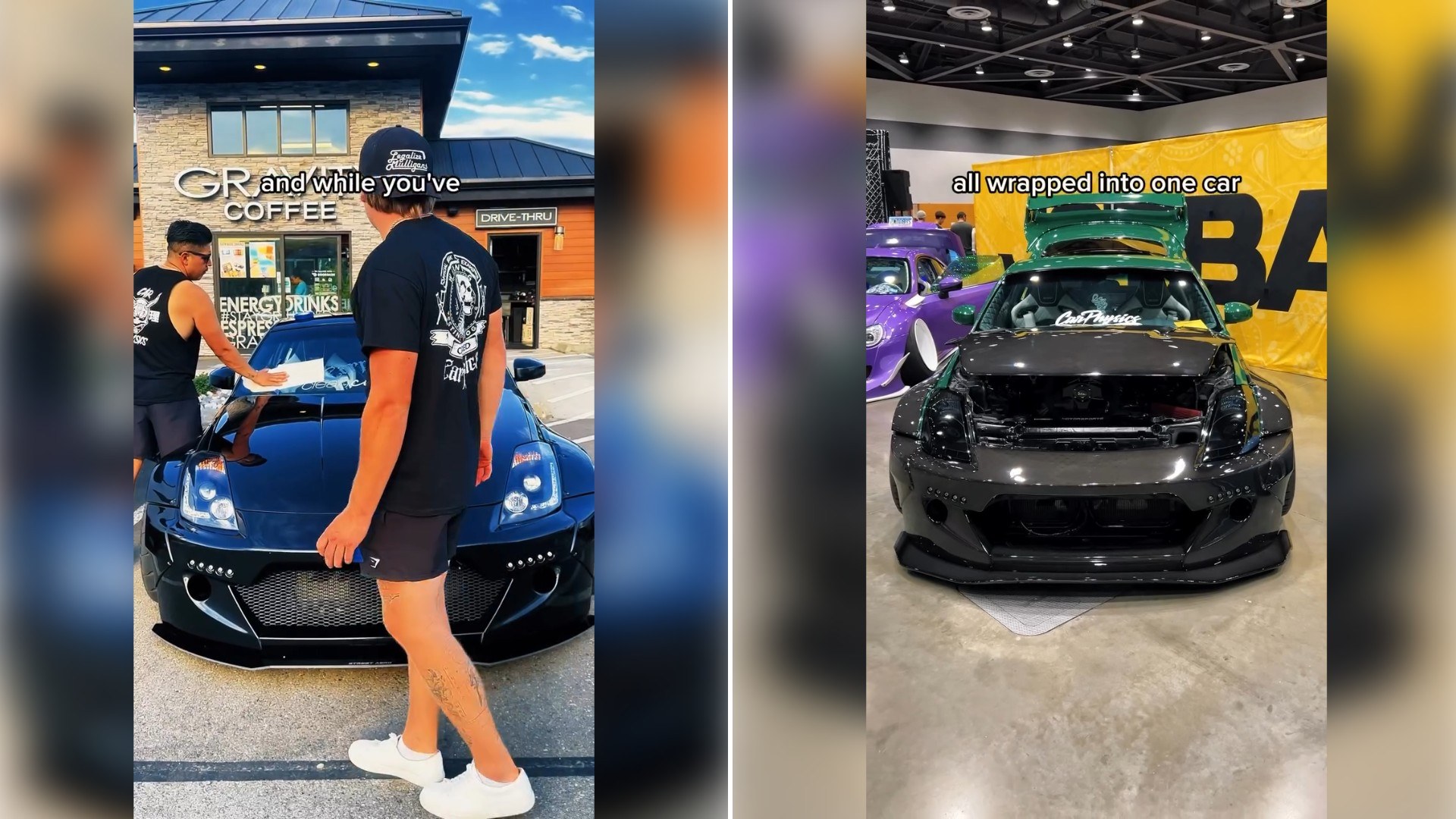
Twenty-eight seconds is all it takes for one Nissan 350Z to go from black to green. A short Instagram reel follows the same car through a lakeside evening, a coffee stop, a driveway wash, a wrap job and an indoor show, with one thought spelled out across the screen the whole way.
Posted by @carphysics, the clip carries the caption, “Some people just see a car. We see every memory attached to it.” The caption credits the car to its own account and the footage to a separate videographer, and tags the post #z33 and #350z_nation.
It opens at dusk beside a lake, with an orange sky and a mountain on the horizon. The Z sits on the shoulder of a two-lane road, low and wide in the fenders, with a tall rear wing and light-coloured wheels. A man in a tank top and shorts walks up to the driver’s door. Over those shots, white text appears a few words at a time: “and then one day,” “into your life,” “a random car,” “important to you.”
The next stop is a coffee stand with a sign advertising energy drinks and espresso. Two men are at the nose of the car, one leaning across the windshield while the other walks around the front bumper. The text keeps going in the same clipped rhythm: “and while you’ve,” “known it for.”
Then the car is parked on wet pavement in front of a garage with its doors open. It is gloss black here, with a banner across the top of the windshield, and a man in a white T-shirt is bent over the hood with a yellow cloth. The words on screen read “you’ve loved it” and then “for a lifetime.”
The colour change comes next. A man in a blue T-shirt and a tan cap presses dark green vinyl onto a body panel with both hands, working along the edge. A few seconds later the car is nosed out of a garage onto a gravel drive, half done: the front bumper and hood are still black while green shows on the bodywork behind them.
“Every drive will remind you why you picked it” is the longest line in the reel, and it lands over the only driving footage. The Z, now green with a dark hood, comes toward the camera on an open road and passes under a concrete overpass.
The last scenes are indoors, on the polished floor of a car show. Purple cars are parked alongside and a yellow banner hangs behind. Two men wipe down the hood and front fender, and the finished car is shown head on: green body, dark vented hood, script lettering across the windshield. The closing text reads “you’ll have your best friend and favourite escape,” followed by “all wrapped into one car.”
What the reel leaves out is as clear as what it shows. There is no parts list, no price, no timeline and no explanation of what has been done under the hood. Nobody speaks to the camera. What it offers instead is a sequence, and a few things in that sequence are useful to anyone with a project car of their own.
The first is to film the ordinary days. Nothing in this clip is dramatic on its own. A wash in the driveway, a stop for coffee and one panel of vinyl going on are the kind of moments most owners never bother to record. Each one lasts only a few seconds here, shot upright on a phone, and together they tell the story of a car changing colour. A montage like this is only possible if the camera came out on the days when nothing special was happening.
The second is that the car stays part of daily life while it changes. The reel shows it sitting half black and half green in a garage, and the vinyl going on by hand one panel at a time. For owners who put off a big visual change because the car would look unfinished for a while, this is a reminder that unfinished is a normal stage and not a reason to wait.
The third is about show day. The final thing anyone does to the car on camera is wipe it, after it is already parked on the show floor. Dust and fingerprints collect on the drive in and during setup, so a clean cloth in the car is worth as much on the day as the hours of washing beforehand.
The last is the way the words are handled. The message arrives a few words at a time in plain white text in the upper part of the frame, so it reads clearly over a bright sky, a grey garage wall and a busy show hall alike. Anyone putting together a clip of their own car can borrow that directly: short phrases, one place on the screen, and footage that carries the rest. A viewer can follow the whole thing from the text and the pictures alone.
By the final shot, the caption’s claim has been made in pictures. The green car under the show lights is the same one that sat black beside the lake at the start, and every stop in between is one of the memories the caption says some people never see.