

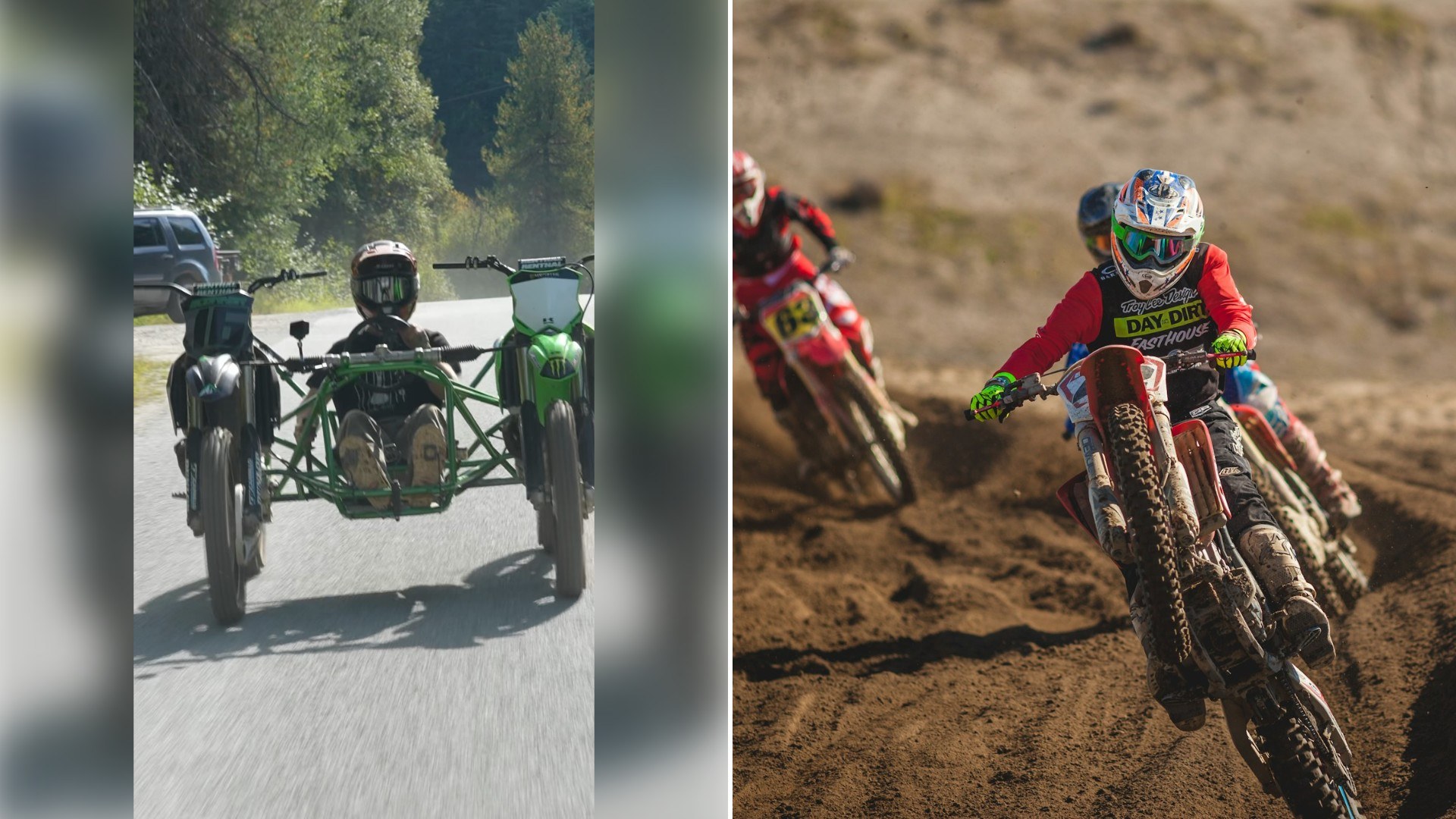
Two dirt bikes, one green frame and a seat slung in the middle. An 18-second reel shows the result leaving a gravel pull-off, running down a paved two-lane road and finishing on a dirt track between tall evergreens.
The clip comes from @grindhardplumbingco, whose caption reads, “The double bike looked absolutely ridiculous on the street. How did everyone enjoy the episode?” There is no text on screen and nothing in the reel explains the build, so the pictures have to do the talking.
The machine is easy to read once it rolls toward the camera. On one side is a dirt bike with bright green plastics and a white number plate. On the other is a darker bike with black bodywork. Both stand upright, and each still has its own front wheel, fork and handlebars. Between them runs a cage of green tubing that ties the two together, which makes four wheels in all.
The person at the controls is not on either saddle. He sits inside that green cage, low and reclined, with his knees up and his feet pointing forward between the two front wheels. He wears a helmet and goggles, and his head comes up to about the height of the handlebars on either side of him.
The opening shots are on pale gravel under trees, where the double bike pulls away and lifts a little dust. Then it is on asphalt. A parked SUV slides past in the background, and the camera, shooting from a vehicle in front, holds the machine close enough to fill the frame before pulling ahead. From there it shrinks to a small, square shape on a country road with a double yellow line, utility poles, grass verges and a row of roadside mailboxes.
The angle changes for the second half. The camera sweeps in beside the machine, so close that one frame is nothing but a front tyre, a fork leg and a brake disc. The surface under it is dirt again. The last few seconds are filmed from the lead vehicle on a straight forest track, with the silver bodywork and a door mirror of the camera car in the corner of the shot, as the double bike drops back into the distance under a blue sky.
In every frame, the two bikes stand level with each other and the driver stays tucked in the same position. No bystanders are visible anywhere in the clip. The verdict that it “looked absolutely ridiculous on the street” is the creator’s own.
The reel is just as clear about what it leaves out. It does not show how the two front ends are steered, whether both engines are running, or how the throttle and brakes are worked from the centre seat. The caption’s question about “the episode” points to a longer video for those answers. This clip is the road test and nothing more.
Even so, a few practical things come through for anyone who builds unusual machines or just likes watching them.
The first is width. Two motorcycles side by side with a seat between them take up far more road than one, and on the paved stretch the double bike fills a good part of its lane. A builder used to threading a single bike through gaps has to drive something like this as a small car.
The second is height. The centre seat puts the driver well below where a motorcyclist’s head would be. That lowers his view of the road and makes him harder for other drivers to pick out. In this clip there is a vehicle running ahead of the double bike for the whole road section, which is a sensible way to take any low, odd machine onto a public road for the first time.
The third is gear. The driver sits in an open frame with a spinning wheel close to each side of him and nothing overhead. The helmet and goggles he wears for an 18-second clip are the minimum worth copying.
The fourth is paperwork, which the reel does not touch. A vehicle assembled from two motorcycles does not match any factory model, and the rules for registering, lighting and insuring a homemade vehicle differ from place to place. Anyone planning a road run in their own creation should check those rules with the local licensing office before the fabrication starts, not after.
The last is about filming. In 18 seconds the clip uses a roadside view, a lead vehicle looking back and a close pass from the side. Those moving shots show how the machine sits and tracks at speed in a way a parked walk-around never could, and they are the reason the build reads so clearly without one word of explanation.
The caption ends by asking viewers how they enjoyed the episode. On the evidence of this clip, the double bike’s first job was simply to make it down the road in one piece, and it does.