

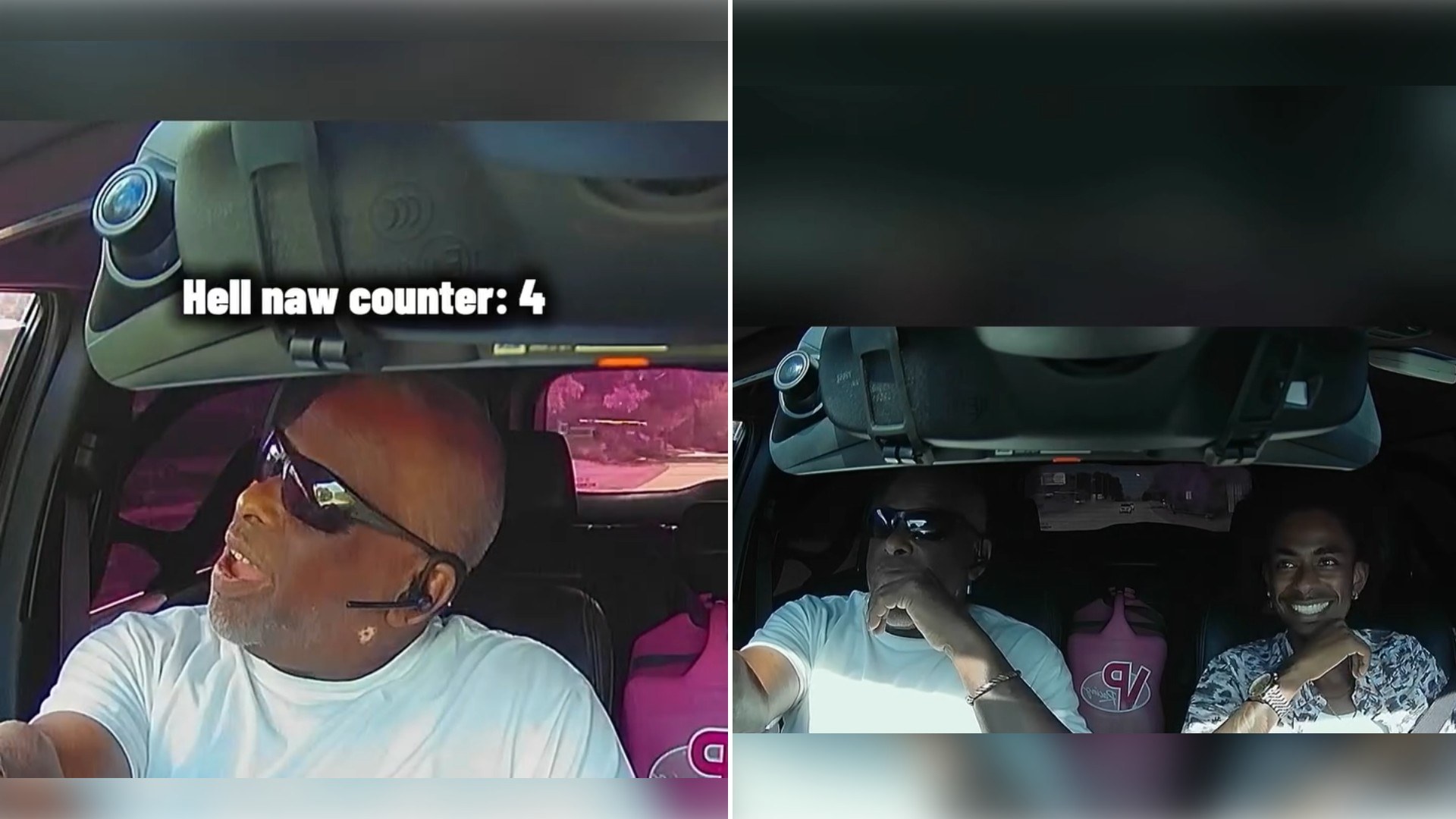
A grandfather in a white T-shirt and dark sunglasses sits behind the wheel of his grandson’s heavily modified Jeep, and for a minute and 45 seconds the main thing viewers learn about the drive is how many times he says no. The clip, posted by @kcreload, opens with a single line of text across the screen: “Grandad drives my 865whp Trackhawk.”
The creator rides in the passenger seat in a patterned short-sleeve shirt, seat belt on, and spends most of the video laughing. A two-way dash camera does the filming. In the opening seconds the screen is split, with the cabin view on top and the forward view below showing a sunny residential street lined with trees, lawns and houses. After that the edit stays inside the car, on the two of them.
Then the running joke starts. About 20 seconds in, white text appears at the top of the frame: “Hell naw counter: 1.” Two seconds later it reads 3. Then 4. By the 33-second mark it is at 6, and a few seconds after that, 7. For several of these the edit punches in tight on the grandfather’s face, close enough to show the wireless earpiece hooked over his ear and his mouth open in the middle of a sentence.
The reel carries no subtitles, so the only words it puts on screen are the title line and the tally. The video never spells out which question each “hell naw” is answering. What the frames do show is the body language that goes with it. The grandfather turns toward the passenger seat, lifts a hand off the wheel to gesture, points, and at one moment raises his arm toward the roof. His grandson doubles over, presses a fist to his mouth, and leans across the cabin laughing.
The counter keeps going. It reads 8 just before the one-minute mark, 11 and then 12 around 1:12, 13 at 1:32 and 14 a second later, the highest number that appears. That works out to a fresh refusal roughly every five seconds from the moment the count begins. In the closing seconds the grandson’s hand comes up in front of the lens, and the clip ends with both men still in their seats and the grandfather still driving.
The dash camera stamps its own data along the bottom of the picture, and the close-ups make some of it legible. The clock reads a little after 3:30 in the afternoon. The speed readout shows 33 mph in one close-up and 14 mph in another. Those are neighborhood speeds on a neighborhood street, which fits everything else in the frame: no highway, no drag strip, no launch, just a slow lap past front yards with a man who has plenty to say about the vehicle he has been handed.
The caption adds one more fact and nothing else. “Built by @palmerperform,” the creator writes, followed by hashtags that include #srt and #racecar. He offers no spec list and no explanation of the drive, and he leaves the counter to tell the story.
That “whp” in the title matters for anyone trying to size up the number. It stands for wheel horsepower, the figure measured at the tires on a dynamometer after the transmission, transfer case and axles have taken their share. It is always lower than the engine figure quoted in a brochure. The Jeep Grand Cherokee Trackhawk left the factory with a supercharged 6.2-liter V8 rated at 707 horsepower at the engine, so a Trackhawk putting 865 to the wheels has been pushed a long way past stock. When a seller or a builder quotes a power figure, the first question to ask is which of the two measurements it is.
The clip is also a decent template for anyone who wants to let a relative try a modified vehicle. The owner stays in the passenger seat. The route is a quiet residential street in daylight. The passenger’s seat belt is on. And the person holding the wheel sets the pace, which here means 14 clear answers and a grandson who laughs at every one of them instead of pushing for a different result. A car with far more power than the driver is used to is still under the control of whoever has their foot on the pedal, and the fastest way to ruin a drive like this one is to pressure someone into using more of it than they want.
The camera setup deserves a note too. A dual-channel dash cam records the road and the cabin at the same time and prints the time and speed on the footage. In this reel that turns a two-minute family drive into something worth posting. On an ordinary day the same recording is a plain record of where a vehicle was, how fast it was moving and who was driving, which is useful to have long before anyone thinks about adding a counter to it.
For this creator, the payoff was simpler. He got his grandad into the driver’s seat of his 865-wheel-horsepower Trackhawk, kept the camera rolling, and counted.