

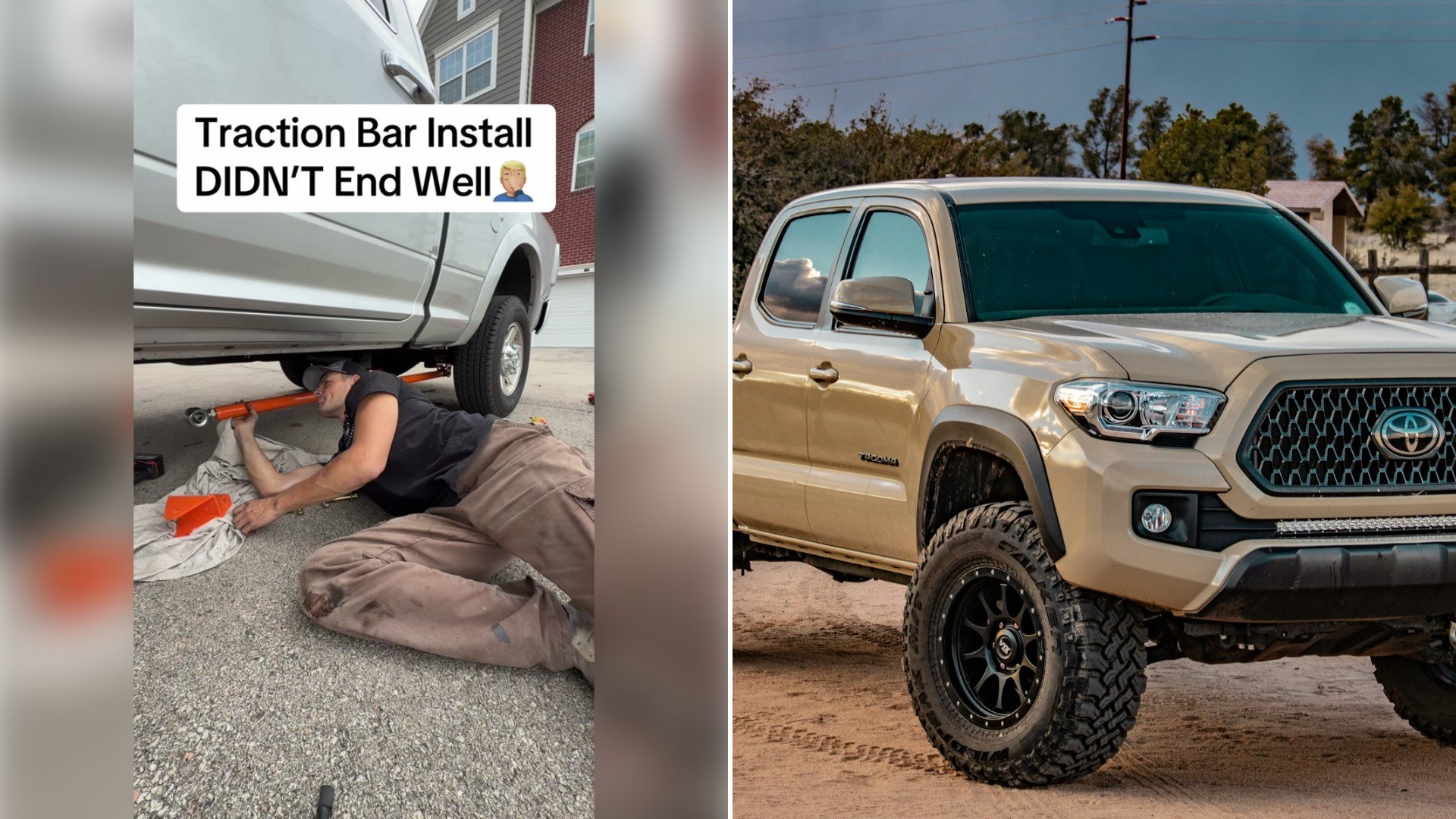
The video starts at the end. A man in a trucker hat is lying on his side on the pavement, reaching under a silver Ram pickup with a bright orange steel bar beside him, and the text on the screen reads “Traction Bar Install DIDN’T End Well.” The first thing he says is the result: “And now I got a bunch of holes in my frame that I have no idea what I’m gonna do with.” His fingers point up at two fresh round holes in the underside of the frame rail.
Then the clip from @zac.lucarz rewinds to how the day began, which was a lot more cheerful. “Today we’re installing some actual traction bars,” he says, holding a length of white plastic pipe up in front of the truck. “And no, these are not made out of PVC.”
@zac.lucarz Anyone know how to patch holes in a frame #truckbuild #truckmods #projecttruck #dieseltruck #carmaintenancetiktokcontest
In the garage he is grinning, with a long orange bar held across his body. “Went ahead and got myself some real traction bars this time,” he says. “And the best part is, these are completely bolt on. So let’s get to installing them.”
The first half of the job goes the way that sentence promised. The axle brackets go on. He holds the hardware for the ends of the bars up to the camera and narrates it with the honesty of someone learning as he goes: “Now time to install our bushing, slash, joint, slash, whatever these are.” With the bar “completely prepped,” he carries it out to the truck to “loosely mount it up,” and admits the catch of working solo. “The fun part is trying to mount this traction bar alone,” he says. A shot from under the truck shows the orange bracket on the rear axle with the end of the bar sitting in it and a cordless impact wrench lying in the gravel. He gets “this bolt all the way through,” and the axle end is done.
The frame end is where the tone changes. “It is time to install our frame bracket,” he says. “Nervous to install these, I gotta use this rivetnut tool, and I have never used a rivetnut tool in my life.” He is crouched on the garage floor over an open kit case, holding a long-handled setting tool with orange grips.
Out at the truck, the orange frame bracket sits on a rag under the frame rail, waiting. “Here goes nothing with the Rivnut tool,” he says. “I have never used this, and it seems like an extremely tight spot for my first try. So let’s see how this goes.” The camera watches him crouch at the side of the truck and work the handles up under the body. The next words are “Ugh. Okay,” followed by the line that sums up a lot of first attempts: “This is not as easy as the tutorial showed.”
The video then cuts to him sitting on the ground beside the truck with the tool still in his hands and a cordless drill by his feet. “I am not afraid to share my wins and losses on these projects with you guys,” he says. “Chalk this one up as a total L.” He explains that he cannot figure out how to get the rivets in with that tool “in this super tight space.” The camera goes back under the truck to the two holes, and he repeats the line from the opening. His plan, for now, is to “go back to the drawing board and figure out how to get these traction bars on the right way.”
The caption turns the problem over to his audience: “Anyone know how to patch holes in a frame.”
For anyone who has not installed a set, traction bars link the rear axle to the frame so the axle housing cannot twist against the leaf springs when the truck puts power down. That twist is called axle wrap, and it is a common complaint on trucks that make a lot of torque. His hashtags describe this one as a diesel project truck.
The lesson in his video is about the words “bolt on.” On this kit the axle side really did bolt on. The frame side needed threaded inserts set into the frame rail, which meant putting holes in the frame first and then using a tool he had never picked up before. A kit can be bolt on and still ask for drilling, so it pays to read the instructions through to the last step before the first bolt comes out, and to look for the one step that calls for a tool or a skill that is new.
A rivet nut is a threaded sleeve that slides into a hole from one side. The setting tool threads into it and pulls, and the sleeve collapses behind the metal and grips, leaving a permanent thread to bolt into. Installers use them where there is no way to get a hand or a wrench behind the panel to hold an ordinary nut. A long-handled tool like the one in the video has to sit square to the hole and needs room for its handles to open and close, and that is the room he says he did not have.
Two habits would have changed how his afternoon went. The first is to set a few inserts in a scrap piece of steel on the bench before touching the truck, so the feel of a properly set rivet nut is familiar. The second is to hold the tool up to the exact spot on the frame before making any holes, to find out whether it fits. If it does not, there are ways to set a rivet nut with a bolt, a nut and a wrench instead of a lever tool, and they need far less space.
As for the holes, they are where the bracket is meant to mount, so the first question is whether they can still do that job once he finds a way to set the inserts. Filling or welding anything on a frame rail is work to run past the kit’s maker or a frame shop before picking up a welder. He has not given up on the bars, and by posting the loss alongside the wins he has given the next person with the same kit a clear look at the step to plan for.