

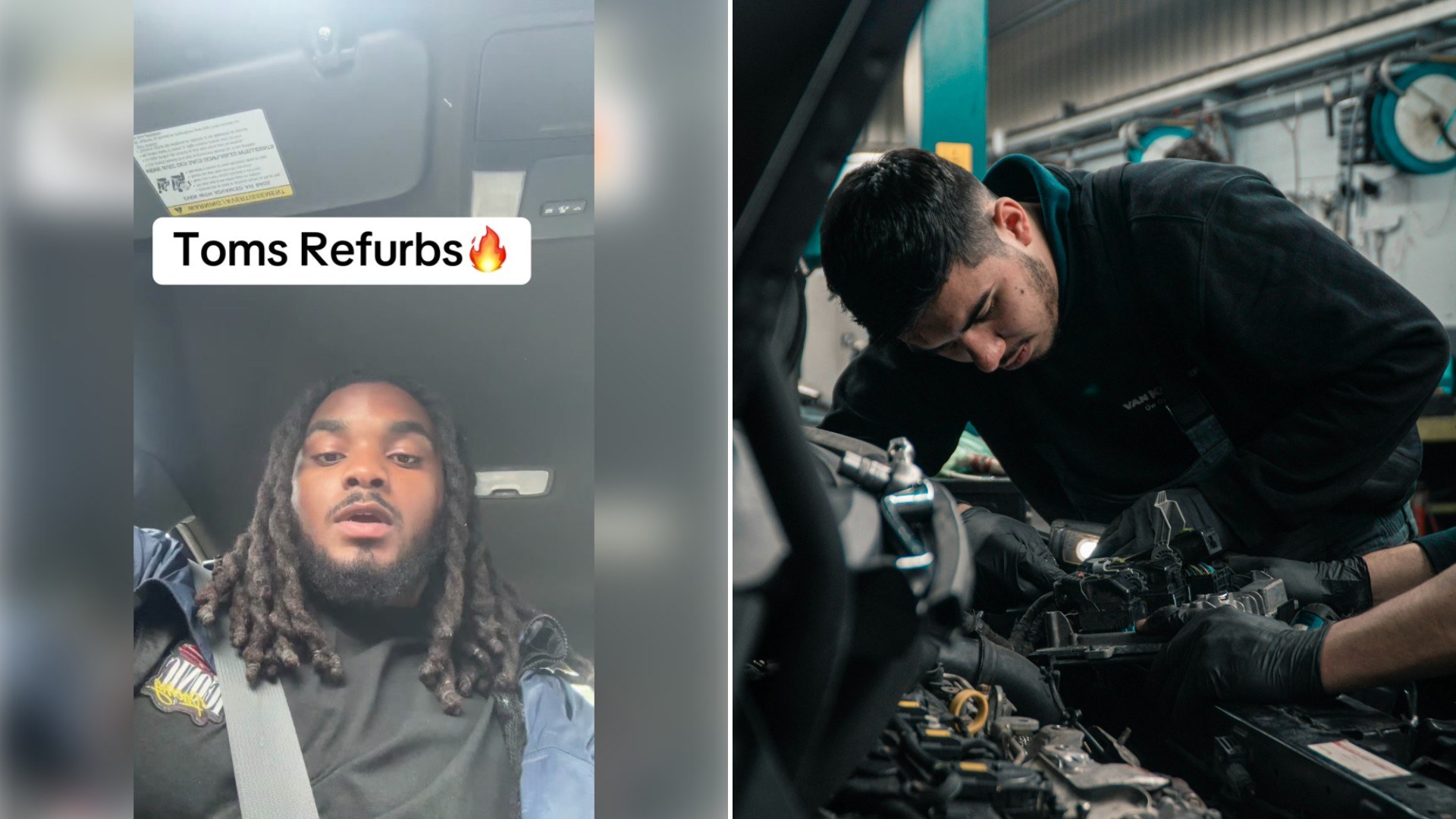
The video from @rituald is 26 seconds long and a single take. He is sitting in a car with his seat belt on, holding the phone low so the camera looks up past his face to the sun visor and the roof lining. A white label sits across the top of the frame for the whole clip. It reads “Toms Refurbs” with a flame emoji after it.
His first line explains the label. “Nobody has never made me want to work on an old car more than” the name on the screen, he says, with a swear word dropped in for emphasis. The caption says the same thing in three words: “I’ve been inspired,” followed by a crying emoji and the tags #car and #tomsrefurb.
@rituald
There is no footage of a car being worked on. The clip is one man in his seat describing, from memory and with obvious affection, how the person he admires goes about bringing an old car back.
The way he tells it, the recipe is short. First, the man is “gonna put a new carburetor” on the car. Then come “some more brakes.” After that, “he might change the fluids in there.” He delivers each item with a pause, looking up and away from the lens and then back down at it, as if ticking them off.
Then the list is over and the fun starts. “And he down the road shifting the hell out of it,” he says, “doing burnouts.” He adds, less politely, that the man does not care in the slightest. The last step in his telling is a set of mufflers going on the car, “and he out of there.”
That is the whole video. He does not name a particular car, a particular job or a place. What he gets across is the appeal of the approach: a car that has been sitting gets fuel, brakes and fluids sorted, and then it gets driven hard and enjoyed instead of being fussed over for years. For him, seeing it done that way is what made working on an old car feel like something he would want to do.
The order he recites happens to be a sound one for anyone thinking about a first project.
Fuel comes first because it is usually what stops an old car from running. Gasoline left in a carburetor for years turns to varnish and blocks the small passages inside it. A new or rebuilt carburetor fixes that, but only if the rest of the system is dealt with as well. Drain the stale fuel from the tank, fit a new fuel filter and replace any rubber fuel hose that has gone hard or cracked.
Brakes come before the first drive, not after it. A car that has sat can have seized wheel cylinders or calipers, perished rubber hoses and brake fluid that has taken on moisture. Go through all of it and make sure the pedal is firm before the car moves under its own power. An engine that will not start is an inconvenience. Brakes that do not work are a danger.
Fluids are cheap and tell you a lot. Change the engine oil and filter, and look at what comes out. Milky oil points to coolant getting where it should not be. Check the coolant, the transmission fluid and the differential oil too, and top up or replace them before asking the car to work.
A few things are missing from his list that belong on yours. Tires that have sat for years can look fine and still be unsafe, so check their age and their sidewalls before any drive, and certainly before any burnout. Belts and coolant hoses harden with time. A battery that has been flat for a long while will probably need replacing.
As for the burnouts, they are a big part of why he enjoys the idea, and they belong somewhere off the public road. A freshly revived car is also still proving itself. A few gentle miles close to home will show up leaks and loose ends before the hard driving starts.
If the clip leaves you feeling the way he does, start small. An older car with a carburetor and a simple ignition system is easier to learn on than a modern one, and parts for common models are easy to find. Buy the workshop manual for it. Take on one system at a time, in the order he gives: fuel, brakes, fluids. Then go for a drive.