

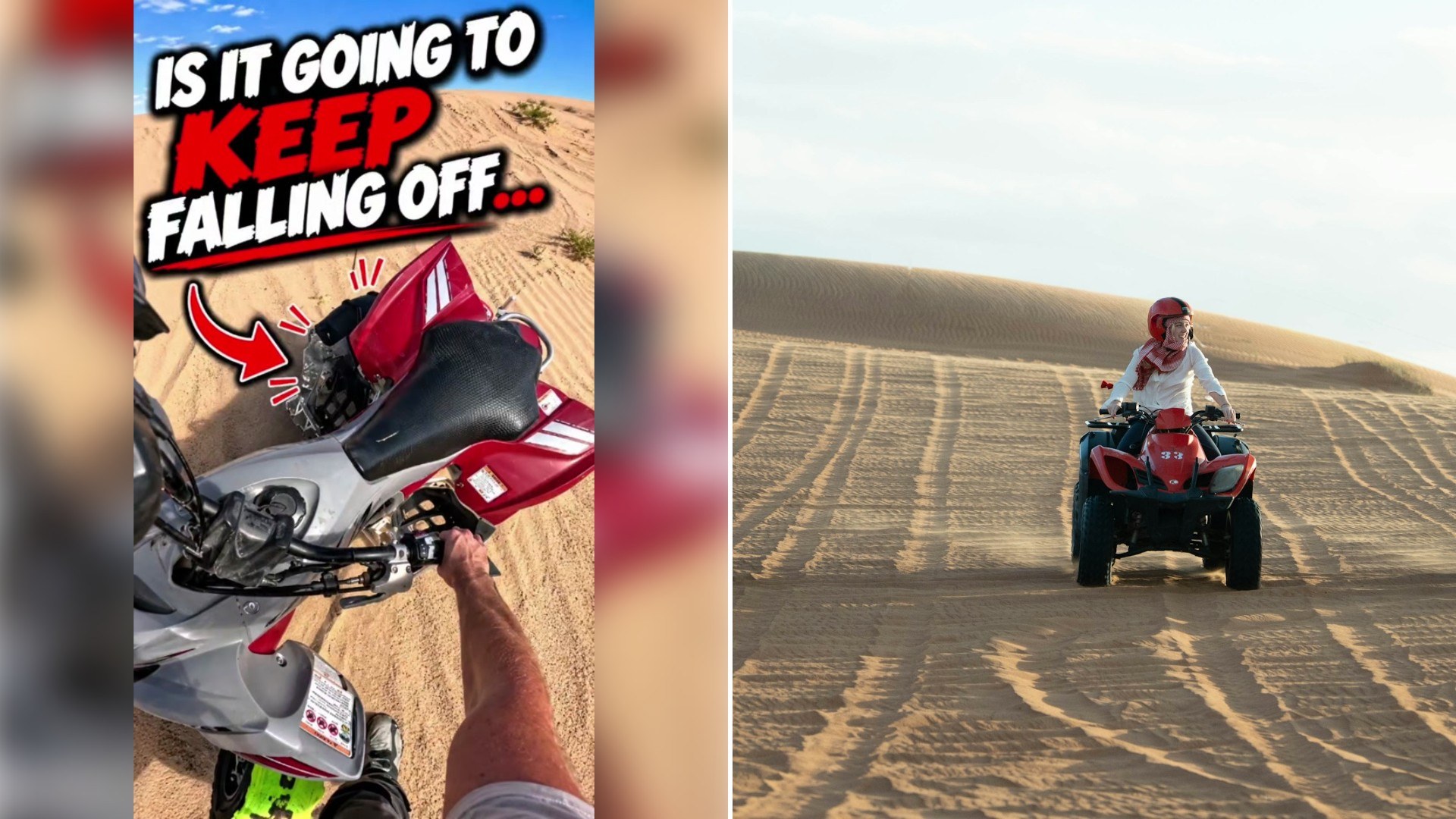
The video starts with @sircraze on the side of a sand dune, working out that one of the wheels is no longer attached to his quad. “What the freak?” he says. “Not again. Dude, the tire just fell off again.” He does not treat it as a one-off, either. “This freaking happens every time I’m at the dunes, dude.”
His caption sums it up as “Dislocated tire at the dunes, heres what I did,” and the text pinned to the screen reads “Hope this holds…” The camera looks down over the handlebars from the rider’s point of view, with a long sandy slope, scrub brush and a faint trail far below. The wheel is not the only casualty. “Freaking flag just busted off too,” he says. “This is just not my day.”
@sircraze
Before he can fix anything, he has to get a quad with a missing wheel off a steep face. “Guess the first thing I need to do is get it down there where it’s flat so I can repair it,” he says. His approach is to move to the front of the machine. That, he explains, keeps the weight off the back hub and pulls it out of the sand, which he hopes will keep sand from getting in there “and grinding stuff out.” He makes sure the quad is in gear, tells viewers to hold the front brakes and climbs on. “This is a steep hill,” he says. “Make sure you got a good grip. Pull on the clutch.”
It does not go to plan. “Oh man, this is sketchy,” he says, and a few seconds later, “That didn’t work, did it?” He tries pulling the quad down the slope to straighten it out and offers the understatement of the video: “Man, it’s hard to drive these things without a tire.” After another attempt he gives up on using power at all. “Well, I guess we’re going without the engine now.” Then, finally: “That might be all we get. Should be flat enough now.”
With the quad on level sand, the tools come out. “I’m usually packing around quite a bit of tools just for this,” he says. On this ride he has an impact, which he says he usually never carries, and what he calls “my sweet heavy duty jack.” The jack goes under the quad and lifts it. “You just never know what you’re gonna run into out here,” he says. “So it’s always good to be prepared.”
He goes to fetch the wheel. “Luckily this time the tire didn’t go too far.” It has not come through unharmed, though. “Look at that,” he says of the damage. “That’s not good.” The bigger problem is the hardware that used to hold it on. “I wasn’t able to find the nuts up there anywhere,” he says. “So lucky for me, I’m always packing an extra set of nuts. Cause these dunes are huge.”
That is the advice he presses hardest. “I highly recommend packing an extra set of nuts with you.” He adds that it is probably not necessary, but he thinks it helps to put a washer on with each nut. For the tool, he says, “14 millimeter seems to be really common size,” and he carries one because it works on quite a few areas of the quad, “especially the wheels.” He snugs the nuts up, warns against over tightening them, lowers the quad and pulls the jack out. His last tip has nothing to do with the wheel. It is hot out, he says, so he always packs something to cool himself off when the work is done.
The video ends there. “Hope this holds…” is as far as he goes on whether the repair lasted the rest of the day.
The kit he describes is small enough for anyone who rides sand to copy: a spare set of wheel nuts that fit your machine, a socket in the matching size, a few washers and a compact jack. None of it is heavy or expensive, and his own experience shows why the spare nuts matter. Once a nut comes off on a dune it is gone, and without replacements the wheel is not going back on no matter how good the rest of the toolkit is.
The line worth sitting with is the one he opens on, that this happens every time he is at the dunes. A wheel that keeps coming off is a sign that the nuts are backing off as he rides, and the simple habit that catches it is checking them before the first run and again at every stop. The owner’s manual gives a torque figure for wheel nuts, and using it is better than guessing, since he makes the point himself that too tight is its own problem. After a wheel has come off once, the studs and the holes in the wheel deserve a close look before the next trip, because damaged threads or chewed-up holes will not hold a nut the way they should.
His word for moving the quad down the hill was “sketchy,” and it is the part of the video to be most careful about copying. Taking weight off the damaged corner made sense for protecting the hub, but a machine with a missing wheel on a steep slope can get away from one person. A second set of hands makes that job far safer, which is one more reason to ride the dunes with someone else.
The broken flag deserves a fix before the next ride too. On dunes, a whip flag is how other riders see a quad that is just over a crest, and a rider stopped on a hillside with a wheel off is exactly who needs to be seen.