

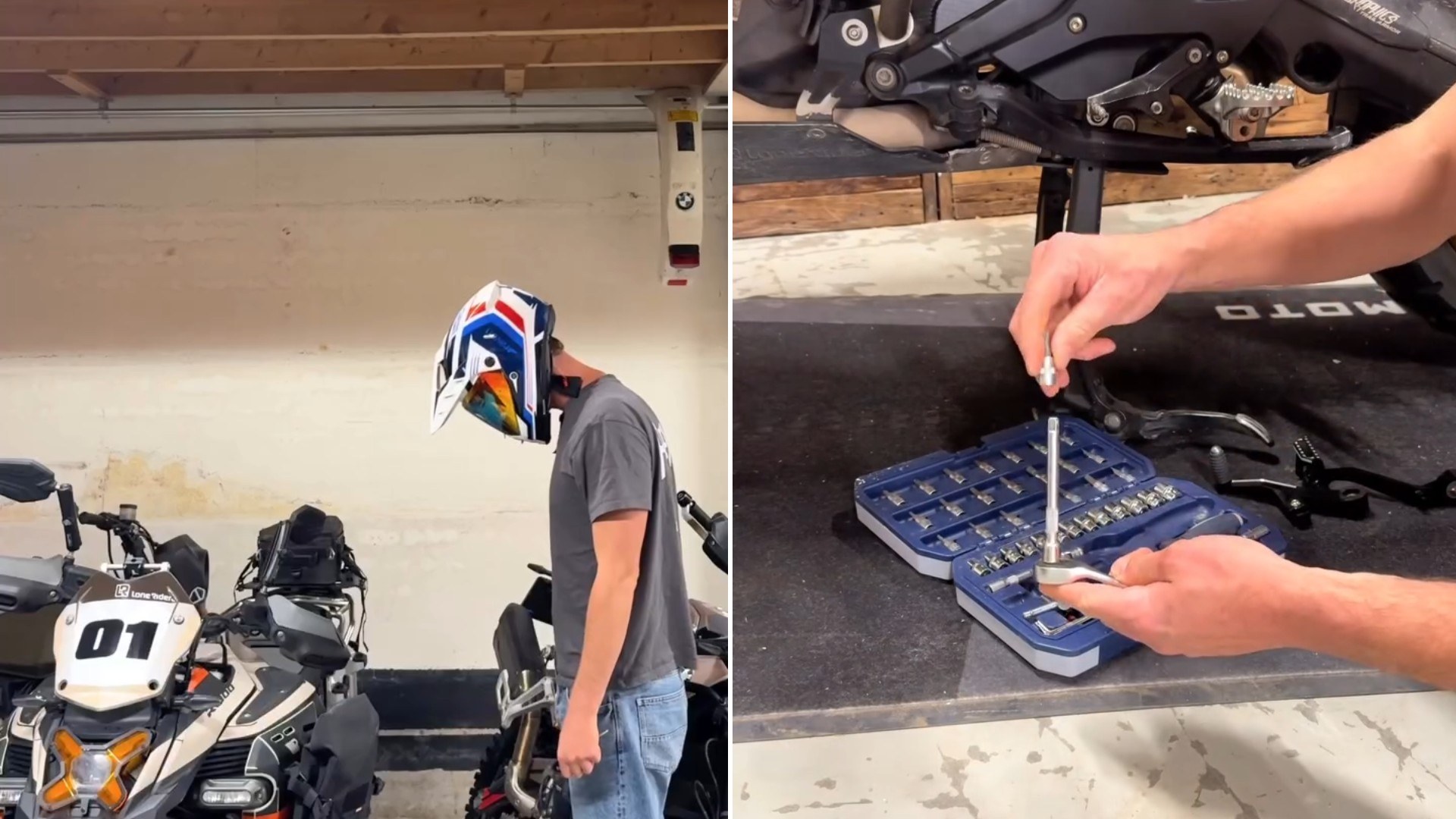
The whole story is in the caption @remy_gsa_rally wrote under the reel: “Bend my gear-lever, repaired it, but ending up replacing for the best riding!” The clip runs 33 seconds and shows all three stages in order, from a bent lever on a filthy bike to a new one on a clean bike.
It opens low on the left side of the motorcycle. The footpeg is packed with dried mud and has a clump of grass hanging from its teeth, the underside of the bike is caked in dirt, and the gear lever is plainly bent out of position. A hand comes into frame with a long silver socket, slides it over the tip of the lever and uses the length of the tool as a handle to pull the lever back toward where it belongs.
View this post on Instagram
The next shot pulls back to show the rider standing beside the bike outdoors, still wearing a motocross-style helmet and goggles with a plaid shirt, looking down at something small in both hands. Then the camera goes back to the lever, where the pivot is being worked on with a wrench and a pair of red-handled pliers while the mud is still on the bike.
That is the repair. The replacement happens in a garage, and the difference is obvious straight away because the bike has been washed. The rider, now in a gray T-shirt with “Raven” across the back, jeans and a different helmet, stands with hands on hips between two adventure bikes, one of them wearing a 01 number plate. A new lever sits in its packaging on the floor mat next to the bike. A blue case of driver bits is opened on the mat and a bit is picked out and fitted to a handle. Then, wearing black gloves, the rider takes the old lever off and bolts the new one on. The reel ends with the same hands-on-hips pose, helmet still on.
The caption fills in the kit with a running joke. “Helmet: raven. Lightweight only!” it reads. “Tools: Proworks Lightweight only!” And then the bike: “bmw r1300gs adventures light weight only?” followed by a sweating smile emoji, a nod to the fact that a big adventure bike is the one item on the list nobody would call light.
The reel does not show how the lever got bent, though the mud and grass packed into the footpeg make it clear the bike had been ridden off pavement. What it does show is a sensible order of operations that any rider can borrow.
The first step is the get-home fix. A gear lever is a thin arm that sticks out from the side of the bike, and when it bends it can end up too close to the engine case or the peg to shift properly. Sliding a tube or a long socket over the end, as the rider does here, gives far more control than pulling on the lever by hand, and it lets the bend come out slowly. Slow matters, because metal that has been bent and then bent back is weaker than it was, and forcing it can snap it.
The second step is the one the caption is really about. The lever was repaired, but the rider replaced it anyway “for the best riding.” A straightened lever rarely goes back to exactly its original shape, and a small change in where the tip sits is something a rider feels on every shift. Treating the straightened lever as temporary and fitting a new one once the bike is home is the cautious choice, and it removes the question of whether the old one will hold the next time it takes a knock.
The video also makes a case for doing the job on a clean bike. The first attempt happens with dirt all over the pivot. The replacement happens after a wash, on a mat, with the bits laid out in a case and gloves on. Grit around a pivot bolt gets into threads and bushings, so a few minutes with a hose before picking up tools is time well spent.
A few habits follow from all this. Know which bit or socket fits the gear lever bolt on your bike and keep it in the kit that travels with you. On longer trips away from pavement, a spare lever is small and light enough to earn its place in a bag. After fitting a new one, sit on the bike in riding boots and check that the tip sits where your foot expects it, tighten the bolt to the figure in the owner’s manual, and click through the gears before riding off.
Finally, a bent lever is a reason to look over the rest of that side of the bike. Whatever bent it may also have reached the footpeg, the side stand or the bodywork, and those are easier to check in the garage than to discover on the next ride.