

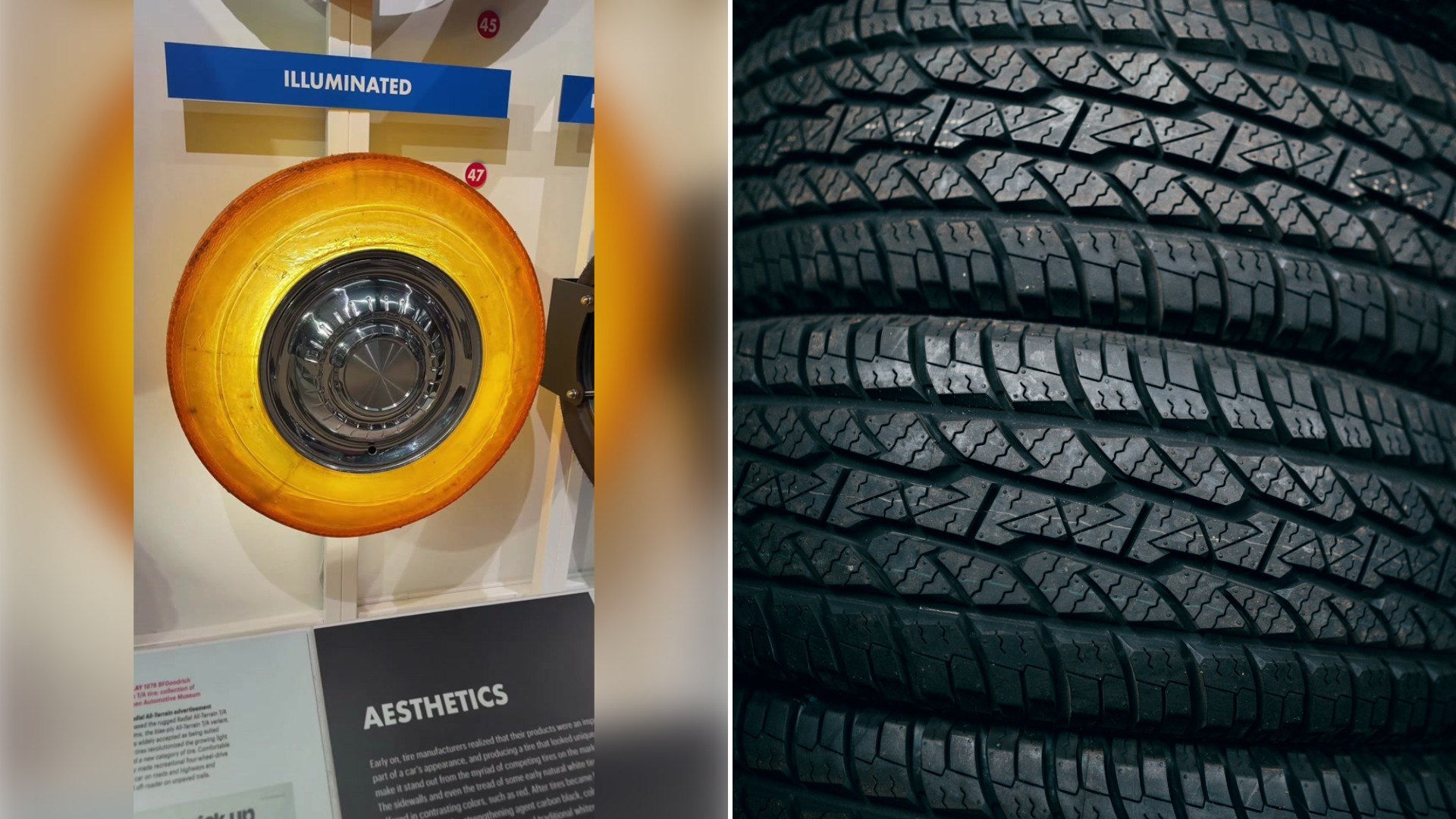
The first thing in the frame is a tire the color of amber, mounted on a white wall under a blue sign that reads “Illuminated.” It is translucent, wrapped around a chrome hubcap, and the creator behind @carsandkeyspicy is clearly pleased to have found it. “It’s the actual original glowing tire,” he says as he moves the camera in close enough to show the tread.
He also knows why nobody is driving on them. “There was a problem with heat and distracting other drivers,” he says. Then he makes the case for a second try: “Though with LEDs today in the ambient lighting, we might need to return to this.” His caption puts it simply: “The illuminated Tire is one of the cooler” automotive innovations.
@carsandkeyspicyThe illuminated Tire is one of the cooler #Automotive #Innovation #CarsoftiktokContest
The tire gets about ten seconds. The rest of the one-minute video is a fast walk through the museum floor, and the car that holds his attention longest is a low, seafoam green coupe with “Plymouth” spelled out across its tail and a display plate reading Petersen Automotive Museum where the license plate would go.
“There is a world where America had this Plymouth instead of the Neon,” he says, walking up behind it. Around the front, the car has a tall grille made of thin vertical bars. On the fender, chrome letters spell out the name, and he reads it with some satisfaction. “This is a Plymouth Explorer. Instead we got the Ford Explorer.”
From there the video turns into a list of things he wants viewers to notice. The lettering comes first. “Is that cartoon font?” he asks, and later, at the back of the car, “I like this Plymouth fun font.” Then the trim. He puts a finger on the white spear that runs down the side of the body under the name. “Look how this white portion trim goes through this,” he says. “And these are parts of the side molding.”
The interior gets the same treatment. Through the open window the camera finds a wood-rimmed steering wheel with polished metal spokes, cream leather seats and a row of round gauges. “Look at how they did each individual circular dial and the magazine holder,” he says.
Behind the seats is the detail that stumps him. A panel of ribbed metal slats sits on the rear shelf under a pair of leather straps, and he cannot tell what it is for. “Do these open? Is that just design language or what are those?” he asks. “How often do you see articulated metal?”
At the tail he points out how low the car sits and one more piece of packaging: “the exhaust right below the tail lights.” The camera shows it, a red lens in a chrome housing with the exhaust outlet tucked directly underneath in the same surround.
The last few seconds belong to two red cars. On the first he goes straight to the paint. “There is gold specks in this paint,” he says, with the lens almost touching the fender. Then the nose: “Look at the grill and how the bumper goes around the headlights.” The chrome bumper loops around each headlight and frames an oval grille. The final shot is of another red car, which he identifies as “this DeSoto concept with this insert grill.”
What makes the video worth a minute is that nearly every line in it is an instruction for how to look at a car. He does not stand back and film whole vehicles. He reads the badge, follows one piece of trim from end to end, checks where the exhaust exits, looks at the gauges one by one and puts the camera close enough to the paint to see what is in it. Anyone heading to a car museum, or a local show, can use the same list: lettering, trim lines, dash, the back shelf, the tail and the paint from a few inches away. Those are the places where one-off cars differ most from anything on a dealer lot.
His questions are part of the method too. He does not know whether the slatted panel opens, and he says so. The placards beside the cars and the museum staff are there for exactly that kind of question, and a detail that prompts one is usually the detail worth reading up on afterward.
The tire carries its own practical point. He names the two reasons a glowing tire did not catch on, heat and the distraction to other drivers, and suggests modern LEDs might change the first of those. The second has not gone away. Lighting on a vehicle is regulated, and the rules on colors, placement and whether lights can be on while moving differ from state to state. That applies to wheel lights and underglow kits on motorcycles as much as on cars. Anyone tempted to bring the idea back on their own machine should read their state’s equipment rules before buying a kit.
The same goes for the question of distraction. Extra lighting that helps other road users see a bike or car from the side is one thing. Lighting that pulls a driver’s eyes away from the road is the problem he describes, and it is the reason the tire on the wall stayed in a museum.