

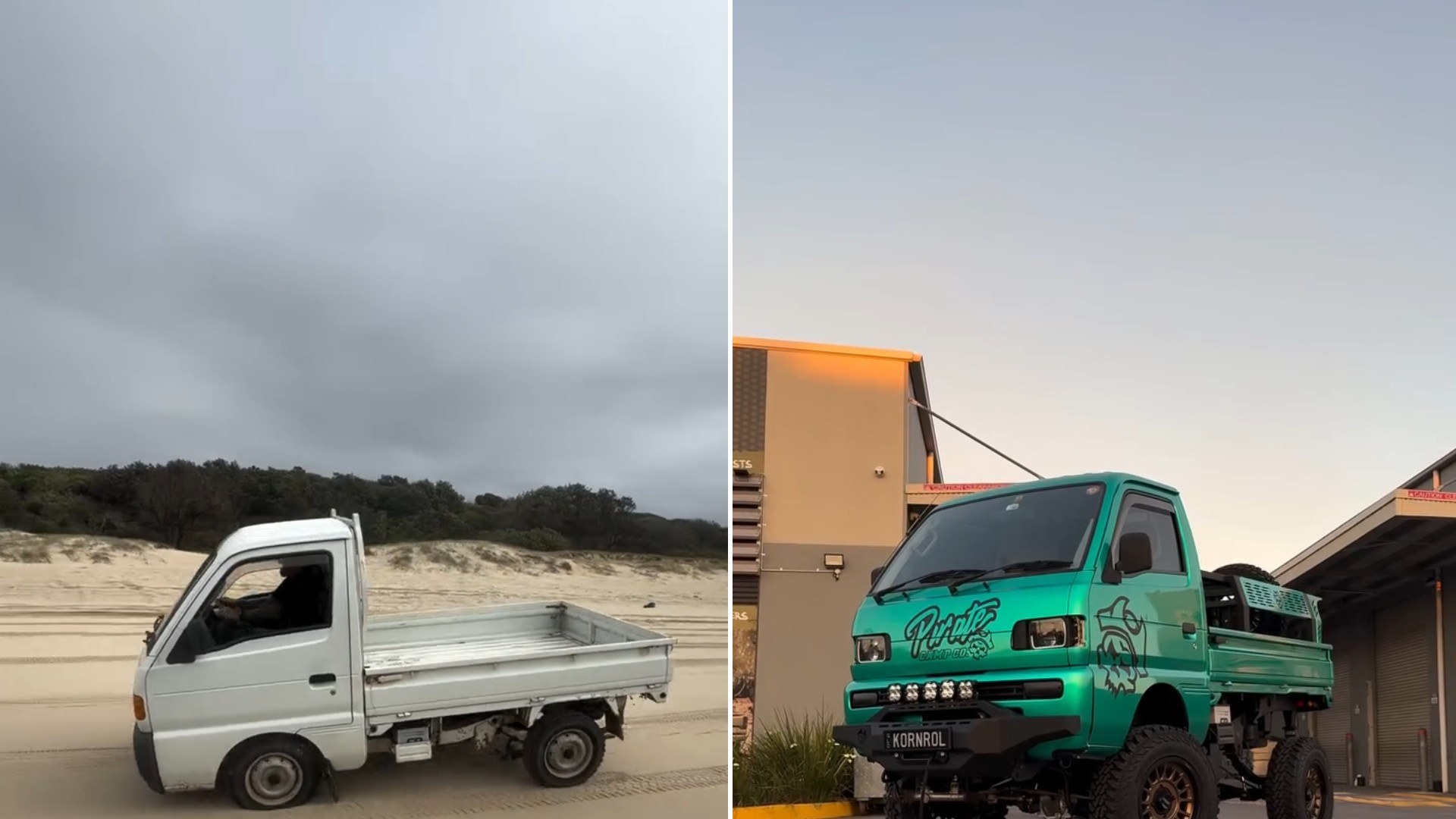
The reel from @piratecampco is 11 seconds long and has two lines of text. The first one sits over a small white kei truck driving across a beach: “OH LOOK ANOTHER KEI TRUCK BUILD.” It is written in quotation marks, as if the builder is reading a comment out loud before anyone has had the chance to type it.
For the first four seconds, the truck gives that comment nothing to argue with. It is plain white with a flat drop side tray, small road wheels and a driver visible through the side window. It rolls along the sand under a gray sky, swings into a wide turn toward the surf and leaves a curve of tire tracks behind it. It looks like the kind of little work truck the on screen text is tired of.
At the five second mark the text changes to one word, “Nevermind…” with a skull under it, and the beach is gone. The next six seconds are a run of quick shots from a workshop. A welder’s arc lights up a bare chassis that is already sitting on a tall, knobby off road tire, with a large Pirate logo painted on the wall behind it. A man with tattooed forearms leans in close with a welding torch. A cab painted bright teal sits with its front bumper off and a floor jack underneath, the same Pirate script and a skull graphic across its door.
Then the truck comes outside. One shot shows the teal cab on its chassis in a parking lot with no tray on the back yet, standing far taller than the white truck on the beach. Another is taken from ground level, looking up at the frame rails and the running gear underneath. A rear view at dusk shows the tray fitted and a full size spare tire standing upright on it. A close shot runs along the side of the tray, with a slotted rack panel along the top and a bronze colored wheel below.
The last two seconds hold on the finished truck from the front corner at sunset. It is teal with black graphics on the door and the nose, it has a steel bar across the front, and it sits high on off road tires far bigger than the wheels on the white truck. The caption does the gloating: “Not your average kei truck build… sorry to break it to you…”
That is all the reel says. There is no parts list, no voiceover and no price. The video never states in words that the white truck from the beach is the one under the teal paint. It is edited as a before and after, and the two lines of text carry the joke.
Short as it is, the workshop footage is the part worth slowing down for, because it shows what separates this truck from a kei truck with bigger wheels bolted on. Three things stand out.
First, there is welding on the chassis. Two of the shop shots show an arc on the frame and inside the cab area. A lift this tall on a truck this small is fabrication work. For anyone planning something similar, that means the job belongs with someone who welds structural steel for a living, and it means finding out what the local rules are before the first cut. Many places put limits on how far a vehicle can be lifted and how much larger than stock its tires can be, and some require an engineer to sign off on chassis changes before the truck can be registered again.
Second, the tires change everything downstream. Kei trucks are built to a Japanese class that caps engine size at 660cc, and the gearing, brakes and axles are sized for small wheels like the ones on the white truck. A much taller, heavier tire raises the effective gearing and asks more of the brakes and the driveline. A build that looks like the teal one needs those parts addressed along with the suspension.
Third, look at the order of the shots. The chassis work comes first, then the painted cab is set on it and rolled outside without the tray, then the tray, the rack and the spare go on. That is a sensible order for any big build: get the rolling chassis right, check how the cab sits on it, and fit the bodywork last.
The plain white truck on the beach has a lesson in it as well. A stock kei truck is light, and a light vehicle floats over soft sand better than a heavy one. Lowering tire pressure before driving onto a beach, and bringing a way to pump the tires back up afterward, does more for a small truck on sand than any lift.