

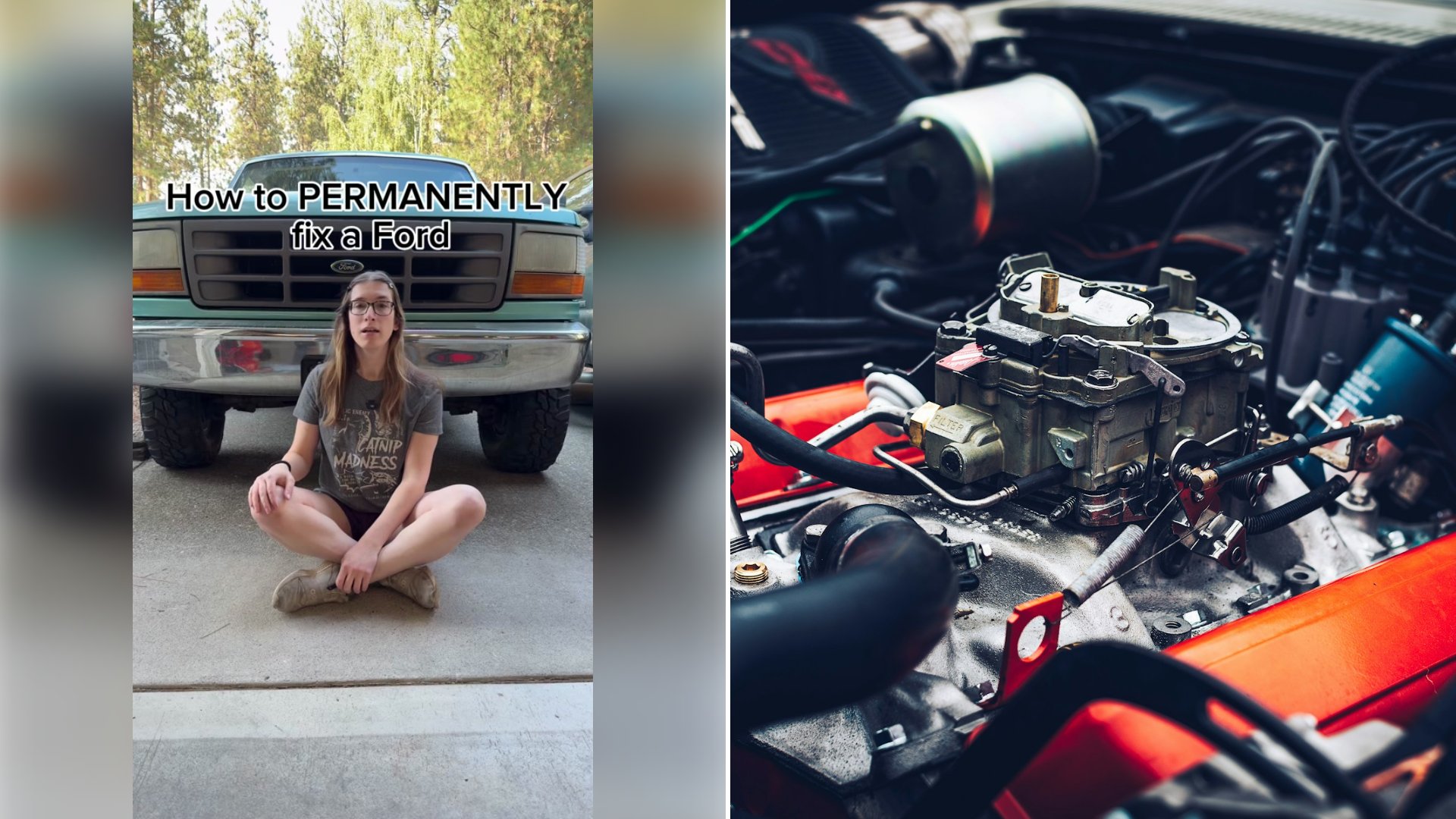
Dip a rag into the coolant reservoir of the Ford truck @cayleependerass bought for two grand, she says, and “it’s entirely filled with milky oil.” That is why a Powerstroke 4×4 came that cheap, and why she then spent what her caption counts as 50 to 60 hours with its engine in pieces.
The video opens with Caylee Harper, as her profile names her, sitting cross legged on the concrete in front of two Ford pickups, announcing she has “doubled the reliability of my old Ford truck with one single part. It’s a key to another old Ford truck.” Her math: “If this works half the time and this works half the time, I have one good truck.”
A Glove Over the Coolant Reservoir
“Normally that would mean a blown head gasket,” she says of the oil. Before accepting that, she runs a test that needs one glove: “If we put this glove over our coolant reservoir and turn the engine on,” she explains, it will show whether combustion gas is being pushed into the coolant. A glove that fills means it is. Her verdict: “I don’t see any air.”
Her reasoning from there: “Since we don’t have combustion gases getting into our coolant, that means the oil is getting into our coolant” some other way. On the 6.0, she says, “it’s usually the heat exchanger, which is an oil to water heat exchanger buried deep in the V of the block.” She calls that “still not an easy job,” but far cheaper than head gaskets.
Eight Hours to Reach One Seal
Partway into the teardown she declares it the worst engine she thinks she has ever worked on. Then the oil cooler is out: “It took every bit of 8 hours to get this out. But luckily I did find the problem.” On the oil cooler housing, she walks through the layout. “Coolant goes through here. Oil is back here. And if you look, that seal is completely blown.”
“Five hours of cleaning later,” she has the old parts clean and the new ones ready. Her list: a new turbo, gaskets, filters, a new fuel pressure regulator, an oil cooler, a new thermostat, “more gaskets” and a fuel injector control module.
“I skipped about 15 hours of work, but we are back together,” she says next. Everything is bolted on and there is no coolant in the system yet when she calls for the first crank, to make sure the new module, the new turbo and the new filters do not leak. “Okay, hit it.”
The last update comes “a week later, running it hot and hard.” The coolant tank holds a mix of Simple Green and distilled water. “Look at that residue,” she says, “but no oil.” Her caption puts the parts at $2,500 on top of the $2,000 purchase and ends, “I have another truck now so I count this as a win.”
Before You Pay $2,000 for a Truck With Oil in the Coolant
Run her two checks in the seller’s driveway, on a cold engine. Rag first: dip it in the coolant reservoir and look for a milky or brown film. Then the glove over the reservoir opening with the engine running. A glove that inflates points to combustion gas in the coolant, the head gasket answer and by her account the more expensive job. No air in the glove is the result she reports. Never open the reservoir on a hot engine, and if the glove leaves you unsure, ask a shop for a combustion gas test on the coolant before you buy.
Add up her real price. $2,000 for the truck plus $2,500 in parts is $4,500, plus 50 to 60 hours. The video accounts for eight of those hours getting the cooler out, five cleaning, and about 15 she skips past. If you would be paying a shop for that time, get a quote for this job on this engine before you make an offer.
Decide what else gets replaced while it is apart. The failed part was one seal. On the same teardown she fitted a turbo, a fuel pressure regulator, a thermostat, filters, a control module and a new cooler. If reaching a part takes eight hours, list what else sits under there and order it before you start, so the truck is not open in the driveway waiting on a delivery.
Crank it before you fill it. She had the engine cranked with the cooling system still empty to look for leaks at the new parts while they were easy to reach. Keep that to a short crank.
Flush, drive, then look again. Oil that has been through a cooling system stays on the inside of the tank and hoses. A week of hard running later, with a cleaner and distilled water mix in the tank, she checked: residue, no oil. Repeat the rag test at that point. Once it comes out clean, drain the flush mix and fill with the coolant the engine calls for.
More from Steel Horse Rides
- 6 Worst Diesel Engines That Mechanics Warn Everyone About
- 9 Repairs That Can Make Owners Wonder Whether the Car Is Even Worth Saving
- Truck Owner Trying to Install Bolt On Traction Bars Cannot Get the Rivet Nuts to Set in a Tight Spot and Ends Up With Holes in His Ram Frame That He Has No Idea How to Patch