

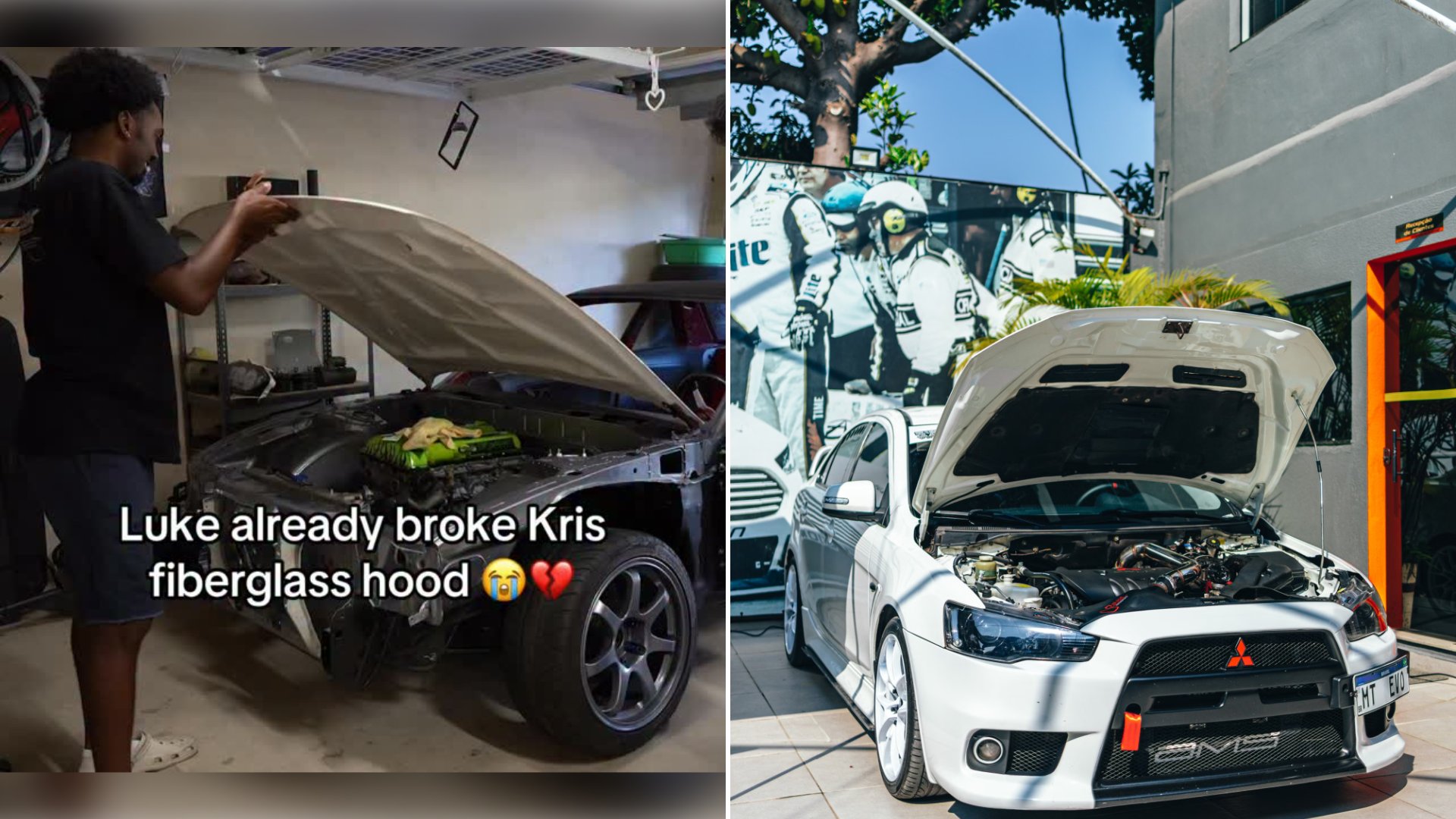
The white fiberglass hood is sitting on the car, and one of the crew is leaning in over the front of it. At about the eight second mark the on screen text flashes “*cracks*.” Earlier in the same clip, another man in the garage stands with a hand clamped over his face.
The 26 second clip comes from @kriswyche_, the Instagram account of YouTuber Kris Wyche, and the line across the screen for the whole video says a member of the crew “already broke Kris fiberglass hood.” The caption sums up the feeling: “Felt that sound in my soul,” with a pointer to his YouTube channel.
After the crack, the clip cuts to a bright flash effect, then back to the garage, where the crew gathers at the nose of the car. One man points at a spot along the front edge of the hood, and two of them crouch down together to look underneath at the area where the hood meets the front of the car. The clip ends there, still looking at the damage. It does not show how bad the break is or what the car is, and the full story is left to his YouTube video.
Several commenters zeroed in on the same thing. One wrote that if the hood broke that easily at the latch, wind at speed could lift it straight into the windshield, and another warned that a hood like this can fly off at highway speed if the latch mounts tear out. The most common advice was simply to “run hoodpins,” and Kris answered in the comments that he would run hood pins.
That advice matches what composite hood makers tell their own customers. Ford Performance’s installation sheet for an Anderson Composites carbon fiber hood sold for the 2018 Mustang Cobra Jet says the hood uses AeroCatch hood pins and has recessed pockets for them. The same sheet warns installers not to fit hood struts because the hood “may bow just forward of the strut mounting,” not to fully tighten the nuts during initial mounting, and that “an assistant is necessary for the installation of the hood.” It also says the hood is not to be installed on vehicles driven on public roads.
Fiberglass body damage can be repaired with materials sold for the purpose. 3M describes its Bondo Fiberglass Resin Repair Kit as a way to repair “cracked, broken or rusted automobile body components,” supplied with resin, hardener, cloth, a spreader and a mixing tray, and says it hardens to a sandable surface in less than two hours.
Fitting a Fiberglass Hood Without Hearing That Sound
Read the maker’s instructions before the hood comes out of the box, and check what fastening it expects. If the instructions call for hood pins, buy them with the hood rather than relying on the factory latch.
Use two people for the fit. The Ford Performance sheet asks for an assistant, and the crack in this clip came while one person was leaning over the front of the hood.
Do not lean on the hood to check gaps. Press gently at the strongest points and adjust the bolts and stops in small steps, leaving the nuts loose until the alignment is right.
Check the latch area and mounting points before every drive. Look for stress cracks around the latch, hinges and pin holes, because those are the spots the commenters warned could let go at speed.
If it does crack, stop and assess before driving. Photograph the damage, decide whether it is a cloth and resin repair or a new panel, and if the crack runs through a latch, hinge or pin mount, keep the car parked until that mount is fixed.
More from Steel Horse Rides
- Honda S2000 Owner Shows a Crunched Front Corner and Missing Bumper Under Video Game Style Price Tags Reading $13 and $1277 With a Caption That Says Fixing Ts Again
- Honda Builder With More Than 15 Years of Experience Launches His Car Channel by Showing the Engine Bay He Stripped and Repainted Before Taking Three Passengers for a Ride
- Owner Whose Garage Door Came Down on His Brand New Porsche 911 Hears a Body Shop Would Probably Charge Five Grand, Then Says a Driveway Repair Looks Like It Never Happened