

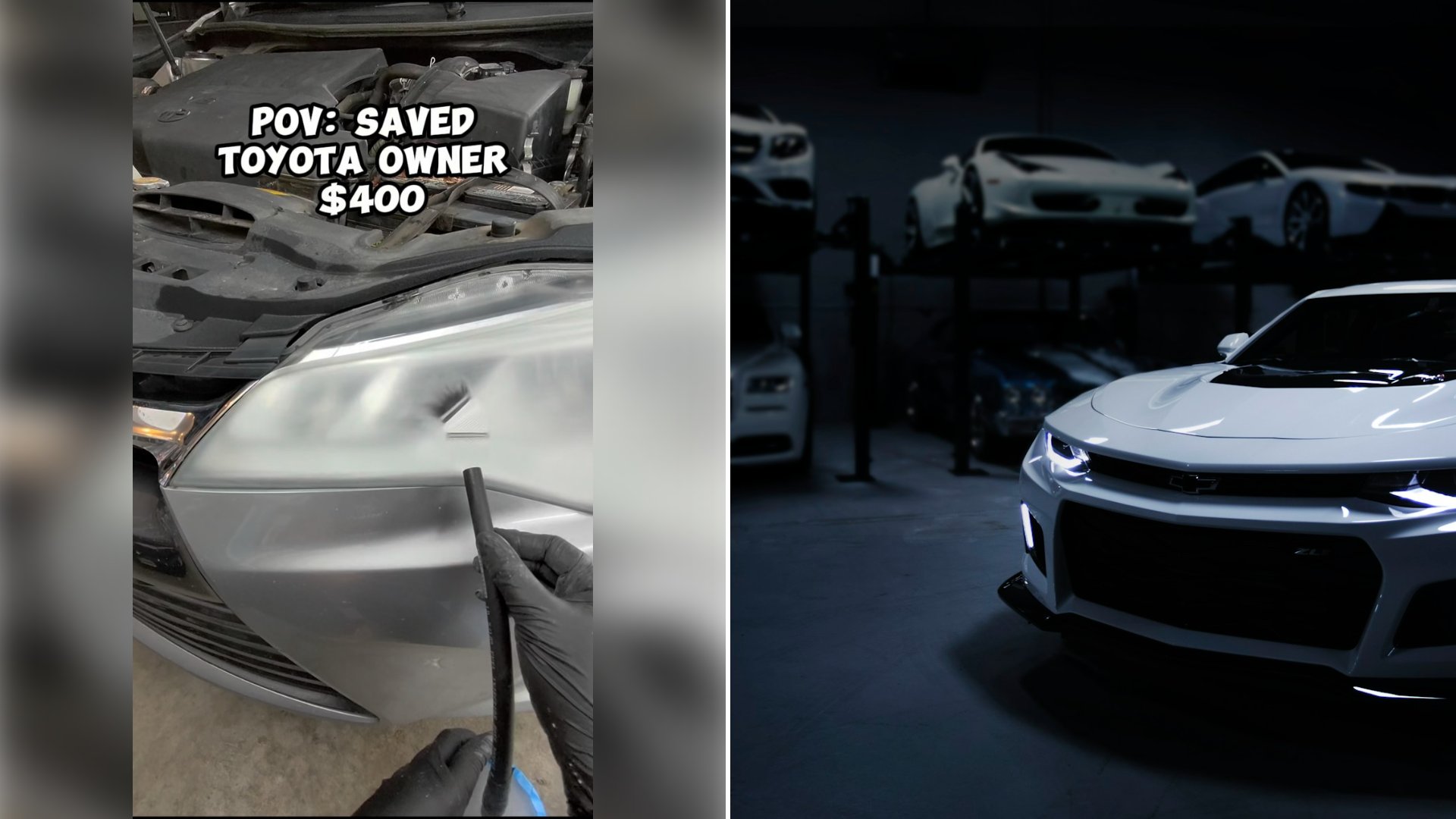
The lens on the silver Toyota is so cloudy that the reflector behind it is just a pale gray shape. He runs his bare palm across it, then lays strips of blue painter’s tape around the edges where the lens meets the paint and the grille, and goes at the plastic with a cordless sander and a yellow pad. The words over every shot read “POV: Saved Toyota owner $400.”
The reel comes from @brunosheadlightrestoration, a headlight restoration account, and it is filmed from his own point of view, his hands in the frame the whole time. The caption repeats the claim, “POV: Saved Toyota owner $400,” with the tag #headlightrestoration. It runs about a minute and a half.
The hood is propped open the whole time, and the car sits in a garage with the engine bay in view above the headlight. After the sanding, he reaches into an open case packed with bottles and supplies and, in black gloves, picks up a black wand on a hose.
The second half of the reel is that wand moving slowly back and forth a few inches from the lens. The change is gradual. At first the plastic is still milky across the top. By about the one minute mark the outer edge has gone glassy and the chrome trim inside the housing shows through. By the end the projector, the reflectors and the amber turn signal section are all sharp behind clear plastic, and the gray haze is gone from the whole lens.
The $400 figure is the creator’s own claim, in the caption and on screen. This article does not link to any product.
How Much Light a Restored Headlight Gives Back
The haze in the first shot is not only cosmetic. In testing published by AAA, clouded or yellowed headlights generated only 20 percent of the light that new headlights do.
The same AAA research found that professional and do it yourself restoration brought light output back to about 70 percent of new. Replacing the headlights with original equipment parts was the only method that restored output to 100 percent, and aftermarket replacements reached roughly 83 to 90 percent. AAA also found that restored lenses produced more glare than federal criteria allow, and it recommends replacement where practical, with restoration as the low cost option.
Before You Pay for a Restoration or Try One Yourself
Look at the bulb through the lens. AAA’s advice is that if the bulb is hard to see through the plastic, the lens should be replaced. If you can still make out the bulb and reflector, restoration is the cheaper path.
Get two prices. Ask a parts counter or dealer for the cost of original equipment headlights for your exact model, and ask a restorer for their price. That comparison is the only way to know whether a claim like “saved $400” applies to your car.
Protect the paint first. He tapes every edge where the sander could touch the bumper, the hood line and the grille before the pad comes near the lens. Do the same with painter’s tape if you try a kit.
Know what you are breathing. If a kit uses a chemical vapor, read its safety data sheet before you start, wear gloves as he does, and work with the garage door open.
Check the beam at night afterward. Park facing a wall and look for a clean cutoff and no scattered glare above it, since AAA found glare was the weak point of restored lenses.
More from Steel Horse Rides
- Mobile Detailer Clay Bars, Polishes and Ceramic Coats a 51 Year Old FMC Motorhome in a Mobile Home Park, and the Owner Who Paid a $100 Tip Looks at the Finish and Says Wow Yes Sir
- Detailer Charges a Client $900 for Five and a Half Hours on His White Lexus and His RV, Then Listens as the Man Adds Up the Quote Himself and Admits He Was Thinking a Thousand
- 7 Ceramic Wax and Spray Brands That Offer a More Practical Finish for Daily Drivers