

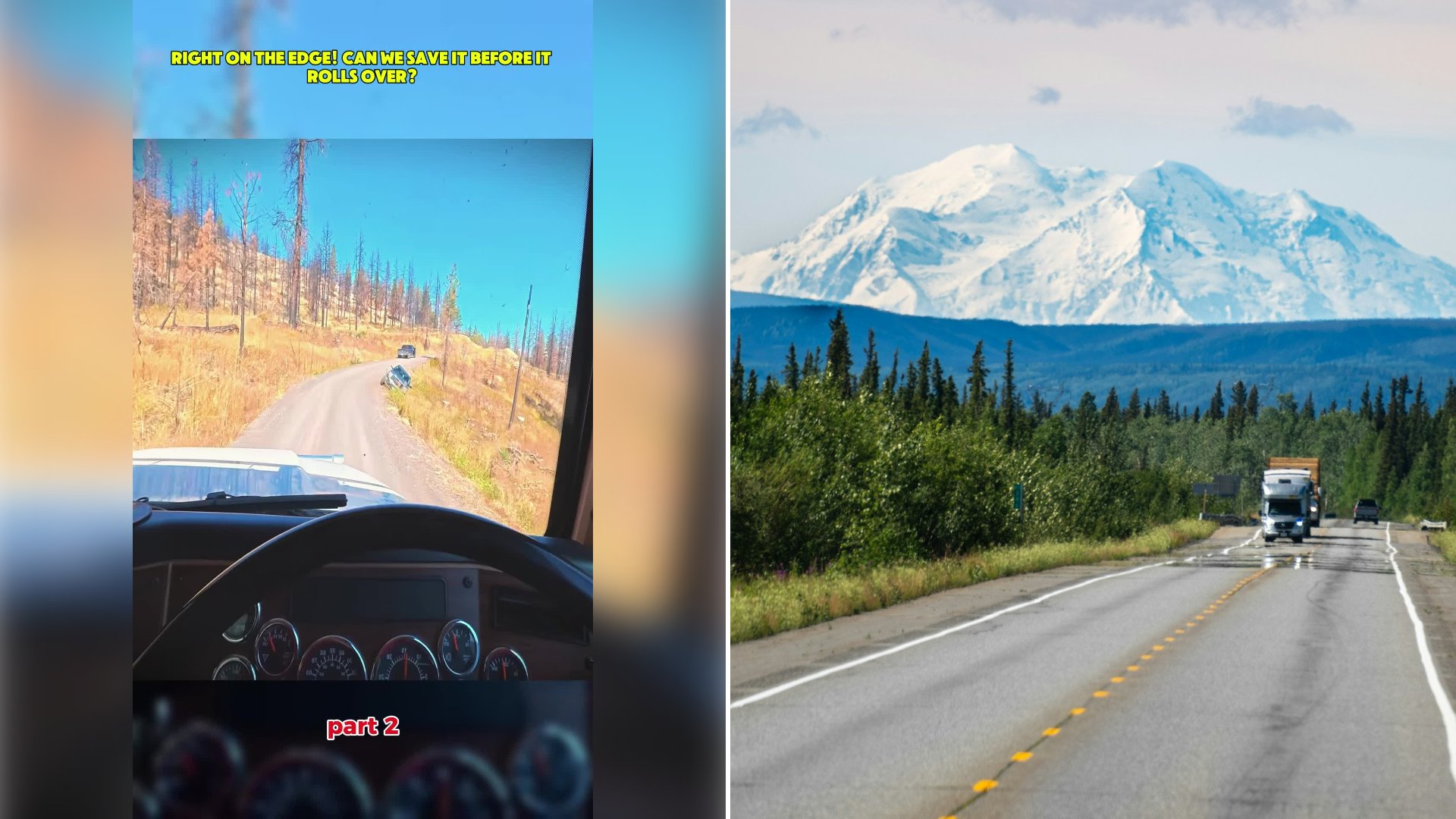
The TikTok account @adchjskt posted a nearly four minute first person recovery video captioned only with hashtags for wrecker, rotator, recovery and towing. Text across the top of the frame reads “Right on the edge! Can we save it before it rolls over?” and a red label at the bottom says “part 2.” The camera is worn by the tow operator, so the viewer sees his gloved hands, the heavy wrecker and the gray pickup he has come to retrieve.
The scene is a gravel road on a burned out mountainside, with blackened tree trunks and dry grass under a clear sky. The pickup sits nose down in the ditch beside the road with its front end tilted over the drop. A man stands on the road watching, and later two men stand near the pickup. “We find a truck off over the side,” the operator says at the start, and then, “It is over pretty far, I would say.”
He talks through the plan as he works. There is “a really nice tree right there,” he says, “but it’s not where we want it,” so he decides to bring the wrecker up “kind of in the ditch.” The plan he describes is to run a drag winch to the back end of the truck and a boom winch to the front wheel, because the pickup “has a little bit of lift on it too,” and the second line will help pull it up and over. He adds that he wants to run another boom line to the frame to hold it from going further.
He is open about the uncertainty. “A lot of times, the one you think is gonna be super simple,” he says, is not, and he warns the people near him, “Watch out, these are gonna pop out of here.” Later he says he is going to use the underreach, the wrecker’s lifting arm, in a way it was not meant to be used today, wants to be tight on it, and will use a chain. He asks for one snatch block, a pulley that redirects the winch line. In the frames the cables lie across the gravel between the wrecker and the pickup, and his gloved hand holds a line at the truck.
The video ends without a clear outcome on screen. The spoken lines in the second half include “Might be too short, but we’ll see in a minute,” “I might have been too close on that one,” and “I might have to pull forward just a hair.” The last frames show cables lying on the gravel by the pickup’s wheel and a man walking along the road. This is part two of a series, and the clip does not say whether the pickup came up. Some lines in the platform’s auto captions are garbled or in the wrong language, so they are left out here.
A recovery like this one runs on equipment that carries heavy loads at a sharp angle, and the rules for that equipment are written down. The Occupational Safety and Health Administration’s standard on rigging equipment for material handling, which covers construction work, says rigging equipment must be inspected before use on each shift, and that damaged or defective slings must be removed from service immediately. It bars using chain slings above their rated capacities, says shock loading is prohibited, and says slings must be protected from the sharp edges of their loads. The chain the operator says he will use is the kind of part those rules cover.
The Army Combat Readiness Center, in its guidance on recovery and towing, says personnel handling wire rope must wear leather gloves because small frays in wire strands can cause severe lacerations to hands, that rope should not be slid through bare or gloved hands, and that hands or body should never be placed between cables under tension. The operator in the video wears gloves while handling the line at the pickup. The center says applying risk management from the start of planning is critical, which fits the long talk through the plan in the first minute of this clip.
For anyone whose vehicle slides off a road, the clip gives a practical picture of what the work involves: which lines go where, why a tree or a pulley is chosen, and why the operator warns the people near him. The part a driver controls is the first step, which is to call the person trained to do it, rather than hook up a line and pull. The video itself shows the operator changing his rigging as he goes and saying out loud that parts of it may not go as planned.
More from Steel Horse Rides
- Drivers in Five Battered Race Cars Chase a Ford Super Duty Towing a Flatbed Around a Banked Oval, Trying to Drive Onto the Moving Trailer, in a Race Cleetus McFarland Fans Call Violent
- Detailer Announces He Is Building a 90s Truck, Then Has a Sun Faded Black Chevy Z71 Chained to a Shop Rack and Cleans Its Maroon Interior With a Brush and a Hot Water Extractor
- Mobile Mechanic Finds a Steady Coolant Drip Under a Red Car at a Gas Station After a Driver Asks for Money, Then Offers to Fix It in the Morning