

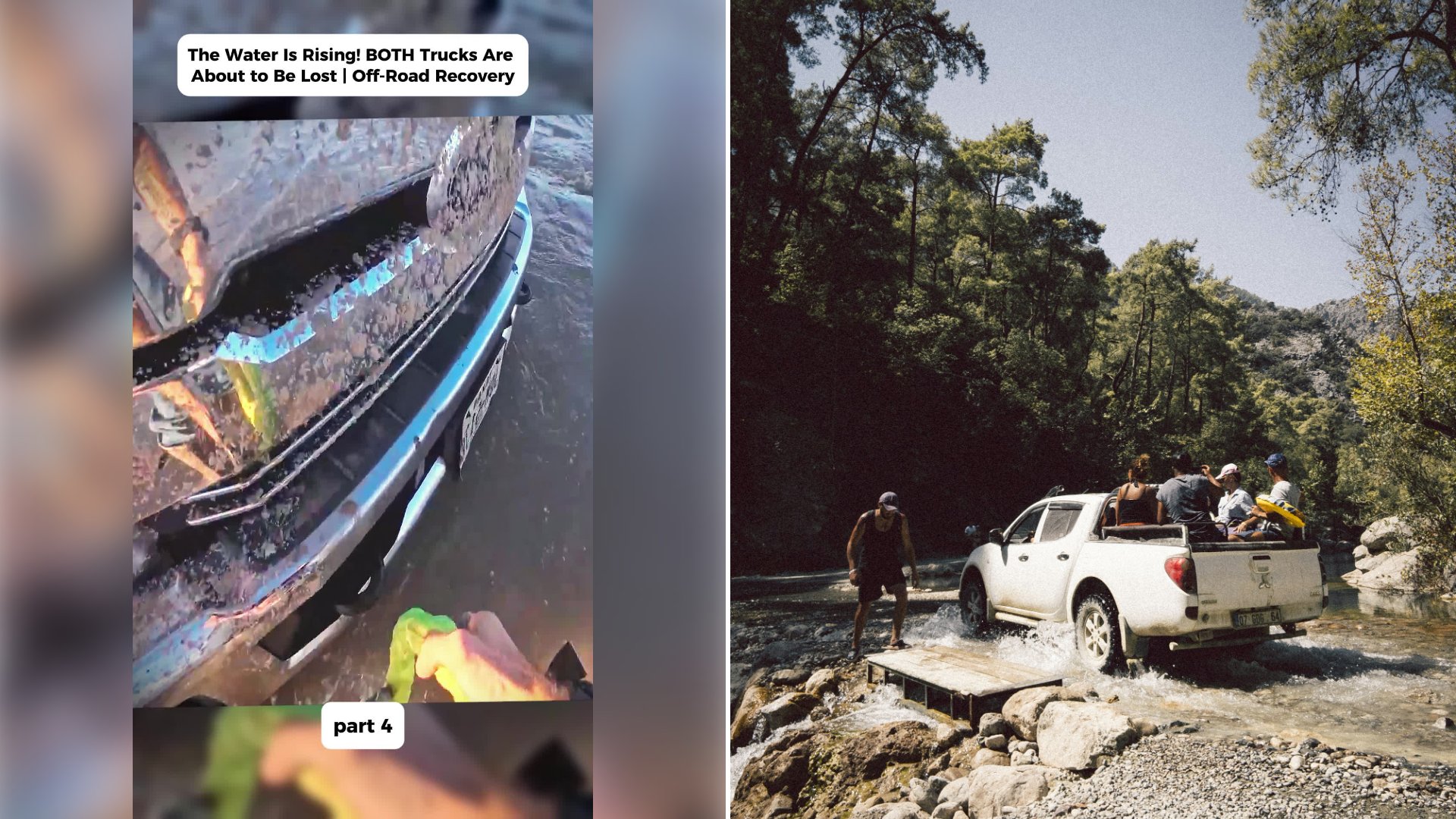
The TikTok account @user6018068hd188 posted a two and a half minute first person beach recovery video with a title card across the top that reads “The Water is Rising! BOTH Trucks Are About to Be Lost” with a tag for off road recovery and a label that says “part 4.” The caption is only hashtags for wrecker, rotator, recovery and towing. The account does not credit anyone else, so the video is described here as that account shares it, with no word on who made the series.
It opens at the waterline. Foam from small waves slides over the front bumper of a white pickup and around a bright green shackle, and the camera wearer’s hand holds the end of a strap. Wide shots show a driftwood strewn beach under a sunset sky, a second vehicle farther down the beach, and a few people standing on the sand. The first line in the audio is “Good thing it’s still running.”
The plan is to winch the stuck pickup out of the water with the narrator’s own Jeep. “Let me engage my winch,” he says, and then, “Let’s see what we can do.” One frame shows him holding a wireless winch remote together with a phone. A voice says to put it in drive and give it gas, and the next lines are about where the pull should come from. He says someone can anchor him by getting behind his Jeep, and “cause it’s pulling me to him” explains why. He also notes that the other driver “has a hitch.”
From there the video is rigging. A red strap runs across a field of bleached driftwood, and a later frame shows the strap lying over a pile of logs. The narrator checks the line and says it is “not really straight but try to tighten up just a little bit.” He adds, “At least I have something behind me though,” and says he is waiting for his Jeep to settle in. Later frames show his hand on the winch remote with the cable tight across wet sand, the winch bumper on the front of his vehicle, and the white pickup still sitting in shallow water with people standing nearby.
The video ends at about two and a half minutes without a shot of the pickup coming out of the water, and the account does not show how part four concludes. Several of the platform’s auto captions near the end are garbled or in other languages, so they are left out here.
The danger in the title card is a matter of timing. According to NOAA’s National Ocean Service, coastal areas experience two high tides and two low tides every lunar day, which lasts 24 hours and 50 minutes. That means a high tide arrives about 50 minutes later each day, so a spot that was dry yesterday afternoon can be underwater at the same hour today. The National Park Service says at Padre Island National Seashore in Texas that a predicted high tide of 1.5 feet or greater has the potential to reach the dunes, and that it is not recommended to camp or drive on the beach at times of higher tides. The park service tells visitors to check NOAA tide predictions before going out.
The same park service page lists equipment for vehicles stuck in sand or other debris, such as shovels, traction boards and tow straps. It says four wheel drive vehicles are recommended, that cell phone service is unreliable in the park, and that visitors should tell a family member or friend their plan before they enter. It states that the park does not tow vehicles that do not belong to the government, and that a private tow down the island can cost several hundred to several thousand dollars.
More from Steel Horse Rides
- Off Roader Peels the Toyota TrueStart Sticker Off a Car Battery and Finds an Interstate Batteries Label Underneath, Then Points at It in a Clip He Calls Rebranded Car Parts
- Detailer Announces He Is Building a 90s Truck, Then Has a Sun Faded Black Chevy Z71 Chained to a Shop Rack and Cleans Its Maroon Interior With a Brush and a Hot Water Extractor
- Buyer Films Himself Walking Out of the Dealership to His Black Jeep Trackhawk, Popping the Hood on the Supercharged V8, Then Turning the Drive Mode Dial Before Pulling Out