

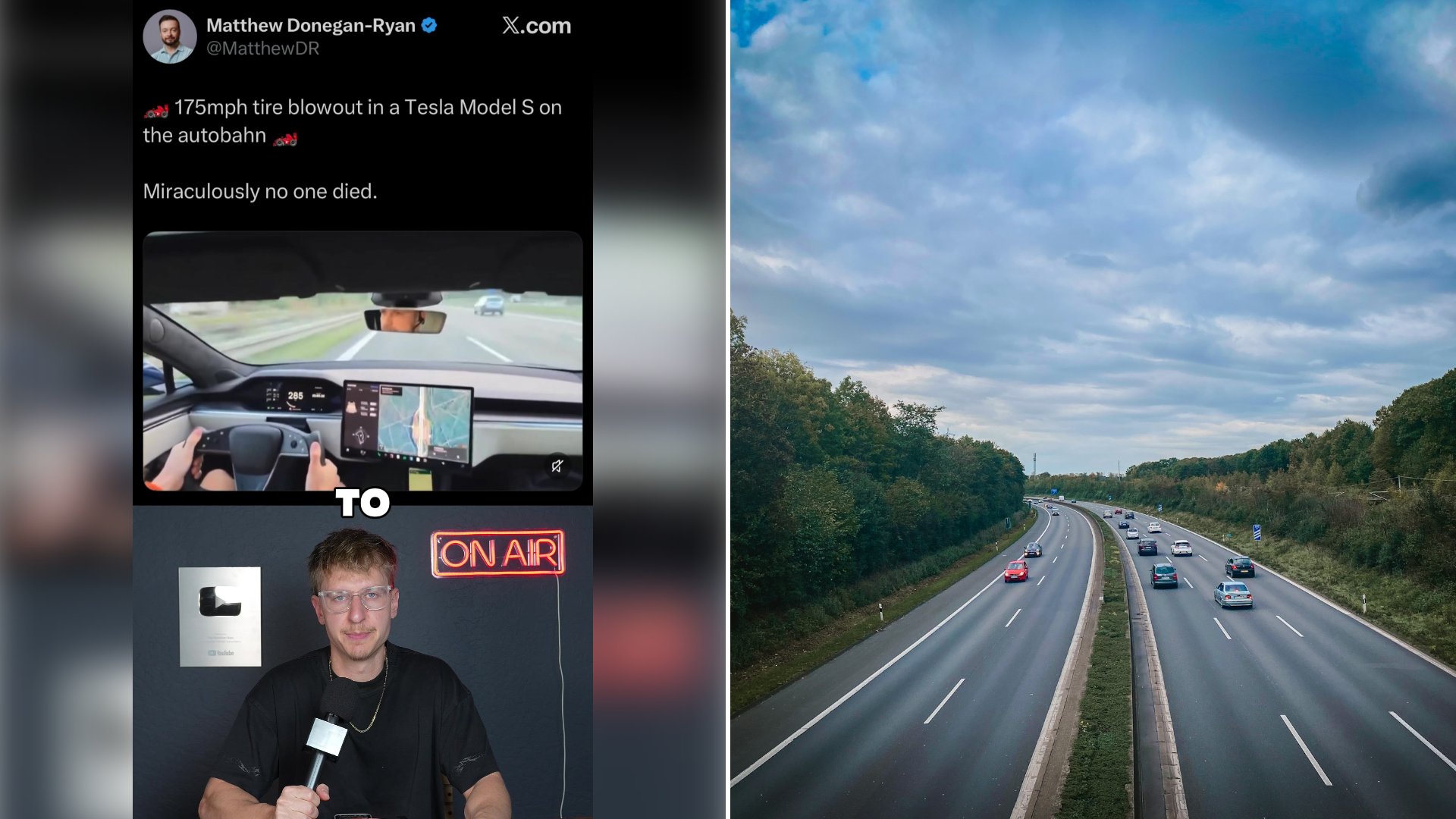
A dashcam clip that has been circulating for weeks is getting a fresh breakdown from TikTok creator @blakesanburg, who walks viewers through a Tesla Model S losing control at roughly 175 miles per hour on an unrestricted stretch of the German Autobahn. The original footage shows the car drifting, spinning, and clipping the guardrail before coming to a stop, and the creator slows it down frame by frame to point out exactly where things went wrong and exactly how the driver ended up walking away. He is blunt about it: at that speed, he says, the driver is lucky to be alive, and the breakdown spends most of its runtime explaining why that is not an exaggeration.
Part of what makes the breakdown worth watching is that it treats the video as a teaching moment rather than just a spectacle. The creator points to specific details in the dashcam footage, like steering input and the moment the rear end breaks loose, to explain how a high speed loss of traction turns into a spin rather than a head on impact, and why that distinction likely made the difference between a survivable crash and a fatal one.
@blakesanburg
The Autobahn’s reputation as a speed-unrestricted highway is accurate, but only in part. Roughly half of Germany’s Autobahn network has no fixed general speed limit, while the rest carries posted limits, often around 130 kilometers per hour (about 81 mph), through construction zones, urban stretches, and high-risk curves. Where no limit applies, Germany still issues an “advisory speed” of 130 km/h, meaning drivers who go faster can be found partially liable in a crash even without breaking a specific law. A speed near 175 mph, which is roughly 280 km/h, is well beyond that advisory and firmly in the range where very few production cars are even tested for stability, let alone driven regularly.
The Tesla Model S itself carries strong formal safety marks, including a five-star overall rating from the National Highway Traffic Safety Administration and top marks in several Euro NCAP crash categories over the years, largely thanks to its low center of gravity from the underfloor battery pack and a stiff structural cage around the occupants. Those ratings, though, are built on crash tests conducted at speeds far below 175 mph. Every crash test standard in the world, in the US, Europe, or elsewhere, evaluates impacts well under 70 mph, because the physics of a crash scale with the square of speed. A crash at double the tested speed does not carry twice the force; it carries roughly four times the force, which is why experts are consistently cautious about assuming any production vehicle’s crash rating still applies once speeds climb into the triple digits.
That gap between what a car is rated for and what actually happened on camera is exactly why the breakdown resonated the way it did. The driver’s survival likely owed something to the Model S’s structural design, something to the spin dissipating energy across a slide rather than a single point of impact, and probably a fair amount of luck regarding exactly where and how the car made contact with the guardrail. None of those factors would have been obvious from the raw dashcam clip alone, which is the gap this kind of frame by frame analysis is built to fill, and why viewers keep coming back to breakdowns like this one instead of just watching the original footage once and moving on.
More from Steel Horse Rides
- Driver Asks Did I Overreact Over Dashcam Footage of an Oncoming Silver Car Coming at Him Near the Center Line, Then Shows His Face Barely Moving the Entire Time
- Buyer Says He Bought a One Hundred Thousand Pound Mercedes GLE That Nobody Could Even Open and Explains What a Salvage Rebuild History Can Hide From New Owners
- Buyer Catches a Facebook Marketplace Car Flipper Rolling Back the Odometer and Says the Title Was Not Even in His Name, Then Warns Other Shoppers