

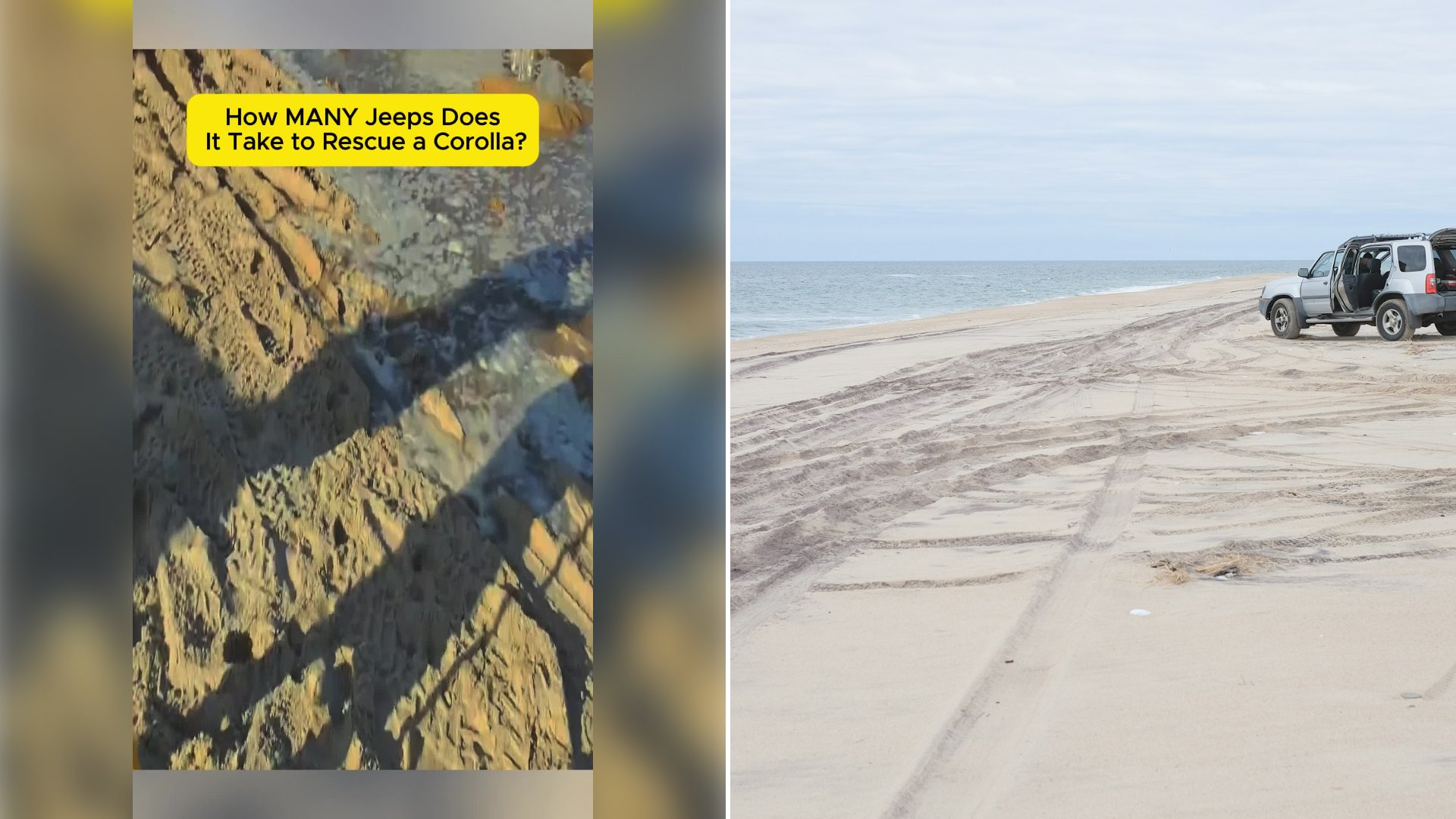
What should have been a quick pull turned into a drawn-out ordeal in this recovery video from TikTok creator @caveislinh.tv, whose towing company documented the process of freeing an ordinary sedan that got stuck in wet beach sand. The car sinks progressively deeper with every attempt, and what starts as a job for one tow vehicle ends up requiring multiple off road capable trucks working together, chains running between them, to finally break the sedan loose. The footage captures the full arc, from confident first attempt to the much more involved operation it eventually becomes.
The comedy of the video is in the mismatch between the car and the terrain. A low-clearance, street-tuned sedan has almost nothing in its design that would help it in wet sand, and the longer it sits, the more its own weight works against it, which is exactly the pattern the recovery crew is fighting the entire time.
@caveislinh.tv
Wet sand behaves very differently from the dry, loose sand most drivers picture. Dry sand compacts somewhat under a tire and can occasionally offer enough traction for a careful driver to creep through. Wet sand near the waterline, by contrast, often behaves almost like quicksand once a vehicle’s weight breaks through its surface tension, collapsing into a suction-like grip around the tires that gets stronger the more the wheels spin. A standard sedan, with narrow tires, low ground clearance, and no low-range gearing, has none of the tools needed to climb back out once that happens, which is exactly why a single tow vehicle on the same soft sand often cannot generate enough traction either, and why this recovery escalated to multiple off road vehicles working in tandem.
The cost gap between an easy recovery and one like this is significant. A standard flatbed tow for a car stuck on pavement or a firm shoulder typically runs in the 75 to 150 dollar range in most markets. A beach or sand recovery requiring specialized off road vehicles, extra rigging, and significantly more time can run several hundred dollars, and some beach-specific towing operators post flat rates specifically for sand recoveries because the job reliably takes longer and demands different equipment than a routine tow. Several jurisdictions with public beach driving, including popular stretches in Florida and parts of the Outer Banks, also require a beach driving permit and publish guidance warning drivers to stay well above the high tide line precisely because of how often ordinary vehicles end up exactly like this one.
For the recovery crew, patience ends up mattering as much as horsepower. Pulling too hard, too fast on a car stuck in wet sand can snap a chain or strap, or tear a bumper or frame mount clean off the stuck vehicle, which is why experienced recovery operators tend to apply steady, building tension rather than a sudden jerk. The length of this particular recovery is less a sign that the crew did anything wrong and more a sign of just how much wet sand can grip a vehicle that was never built to be anywhere near it.
More from Steel Horse Rides
- Off Roader Peels the Toyota TrueStart Sticker Off a Car Battery and Finds an Interstate Batteries Label Underneath, Then Points at It in a Clip He Calls Rebranded Car Parts
- Arizona Technician Sorts Nine SUVs and Trucks Into Reliable or Unreliable, Putting the Chevy Equinox 2.4 in Red Over Oil Use and Calling the Ford F150 5.0 a Truck for His Family
- Buyer Films Himself Walking Out of the Dealership to His Black Jeep Trackhawk, Popping the Hood on the Supercharged V8, Then Turning the Drive Mode Dial Before Pulling Out