

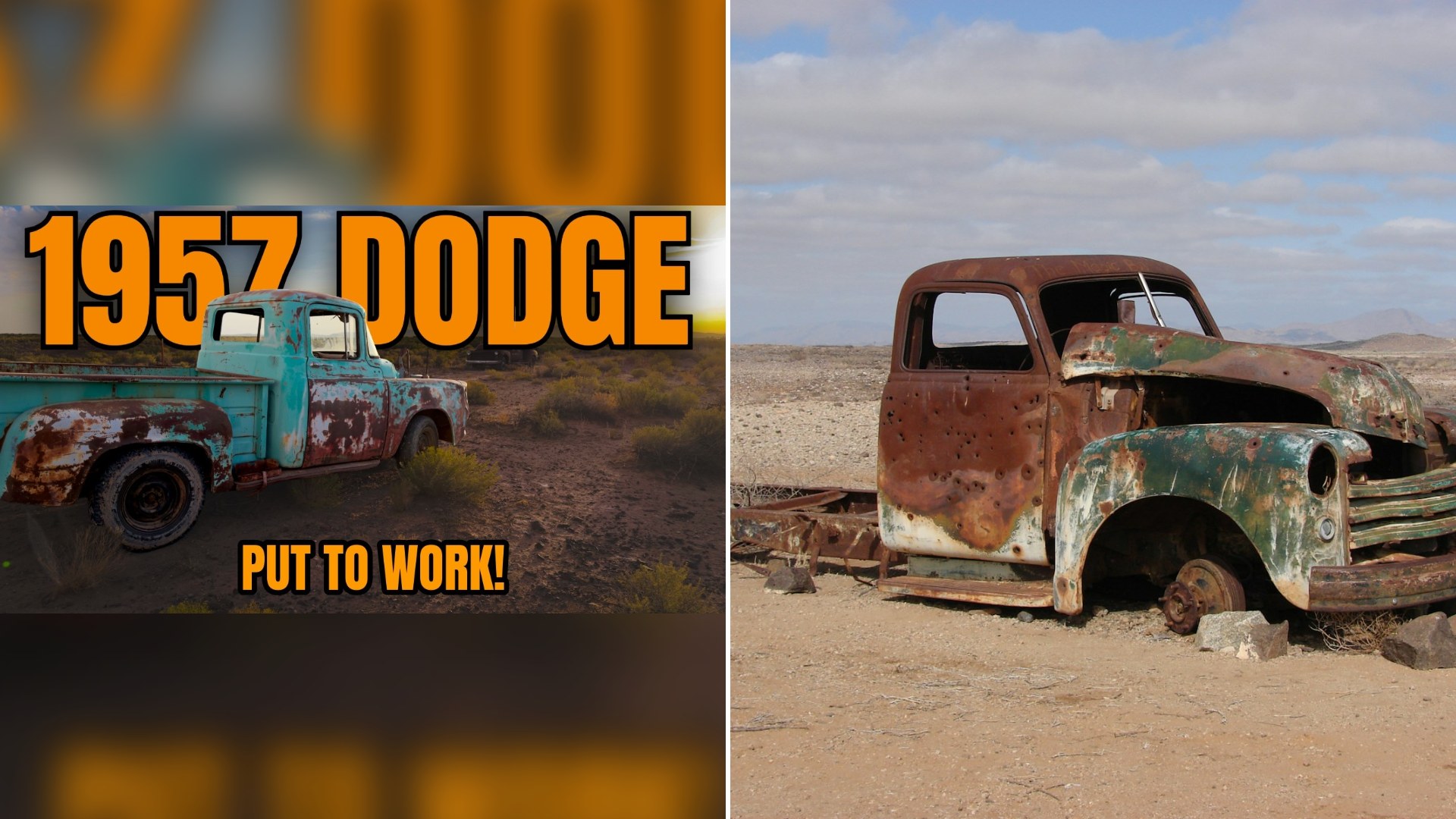
Some projects are finished when the engine fires. Others, as a creator named Jesse of Atomic Era Motors found out, are only getting started. He pulled a 1957 Dodge truck out of a junkyard, dropped a big block Chrysler drivetrain into it, got it running, and then discovered it still could not do much of anything useful. He shared the follow up from the desert of New Mexico, and the story takes some unexpected turns, including a land purchase and a fencing job.
One note before we dig in. What follows is based on only part of a very long upload, which runs over an hour. The opening few minutes and a section about his new property are covered here, and the repair work in the middle is not, so this story does not say how every problem was solved.
A Truck That Went, But Could Not Stop
Jesse says he built the truck a little over a month before this return trip. The setup was a 413 cubic inch big block and a push button TorqueFlite automatic transmission, both out of a 1964 Chrysler. He got the truck running and driving, but, as he put it, not stopping. Now he was back to fix the things he did not fix the first time.
The list was long. The radiator did not hold water. The freeze plugs were rusted out. There were absolutely no brakes. And there were no wheels of its own, because the truck had been borrowing the wheels from a 1961 Chrysler parked nearby. He said he needed wheels, brakes, a cooling system, maybe a bed floor, maybe lights, and a hood, which he said is very hard to find for a 1957 Dodge truck. Jesse lives in Missouri, so he asked anyone near Missouri or New Mexico with a hood to get in touch.
He also made no secret of why he cared. The truck was a rare bird that was headed for the crusher, and the drivetrain came from a car that was also headed for the crusher. He had something he needed the truck for, he said, though it did not need to be perfect.
Starting With The Brakes
Jesse chose to begin with the brakes, saying they are the part that bites him hardest on cars like this, mostly because of the trouble of finding parts. The wheels all spun, and the brake lines and hoses looked good, which he says is typical of a desert vehicle where you can often reuse hoses and hard lines. The master cylinder, however, was dead. He had tried to revive it a month earlier with brake fluid and a motor additive to swell the seal, and it did not work.
On many vehicles from the fifties, the master cylinder sits under the floor, so he crawled underneath. It had clearly been replaced at some point, he noticed, because it was held on by only two bolts when there should have been three. His plan was to pull it, take it apart, and see whether he could rebuild and hone it. If that worked, he reasoned, there was a good chance at least a couple of the wheel cylinders would work too. He pointed out one perk of working in the desert: parts come apart easily, something he says you cannot do on cars up north, even though their cooling systems usually work.
The Land Purchase
Then the story takes a turn. Jesse says he bought a piece of property in New Mexico, and he joked with the friends alongside him that it may not have been the wisest financial decision. His friends teased him about the whole arrangement, and Jesse laughed along.
If you are ever tempted by cheap rural land, the usual homework applies. Confirm who holds title, check that the parcel has legal access, look at the boundaries and any easements, and have a professional review the paperwork before you sign.
Why New Mexico? He gave a few reasons: it is beautiful, it is full of old cars, and the land is affordable. A property like this lets him work on rescuing cars all year, which is harder back home. He is not moving there, at least not yet. The parcel is 160 acres. He also joked that a couple of acres in Missouri cost more than this entire property.
The Fencing Job
That brings us back to the job he needed a truck for. Part of the land needed to be fenced. Jesse says someone seems to have been using one section as a trash dump, which he described as common out there, and he believes dumping into a canyon at the end of a road may have gone on for twenty years or more. He wanted to close up most of the western fence line, plus a bit on the east.
He brought what he called the two most capable vehicles around: a 1953 GMC with a slant six, nicknamed the Jimmy, and the Dodge, which he planned to endurance test. His friends were not convinced the Dodge would measure up. One of them quipped that at least there was a pedal to push when you are scared. Jesse also acknowledged that the land has its own challenges, including canyons and arroyos, and no way to reach it without crossing other properties. Building roads, he said, would be next time.
Tips If You Are Reviving A Sleeping Truck
Jesse’s experience offers a lot of good general lessons for anyone bringing an old vehicle back to life.
- Fix the stopping before you improve the going. A big block makes a heavy truck very fast, and brakes from the fifties were designed for far less power.
- Do not trust old rubber or seals. A master cylinder that has sat for decades often needs a rebuild or replacement, and old brake fluid draws moisture and causes corrosion inside.
- Check the cooling system carefully. Rusted freeze plugs and a leaking radiator are common on trucks that sat, and overheating can ruin a good engine.
- Make a written list of what is left to do. Jesse’s list of wheels, brakes, cooling, bed floor, lights and hood is the kind of plan that keeps a project moving.
- Ask the community for rare parts. Sheet metal such as a hood for a rare truck is often found through owners clubs, forums and word of mouth.
The bigger lesson may be about priorities. Jesse says the land lets him rescue cars all year, and the truck’s job was to help him fence part of it. Whatever your own project, start with the work that makes a vehicle safe, then move on to the work that makes it useful.