

You drop your car off because the air conditioning quit. You expect a fix. What you do not expect is a pricey repair that might not even be the real problem. A mechanic posting as @menjicar says that is what almost happened to a Honda owner, and he took the time to prove it.
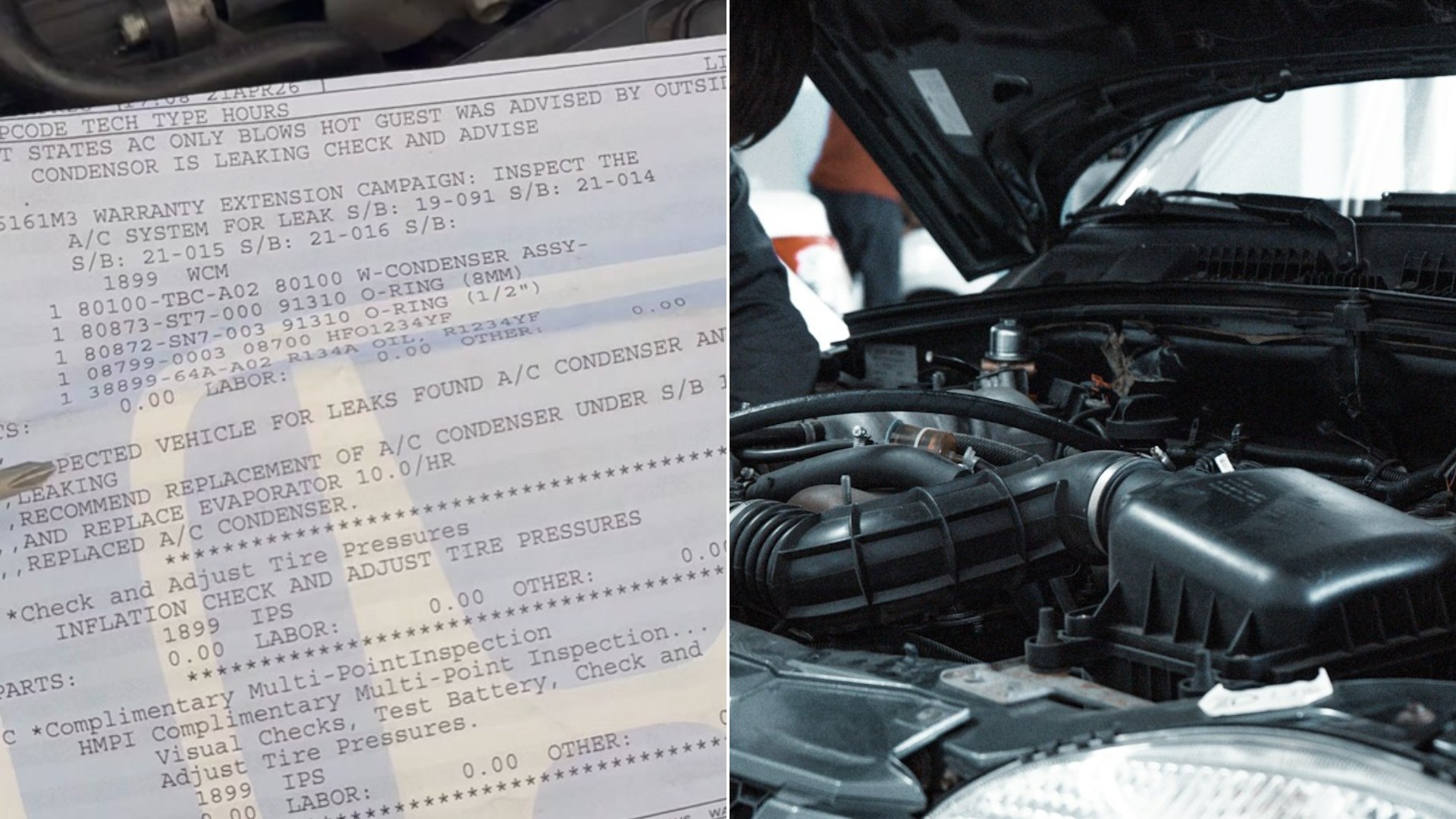
The customer came in with an AC that was not cooling. The mechanic found the first problem quickly: the condenser was leaking. The good news was that it was covered under Honda’s extended warranty. He even points to a service bulletin from Honda covering the condenser, and another covering the AC compressor seal.
Then came the part that raised his eyebrows. According to him, the dealership had also pointed at the evaporator as the problem. The evaporator sits behind the dashboard, and replacing it is a big job.
@menjicar
Checking the dealer’s claim
He called it suspicious, but he did not just argue. He checked. When an evaporator leaks, he explains, you can usually see it at the drain hose, where you will find dye or an oily residue left behind by the refrigerant system. This one had nothing.
So he reached for a borescope, a small camera on a flexible cable that lets a mechanic see into tight places without taking everything apart. With it he looked at the evaporator, and it was not leaking at all.
That left the question of where the AC was actually losing refrigerant. After a little more inspection, he found it. A hard line, one of the rigid metal refrigerant lines, had been rubbing against something and had worn a hole in itself. That was the leak.
A $100 part against ten hours of labor
Here is where the numbers get interesting. That hard line costs about $100. The evaporator job, he says, would have meant roughly 10 hours of labor. He installed the new line and made sure there were no more leaks. Then the system was pressurized and recharged with new refrigerant, and the air came out nice and cold, about 40 degrees.
The condenser was replaced under warranty, as it should be. The mechanic’s view is that the evaporator suggestion looked like an attempt to upsell a repair the customer did not need, just to make some money. The car only had 74,000 miles on it.
To be fair, we only have one side of this. The post does not say what the dealership charged or how it reached its recommendation, and a mistaken diagnosis is not the same thing as a deliberate upsell. But the lesson holds either way: a big repair estimate deserves a second look before you agree to it.
How to protect yourself on AC repairs
Air conditioning problems are common, and they can get expensive fast, so it pays to know the questions to ask:
- Ask what proof they have. A good shop can show you the leak: dye under a black light, oily residue at a fitting or a hose, or a photo from a camera. If someone recommends a major part, ask to see why.
- Ask how they found the leak. A leak test with dye or a pressure test is standard. If the answer is a guess, get a second opinion.
- Check your warranty first. Look at your coverage, including any extended warranty, and ask the shop whether there is a service bulletin for your symptoms. Covered repairs should not cost you out of pocket.
- Get it in writing. A written estimate that lists each part and the labor hours lets you compare prices. A job that is listed at ten hours of labor deserves a hard look.
- Ask for the old parts back. It is your right in most places, and it keeps everyone honest.
- Get a second opinion on big jobs. A short visit to another shop, ideally one with a good local reputation, can save you hundreds or even thousands of dollars.
- Do not ignore a weak AC. Slowly losing cooling usually means a leak. Catching it early often costs less than waiting until the compressor suffers.
Why this kind of upsell works
Most of us cannot see inside our own dashboards. When a service advisor says a part is bad, we tend to believe them, and the larger the repair, the more scared we get about saying no. That is why a simple step like asking to see the evidence matters so much. Honest shops will not mind the question, and the ones that do mind are telling you something.
The takeaway for Honda owners
The mechanic ends with a practical note: if you have a Honda with a similar AC issue, take it to the dealer, because it is most likely covered by a warranty. That is worth remembering. Coverage may cover the condenser, the compressor seal and other pieces, so a dealer visit can save you real money. Just stay engaged in the process. Ask what is being replaced and why, and make sure the repair matches the actual leak.
A $100 hose and a sharp-eyed mechanic with a camera turned out to be the answer here. Next time you hear that you need a major repair, remember this story and ask for proof.
More Stories You May Like
- Family Sold Their Grandmother’s 1971 Plymouth Valiant To A Detailer For Five Hundred Dollars Cash After Twenty Seven Years In A Field And He Made It Shine Again
- Car Buying Expert Lists The Sleazy Dealership Tricks That Take Advantage Of Shoppers From Add Ons On The Final Paperwork To Forcing You Into Their Financing
- Honda Owner Went For A Coupon Oil Change And The Dealership Said The Oil Pan Was Leaking Until An Independent Shop Looked And Found No Oil At All