

There is something special about a hot rod that shows its age. Matt of IronTrap Garage has a 1932 Ford roadster that has plenty of it. The doors were stuffed with old newspapers from the 1950s, including pages from the Los Angeles Times. There is a receipt from when it was bought in the late 1960s in Santa Monica. He picked it up while buying out a collection of 1932 Fords in Ohio, and he decided to skim this one off the top for himself. He loves crusty old hot rod stuff, and this roadster has history.
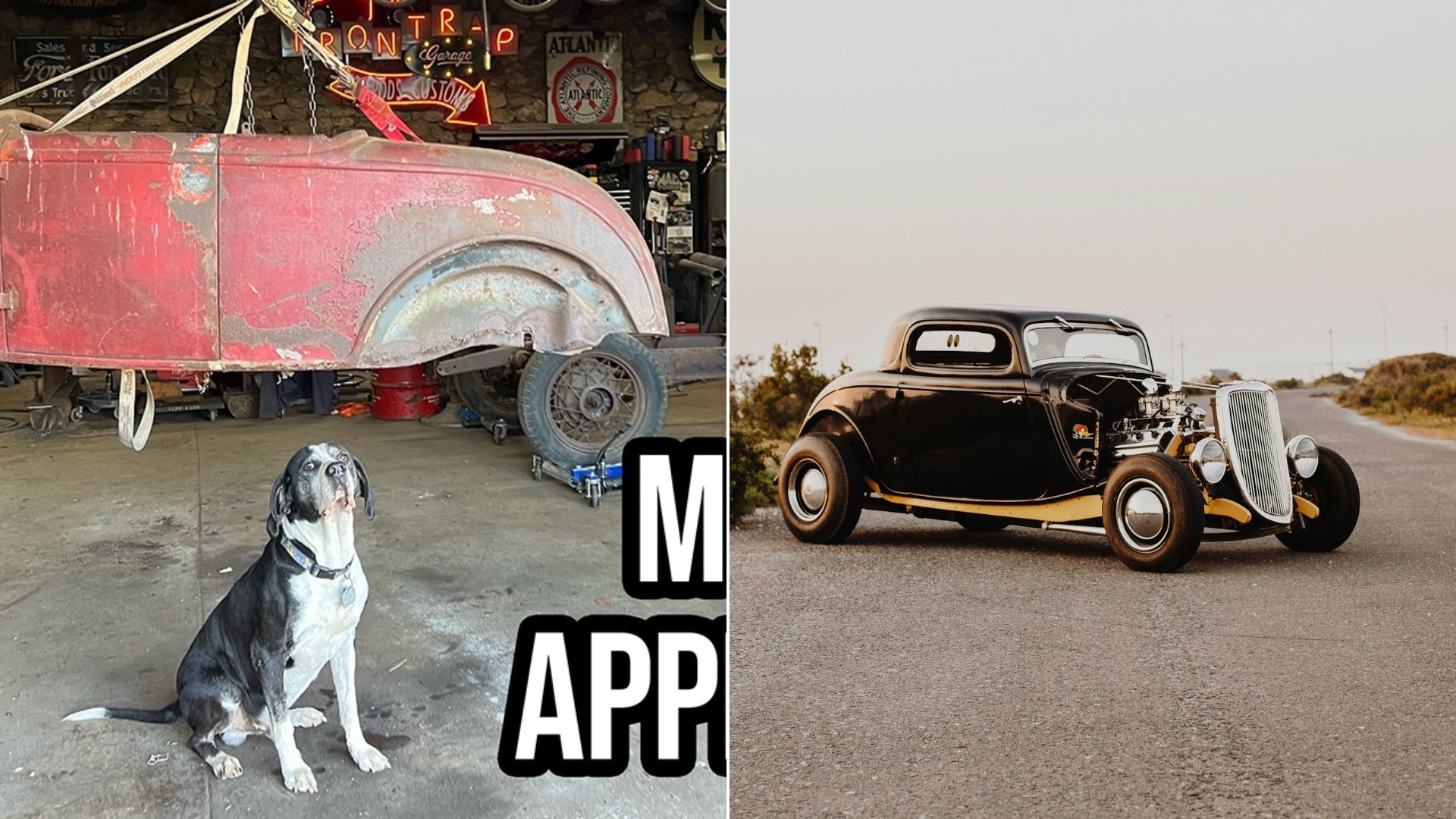
Then came the surprise. After the car sat in the shop for a while, the crew realized it was sitting on the wrong chassis. Somewhere in its life, the last owner had probably bought it as just a body and set it on whatever frame he had, and with multiple deuces around, things got mixed up. A different frame from the same estate came with a roadster title, and that one is believed to be the correct match.
Playing Big Kid Legos
So Matt decided to do what he has done most of his life: take a pile of parts and a body and play big kid Legos. The plan was a fun mock-up. Prep the correct frame, swap the body over, drop in an engine he already had in mind, and see what the silhouette might look like. It was not going to be a serious build, and he said the car would not be driven. The goal was to get it looking and sitting better, and to figure out what parts are still missing.
The engine was something he bought a long time ago, hiding in a corner on dollies. Helping him was Steve, who did a lot of the wrenching. They hit the small snags that every garage knows. The transmission did not fit a clutch disc at first. Steve found a smaller centering tool, which turned out to be marked for a Mustang, and that led to the guess that the engine had once been fitted with a later Ford four-speed with a smaller input shaft. When Steve pulled the clutch apart, they found a brand-new, never-run disc, with the writing still on it. Matt said that is why he hoards parts: when you have things sitting around, you can put them together.
The Engine Tour
The engine is a Riley four-port conversion for the Ford four-cylinder, and Matt is clearly proud of it. He said the head casting and serial number point to 1938. It has hand-engraved, crude Riley racing rocker covers, a distributor that he thinks came from a Volkswagen, and a pair of Ball and Ball carburetors from what he believes was the 1950s. They are mounted on homemade adapters, since the Riley head was designed for four-bolt carburetors. Matt said he is not sure of all of it, and that he might be wrong.
The oiling system puzzled him. There are lines running everywhere, a mystery canister with a screw on the back that might regulate pressure, and an oil pump brazed to an original timing cover. It was crude, but he said it was pretty good considering when it was probably done. He also suspects the engine was converted from babbitt bearings to a more modern setup, and called that a red flag. There was also a homemade fuel block with three ports, which suggests it may once have had three carburetors. He kept it with the engine, as he always does.
A NOS front motor mount from a collector friend went on, after Matt said he had somehow sold all of his and could not find one anywhere.
The Body Goes On
With the engine in the correct chassis, the crew set the body on, then tossed on the firewall and grille so they could end the day on a high note. Matt said it looks like an original hot rod barn find, and that they could probably fool people into thinking it was found just like that. He clipped in the old dash with a full row of gauges that came from the same estate.
He pictured something like a 1940s dry lakes jalopy, the kind of car a kid might have bought out of a junkyard for 20 dollars and hopped up. For that look, he picked bent spoke Kelsey Hayes wire wheels, and half-tread 7.60-16 tires from Coker for the back. He also found early motorcycle-style tires but decided they were too small for a 32 and saved them for a Model A or T. He plans to go mostly stock suspension, maybe with a drop axle and a few leaves removed, but not slammed.
The mock-up also showed what he is missing. He had to buy an engine mount, and the double crank pulley turned out to be a welded-up, broken piece that does not clear the crossmember, so he needs a stock one. He also showed an old four-cylinder header with a canister cutout he bought at Carlisle years ago and thinks he will need split wishbones to fit it.
Buying Old Hot Rod Parts: A Few Pointers
- Check that the body and chassis match. Titles and numbers matter, and a body on the wrong frame is more common than you think.
- Look inside doors and panels. Old newspaper, receipts and notes can help date a car and trace its past.
- Mock it up first. Setting parts in place before paint and welding shows what is missing and what does not fit.
- Keep the odd parts with the engine. A strange fuel block or bracket may be the key to its history.
- Do not trust that old repairs are wrong. Crude brazing may still hold, but have it inspected before use.
- Be patient with swap meets. Missing pieces for older engines are often found by hunting.
Matt said he is still digging into the history of the body. The search goes on, and so does the fun of the hunt.
More Stories You May Like
- Driver Pulled Over for Texting Handed the Officer What He Thought Was His Registration and It Turned Out to Be an Old Unpaid Ticket
- Collectors Let Two Pickers Dig Through A Crowded Old Bus Where They Walked Off With A World War Two Oxygen Tank For 5 Dollars And A Porcelain Sign For 30
- Honda Dealer Pushes An Expensive Evaporator Repair On A Customer With A Broken AC But A Mechanic’s Borescope Shows The Real Problem Was A One Hundred Dollar Part