

Trees grew right up through the bed of this old Ford dump truck, and it has sat in that junkyard for what looks like forever. The viewers of What the Rust? voted overwhelmingly: get it running. So the host went back into the woods with a friend and a can of homemade engine freeing juice.
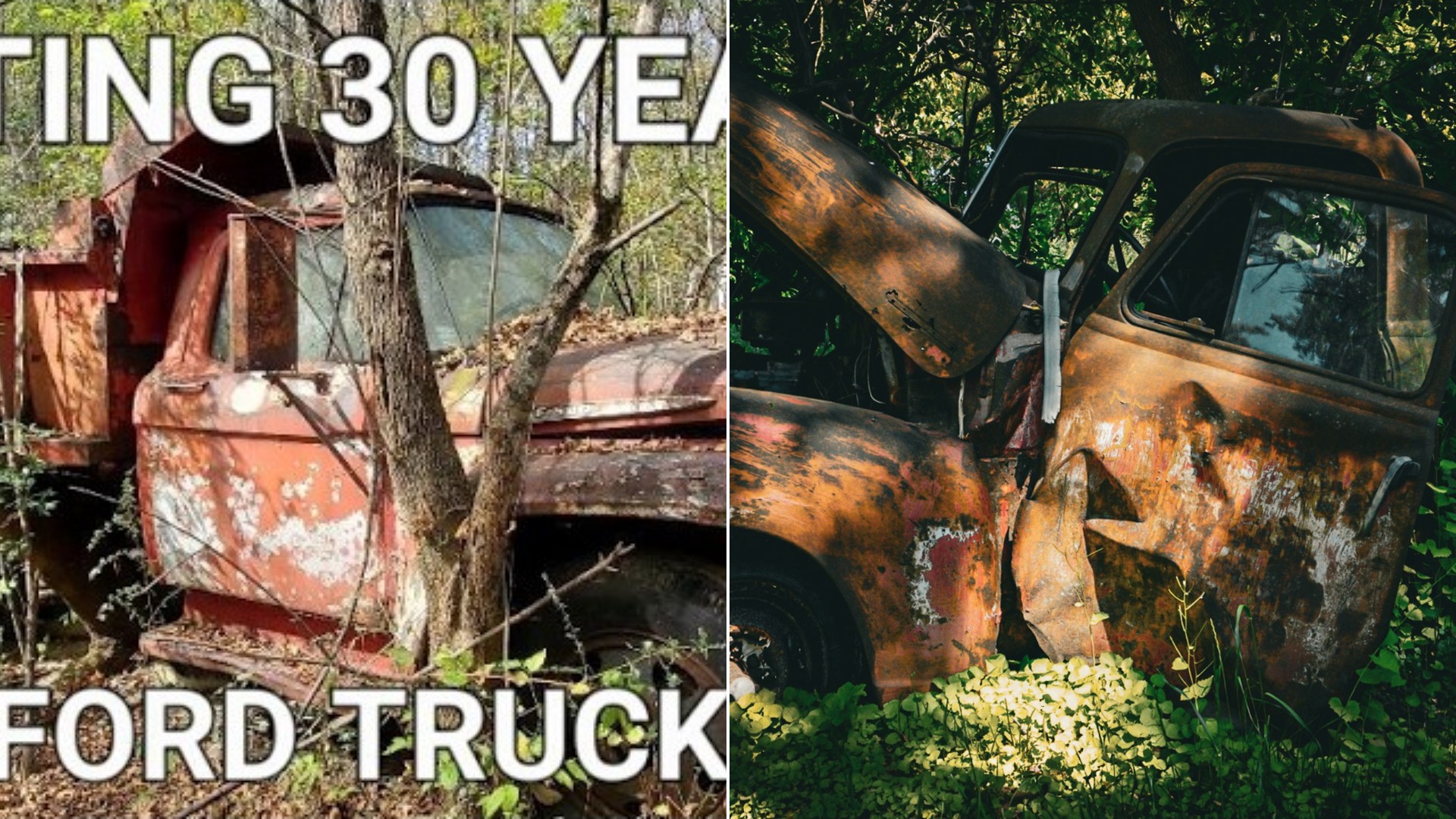
“If we can get this running, we’re actually going to pull it out of here,” he says. The truck is an early 1960s Ford, an F500, and it had been there “forever.”
Trees Grew Around It “Basically Had Too Much Shade”
When he first found the truck weeks earlier, the trees had decided to grow right up through and around the bed. He calls the metal “crazy solid.” Even the door still opens.
Bill from Flat Broke Garage came along to run the camera and help. Under the hood is a 292 engine, with power brakes that struck the pair as strange for a truck like this. And the carburetor and oil filler were left uncovered all those years.
An Acetone And ATF Mix Goes Into Every Cylinder
The engine is stuck hard, so the host pours his mixture of acetone and automatic transmission fluid into the cylinders. The pair pull the plugs and look inside with a scope. The first cylinders look fine, with cross-hatching still visible on the walls.
Then comes a problem child. One cylinder shows heavy rust, and the wall looks trashed. “That’s not worth going after in my opinion,” a friend says. Others look great. One looked “like a brand new engine.”
They fill every cylinder anyway. “We’re here,” he says. They had walked about seven miles in 90 degree humid heat that day, and he reminds viewers, “We do this for fun. This is our hobby.”
Wrenching on the crank gets nowhere that day, so they leave it to soak.
Six Weeks Later, The Engine Finally Moves
When they return, the mixture has sat in the cylinders for about six weeks. The wrench still will not turn it. So they try the starter, which sticks at first. Then the crew gives it a whack, and the engine moves a little.
Fluid begins to creep out of a cylinder when they turn it. “Wow. Woohoo! It’s loose enough now,” he says. Later, he pulls the plugs because he does not want to hydrolock the engine.
The Oil Was “All Water” And The Points Were Covered In White Corrosion
On start day, the old Ford is dead electrically. Nothing works, not even the headlights. The oil he drains is “all water at this point.”
The distributor cap looks wonderful inside, but the rotor is extremely corroded. The points are covered in white corrosion. He cleans them up. “They would have never fired the way they were,” he says.
A shot of gas down the throat gets a pop through the carburetor, and a bit of fire. So he pours water around the engine as a precaution.
A Bad Battery Cable Eats An Hour And A Quarter
The jump box turns the engine over, but the batteries do not, even though both are fully charged. He cleans connections, runs a new ground and even tries a second jump box.
The culprit is the positive battery cable. “It looks okay, but it’s bad.” They replace it, and add a remote trigger so no one has to run back and forth.
It Fires, Then Runs Out Of Gas Right Away
With starting fluid, the engine fires and runs for a second. “Technically, I did run,” he jokes. But the fuel isn’t getting through. The carburetor bowl is completely dry because the needle is stuck down.
He frees the needle, but the engine still runs out of gas right away and backfires. “Frankly, I’m not going to be pouring gas down that carb with it backfiring like that and potentially set this whole place on fire,” he says.
He decides to take the carburetor home. “This is what happens in the real world. I should have brought a spare carb.”
The Rebuild Uncovers Plugged Jets And A Hole In The Power Valve
On the bench, he finds the jets plugged solid and the needle worn out. The power valve has a hole in its rubber, which would have dumped gas into the engine. He bought two kits, picked the one with the right upper gasket and took his chances.
The truck is built in Illinois, going by a sticker on the window, and shows 75,000 and some change. It spent 30 years in the woods.
Drive Day: It Runs, But Not Well
On drive day, the engine comes alive. “It’s missing for sure,” he says, but “given it’s been asleep so long, I’ll take it.” He adds full strength coolant, because he does not like to put water in old rigs that will sit for years.
Then it starts to run worse. The plug wires get checked and rechecked. A TDC check shows the timing mark is only about 2 degrees off, so the engine has not jumped time. But the rotor is well past where it should be. The distributor needs to move, and it is stuck.
In a desperation move, he shifts the plug wires over by one. It helps for a moment, but the carburetor still runs out of fuel. “It runs, but it doesn’t run well,” he says. He puts the wires back and lets the distributor soak.
What To Take From A Stuck Engine Revival
Patience beats force. Soaking the cylinders for weeks gave him a turning engine without a teardown, and he was careful to avoid hydrolock.
Check the basics first on a long-dead engine. A bad battery cable, corroded points and a stuck needle and seat each stopped this truck, and each one was cheap to fix.
And bring spares. He wished he had a spare carburetor on hand, as the trek back to the truck can eat a whole day.
More Stories You May Like
- Skipping Alignment And Tire Rotation Lets Uneven Wear Eat A Set Of Tires Early, So Check Your Owner’s Manual Because The Right Schedule Varies
- This Rider Bought A Sport Bike At Age 50 With Zero Riding Experience And Could Not Even Ride It Home But Calls It One Of The Best Decisions Of Their Adult Life
- Junkyard Hunter Walks A Monrovia Yard Looking For Two Dodges And Finds One With Peanut Bumpers A Slant Six And Manual Everything He Calls Rad