

Put a four-cylinder in a 1968 Mustang and a certain kind of car fan will let you know exactly how they feel about it. Builder benlackoff says he knew the reaction was coming, and that he would have built the car even sooner if he had known how loud it would get.
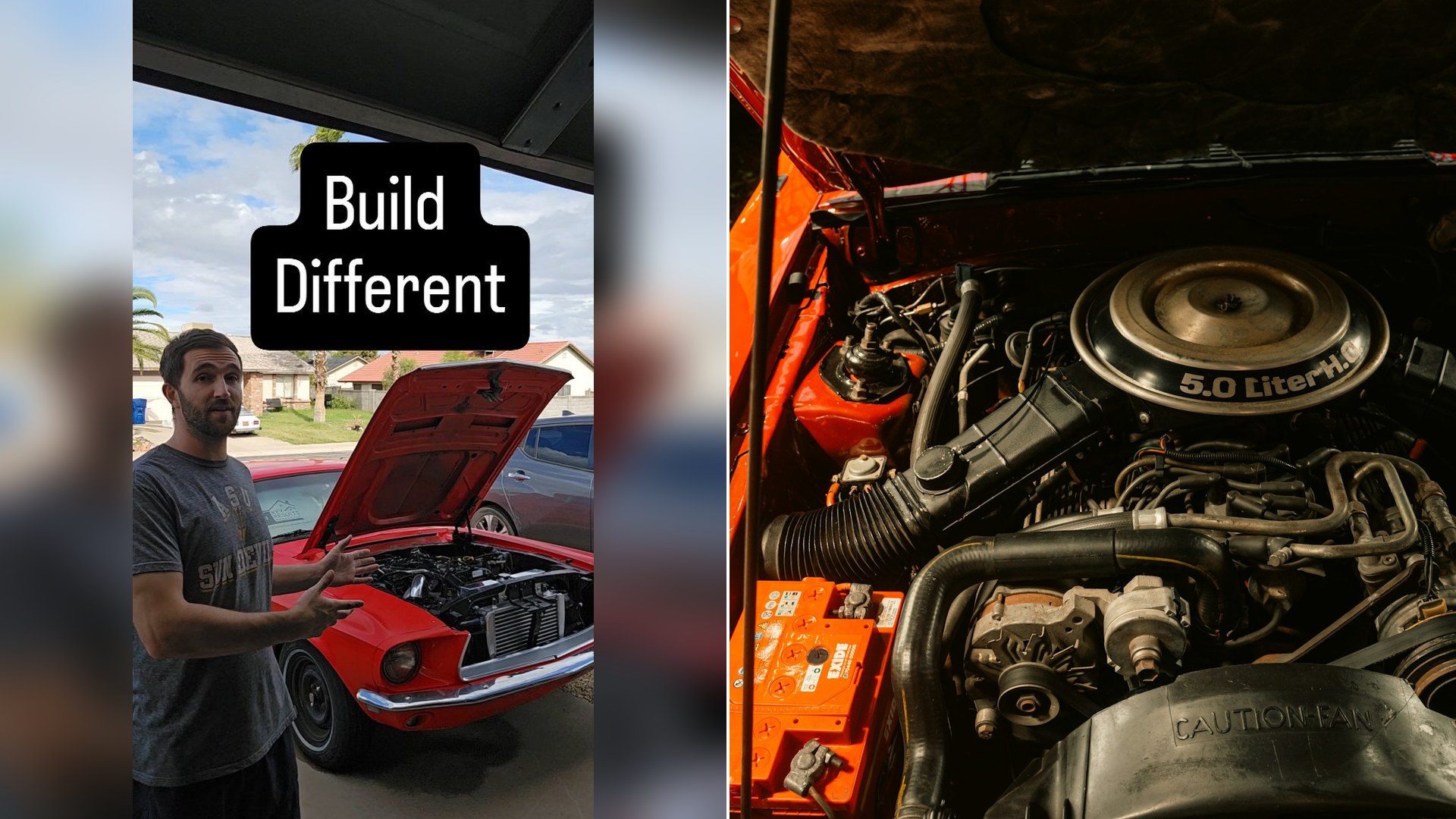
His Mustang runs a 2.3 liter EcoBoost four-cylinder, paired with a 10-speed automatic. And he says the whole thing cost him just $4,600.
View this post on Instagram
“If I Had Known How Many People This Car Would Upset, I Would Have Built It Even Sooner”
That is how the builder opens his video, and he does not sound sorry. He says the single thing that really gets under people’s skin is the swap itself: a small turbocharged four-banger in a car that left the factory with a V8 option and a lot of mystique.
Then he lays out his side. Cruising down the road, he says, he sees 35 miles per gallon. When he stomps on it, the car makes 320 horsepower through that 10-speed transmission. “I really don’t feel that bad about it,” he says.
For many older readers, those numbers will raise eyebrows on their own. Fuel economy was not a selling point for a 1968 Mustang, and it was not unusual for a V8 car of that era to struggle to reach the low twenties on a highway trip.
$4,600 Total, Air Conditioning Included, Running And Driving Down The Road
The price is the heart of his argument. He says that, the way the car sits right now, with air conditioning, running and driving, he has $4,600 into it.
That number covers the finished car in its current state, according to him. For anyone who has priced a fully built classic with a modern drivetrain, a figure like that is eye-catching. Shops commonly quote far more for a complete engine swap, before the first bolt is turned on the rest of the car.
His point is not that everyone should copy the build. It is that there is more than one way to enjoy an old pony car, and that a smaller budget should not keep a person out of the garage.
If The Mustang Is Not Your Cup Of Tea, He Has A 1969 C10 With An LT Swap On The Way
He knows the Mustang may not please every viewer, so he points to another project at his shop. It is a 1969 Chevrolet C10 pickup getting an LT engine swap.
The engine is an L83 out of a 2015 Chevrolet Silverado. He says it has some cool details, including LS pistons in place of the special dished pistons that come with the direct-injection design.
His claim is that you can build one of those LT engines for $2,000. For a builder who wants V8 sound without a big bill, he is saying there is a path.
The Channel Says It Is Not Trying To Make Enemies, Just Show Cheaper Ways To Build Something Different
He is clear about what his channel is for. In his words, the point is not to make people angry. It is to show cool ways to save money and build something different.
He finishes by promising more projects done for a lot less money than most people are spending, and he asks viewers to stay tuned.
The Mustang and the Chevy truck sit side by side in that pitch: one with a small turbocharged engine, one with a thrifty V8 built from a late-model truck engine. Both are aimed at the same buyer, someone who wants something different without an enormous bill.
That is a message with real appeal for hobbyists who have watched the cost of parts, labor and classic cars climb for years.
Why Engine Swaps Spark So Much Argument
Engine swaps have been part of American car culture for generations. Hot rodders have always dropped bigger or newer engines into older bodies, and the arguments over originality are almost as old as the hobby.
Purists value a car that matches how it left the factory, and that matters a great deal at auctions and shows. Restomod builders care more about how the car drives today, with modern fuel economy, air conditioning and a transmission that does not need constant care.
Both camps are right about different things. A numbers-matching car has one kind of value, and a comfortable daily driver has another.
What To Think About Before You Try A Swap Of Your Own
If you are tempted, start with the goal. Do you want a show car, a cruiser for Sunday drives, or a car you can drive to the grocery store in July? The answer will steer the engine, the transmission and the budget.
Think about the total job. The engine is only part of it. Wiring, fuel delivery, cooling, engine mounts, the driveshaft, brakes and the computer that runs a modern engine all add up, so a low sticker price on the motor is only the beginning.
Keep the original parts if you can. Holding on to the original engine and transmission keeps your options open if you later want to sell to a buyer who values stock.
And finally, ignore the noise. Someone will always be upset by a build. If it is safe, legal where you live and makes you smile every time you turn the key, you have done what the hobby is for.
More Stories You May Like
- Supercharged Raptor Owner Keeps Making Dyno Pulls At 11 PM Until An Officer Shows Up, And His Defense Is That He Was Not Making Any Noise
- Customer Says The Steering Suddenly Went Stiff, And When The Mechanic Lifts The Car He Finds A Power Steering Leak And Rust So Bad He Doubts It Is Worth Fixing
- Nearly 27,000 Kenworth And Peterbilt Trucks Are Recalled For A Fuel Hose That Can Leak And Stall The Engine, But Paccar Says Only 3% Are Actually Defective