

A buddy told him he was crazy. Twenty grand for a car that sat in a barn for 32 years? On @unclerickuss, the new owner of a 1970 Dodge Charger says he heard that line and answered with a promise: not one drop of new paint, and the factory black would come back.
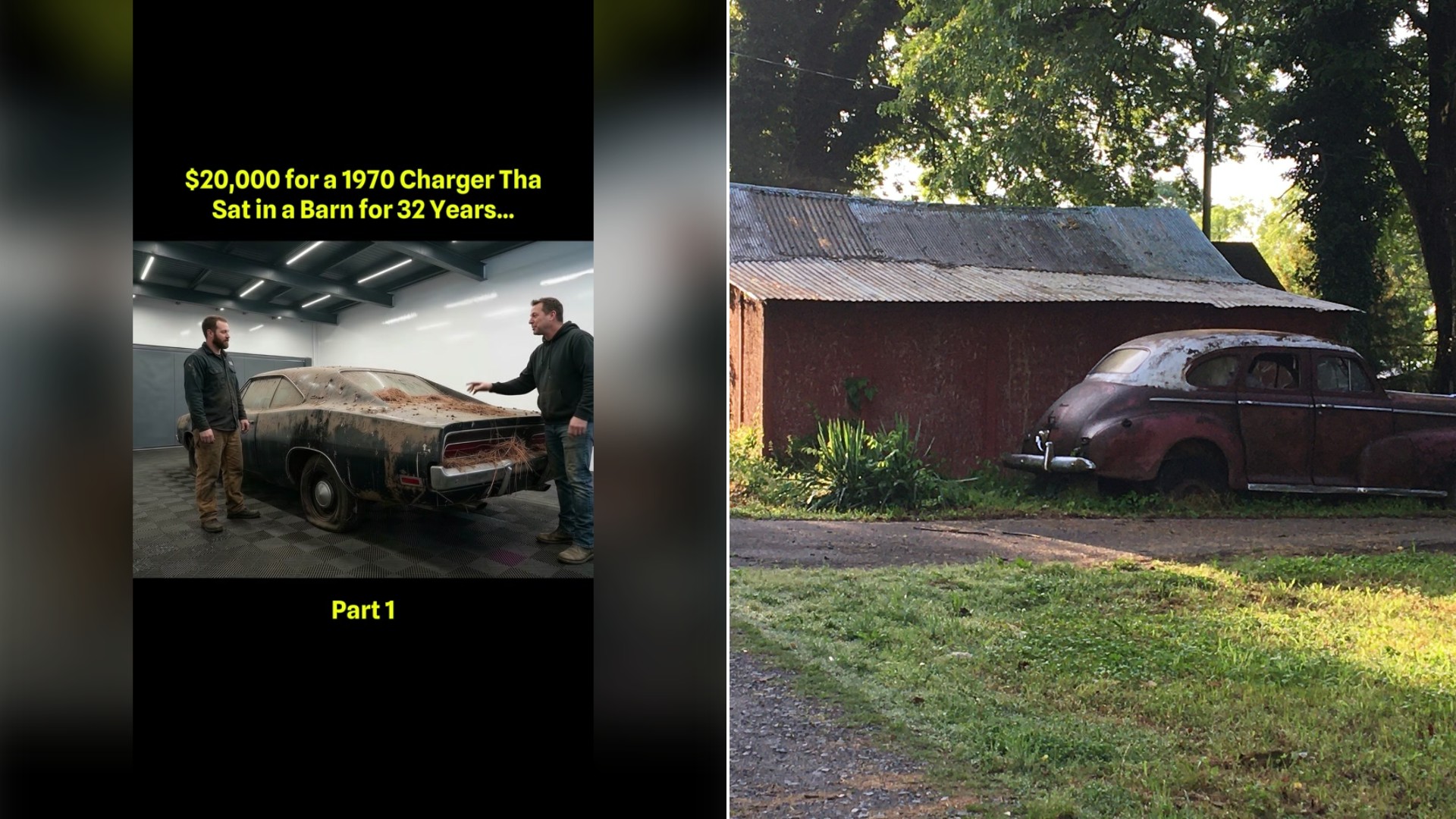
This is part one of his story, and it starts with a barn in Utah, a dead fuel pump and a whole lot of straw.
The Charger Sat Exactly Where Its Owner Left It In 1994
@unclerickuss
According to the creator, the car’s original owner bought it in 1974, during the oil crisis, when nobody wanted a big engine. In 1994 the fuel pump died. The ranch needed every dollar, the pickup became the family car, and after that nobody was allowed to touch the Charger.
Under the hood sits the 440 Magnum, Dodge’s big V8, rated at 375 horsepower from the factory. He says he paid $20,000, and that a running, clean Charger like this goes for over $80,000 at auction. Mine did not run, he says, and that gap “was exactly the size of my risk.”
His rule number one is simple: this car will not be painted. Only what cannot be saved gets replaced.
32 Years Of Straw, Pine Needles And Dried Mud Came Out By Hand
The first job was getting the barn off the car. He pulled pine needles, straw and dry leaves by hand. Every gap in the grill and the cowl was packed with 32 years of straw, and a vacuum handled what his fingers could not reach.
Then came snow foam over the whole car. He says it slid down slowly, carrying 32 years of dust with it. The routine was panel by panel: foam, brush, rinse, and one pass was never going to be enough.
He foamed down the sides to the rocker panels, where the mud had dried hard, and worked brushes into every gap of the grill where the dirt had turned to crust. Even the badges got a soft brush so the chrome letters would not scratch.
Under The Foam Came The First Answer, The Black Was Original
As the foam cleared, he says the black was dull and scratched, but it was everywhere. This car had never been repainted, and that paint left the assembly line in 1970.
The wash also showed rust spots on a door edge, a fender corner and the windshield frame. He calls it surface rust only, with no holes, and says he will deal with it later, without a drop of paint.
Collectors have a name for a car that still wears its original paint at 56 years old. They call it a survivor, and that word often carries a big premium, because original paint can never be made again once it is gone.
The Engine Bay Looked Like It Had Never Been Opened
Under the hood were 32 years of farm life: straw, hard dust and cobwebs. He cleaned the whole bay first, since nobody judges an engine covered in dirt. Degreaser went on the valve covers, the air cleaner and the hoses, followed by a soft brush.
When the water hit, the orange paint and the chrome started to show again. He says there were no marks of the engine ever being opened and no signs of a rebuild. If it ran, he says, it would run exactly as it came from the factory.
His Mechanic Roy Turned The Key, The Engine Spun Free, And Still Nothing
Then his mechanic, Roy, came to try it. He sprayed the carburetor and turned the key. The engine turned over smooth and free, with no locking noise, but it did not start. So it was not seized, and something else was stopping it.
Roy’s verdict was short. The carburetor was beyond saving, and the car needed a new one, better than the original.
Under the car, he says, the frame rails were straight and the floor was solid. The ranch left plenty of dirt but no rust in the structure, and he says that was not luck. After degreaser on the floor pans and the axle and springs, a pressure washer and a purple cleaner for the old grease around the transmission, the bare metal underneath was solid everywhere he looked.
The body was clean, but the engine still would not start. His question to viewers is the one he asked himself: would you bet on it running? “I wouldn’t,” he says. “Not yet.”
What A Smart Buyer Can Learn From A Barn Find Gamble
A story like this tempts every classic car fan, so it is worth looking at how he handled it. He did not pay for a perfect car. He paid for a car with a problem and priced the risk before he wrote the check.
- Know the finished value. A running, clean Charger like this brings over $80,000 at auction, so a $20,000 buy leaves room for parts, labor and surprises.
- Start with the gentlest method. Hand removal, a vacuum, foam and soft brushes protect old paint and chrome. Harsh scrubbing can erase the very thing that makes a survivor valuable.
- Check the bones before the beauty. Straight frame rails and a solid floor matter more than a dull finish, because structure is the costly part to fix.
- Test the engine by turning it over. If it spins freely, the engine is not seized, and a worn carburetor or fuel system is a far cheaper problem.
- Bring a mechanic you trust. A second set of eyes, like Roy’s, can save you from guessing.
The creator says the answer to the original question, whether the buy was crazy, depends on what comes next. For now the Charger has its original black, a solid frame, a 440 Magnum that spins free and a carburetor that needs replacing. For a car that sat since 1994, that is a decent start.
More Stories You May Like
- NHTSA Investigates 1,033,632 Hondas And Acuras After 701 Complaints That Engines Will Not Restart After The Start Stop System Shuts Them Off
- Chevy Never Offered The C8 Corvette With A Manual, So A Houston Shop Built A Six Speed Stick Conversion Priced Just Under $75,000 While The New Gearbox Alone Runs Near $20,000
- Honda CRX Si With 218,000 Miles And A Faded Black Repaint Still Sells For $5,420 With No Reserve After More Than Three Decades In California