
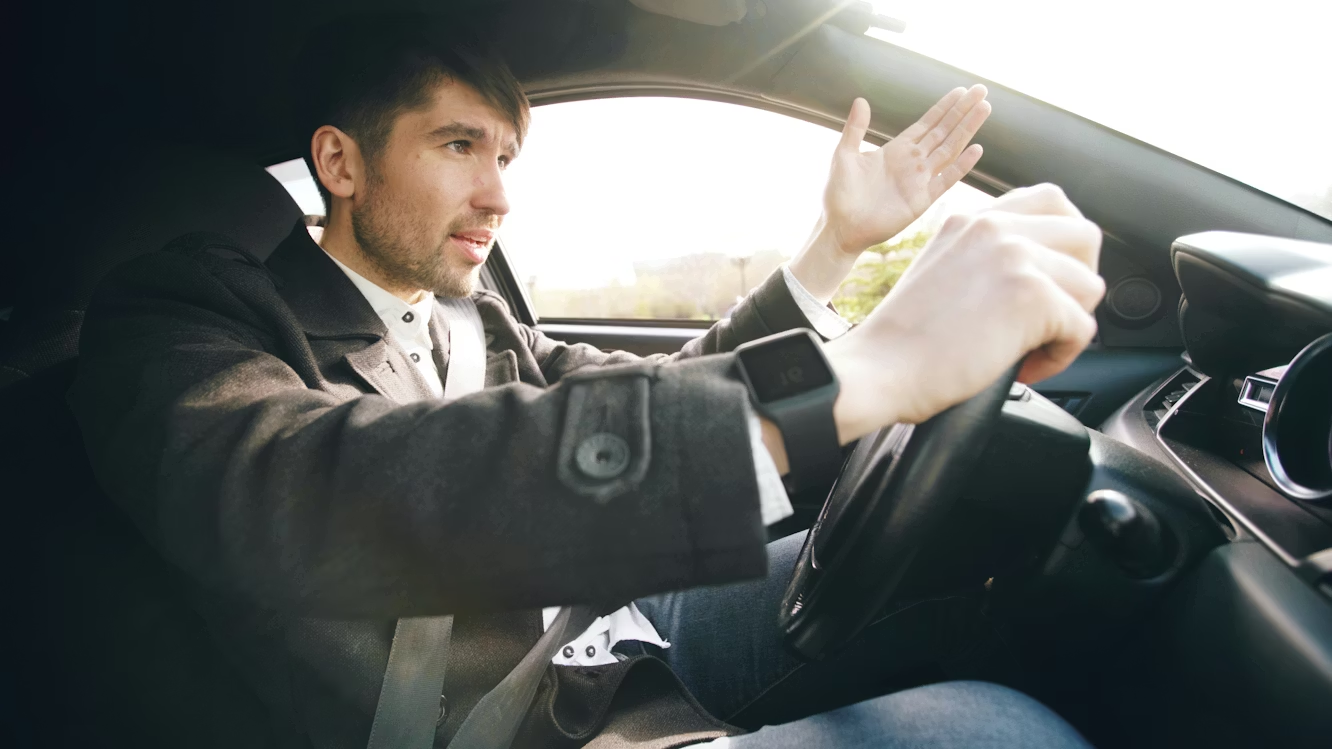

You pass a slower car on the highway, signal back into the right lane, and think nothing of it. Then the car you just passed accelerates, locks onto your bumper, and mirrors every lane change you make. When you take an exit, so do they. When you turn left, so do they. What started as a routine maneuver now feels like a pursuit, and you are running through options: call 911, find a police station, or keep circling the block so a stranger does not learn where you live.
This is not a rare scenario. According to the AAA Foundation for Traffic Safety, nearly 80 percent of U.S. drivers expressed significant anger, aggression, or road rage behind the wheel at least once in a 12-month period. A separate AAA analysis found that approximately eight million drivers engaged in extreme behaviors such as ramming another vehicle or getting out of their car to confront someone. As of early 2026, law enforcement agencies and traffic safety researchers say the problem has not improved, and some indicators suggest it has worsened since the pandemic.
The highway pass that turns into a pursuit
The pattern shows up repeatedly in police reports and driver accounts: a motorist passes a slower vehicle, and the passed driver treats it as a personal challenge. Rather than letting it go, they speed up, tailgate, and follow the other car off the highway and into surface streets. In a Reddit thread with hundreds of responses, drivers described being trailed for miles after a simple pass, with aggressors matching turns, rolling down windows to shout, and even attempting to box them in at intersections.
These accounts are not just internet anecdotes. In July 2024, deputies in an Oregon county reported that Seth Schuetler, 30, allegedly stopped his vehicle in the road, was honked at by a passing motorist, then followed a woman home, broke into her house, and attacked her husband before fleeing, according to The Kansas City Star. In Jackson County, Missouri, a prosecutor publicly warned that road rage confrontations were escalating to deadly violence, citing multiple local cases where honking or passing led to physical attacks, as covered in a local news briefing.
The numbers behind the anger
Several large-scale studies confirm that aggressive driving is widespread, not a fringe behavior. The AAA Foundation’s national survey found that roughly 96 percent of drivers admitted to at least one form of aggressive driving, including tailgating, speeding 15 mph or more over the limit, or cutting off another vehicle. That figure blurs the line between victim and perpetrator: nearly everyone is contributing to the problem at some level.
More recent survey data from The Zebra’s 2024 road rage report found that 96 percent of respondents said they had witnessed at least one act of road rage in the prior six months, with incidents ranging from aggressive tailgating to drivers exiting their vehicles to confront others. In a companion study, 76 percent of those surveyed said they believed road rage had gotten worse compared with the previous year.
The most alarming trend involves firearms. The Gun Violence Archive has tracked hundreds of road rage shooting incidents annually in recent years, a figure that was relatively rare before 2020. Everytown for Gun Safety has reported that road rage incidents involving a firearm have roughly doubled over the past decade, making what used to be a shouting match potentially lethal.
Why a simple pass triggers such extreme reactions
Dr. Jerry Deffenbacher, a Colorado State University psychologist who has studied anger in drivers for decades, has identified a profile he calls the “high-anger driver”: someone who interprets ambiguous traffic situations as personal insults and responds with disproportionate hostility. Being passed, in this framework, is not a neutral event. It is a status threat.
Several psychological factors make the car an unusually effective incubator for rage. The enclosed cabin creates a sense of anonymity. Drivers cannot talk to each other, so they fill in the other person’s intentions with the worst possible reading. Time pressure and stress shorten the fuse. According to a review of road rage psychology, the combination of anonymity, perceived provocation, and the inability to communicate clearly accelerates anger into aggression faster than almost any other everyday setting.
Broader social stressors have compounded the problem. Traffic safety analysts at Smith System, a fleet safety firm, have linked the post-2020 surge in dangerous driving to pandemic-related anxiety, reduced law enforcement presence on highways during and after COVID-19 lockdowns, and a general erosion of patience that has not fully recovered. Legal commentators have pointed to financial pressure, political polarization, and weakened social norms as additional accelerants.
Aggressive driving vs. criminal road rage: where the legal line falls
Traffic law draws a meaningful distinction between aggressive driving and road rage, even though the terms are often used interchangeably. Aggressive driving typically covers speeding, tailgating, and unsafe lane changes. These are traffic infractions. Road rage involves a deliberate intent to intimidate, threaten, or harm another person, and it can carry criminal charges.
As one legal analysis from Gallo Law in Nevada explains, a driver who follows another vehicle for several miles, pulls alongside, and yells threats could face charges for reckless driving, assault, or stalking, depending on the jurisdiction. In states with specific road rage statutes, penalties can include felony charges if a weapon is involved or if the behavior results in injury.
For the driver being followed, this distinction matters practically: if someone is merely tailgating aggressively, the situation may resolve on its own. If they follow you off the highway and through multiple turns, that behavior has likely crossed into criminal territory, and calling 911 is appropriate.
What to do if someone is following you after a road rage encounter
Safety guidance from law enforcement and traffic safety organizations is consistent on this point. If you believe another driver is following you out of anger:
- Do not go home. Leading an aggressive stranger to your address creates a longer-term safety risk.
- Do not stop in a secluded area or get out of your car. Stay in your vehicle with doors locked and windows up.
- Stay on well-lit, well-traveled roads. Other drivers and witnesses are a deterrent.
- Drive to a safe destination. A police station is ideal. A fire station, hospital emergency entrance, or busy 24-hour business (gas station, supermarket) also works. As one driver in an Austin-area discussion suggested, it helps to mentally map these locations along your regular routes before you need them.
- Call 911. Give the dispatcher your location, direction of travel, and a description of the other vehicle, including the license plate if you can read it safely. As De Luca & Geffner’s safety guide notes, once behavior crosses from aggressive driving into deliberate pursuit, involving law enforcement is the right call.
- Do not engage. Avoid eye contact, gestures, or any response that could be interpreted as a challenge. The goal is to bore the other driver into giving up or to reach a safe location before the situation escalates further.
Dashcams and documentation
One practical step that safety advocates increasingly recommend is installing a front-and-rear dashcam. Footage of an aggressive driver following you provides law enforcement with evidence that can support charges and helps establish a clear record if the situation escalates to a collision or confrontation. Many modern dashcams record GPS coordinates and timestamps automatically, which strengthens any police report or insurance claim.
The bigger picture
Road rage after being passed is not a new phenomenon, but the intensity and frequency of these encounters appear to be climbing. A combination of widespread stress, reduced traffic enforcement in many jurisdictions, and a cultural shift toward shorter tempers on the road has created conditions where a routine lane change can spiral into a genuine threat. The data from AAA, The Zebra, and the Gun Violence Archive all point in the same direction: more drivers are angry, more confrontations are happening, and more of those confrontations involve serious danger.
For individual drivers, the most effective response is also the least satisfying: do not engage, do not retaliate, and have a plan for reaching safety. The pass that bruised someone’s ego is not worth a confrontation that could end in violence.
More from Wilder Media Group: