
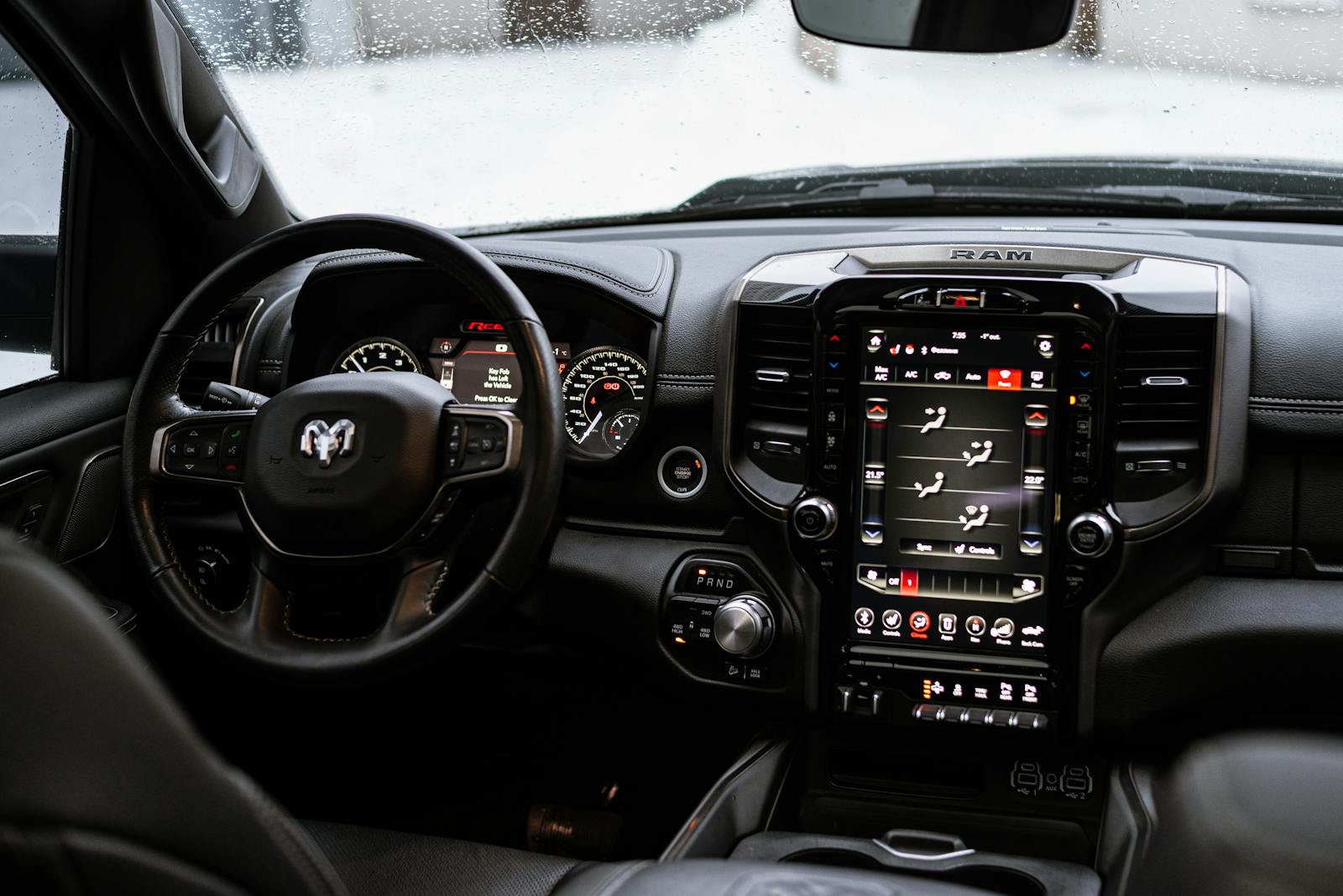

Kyle Decker bought a 2025 Ram 1500 last fall expecting the best truck he’d ever owned. What he didn’t expect was a fight with the dashboard every time he wanted to defog the windshield. “I’m pulling a horse trailer on a two-lane road in the rain, and I have to look down and tap through two menus to get the defroster going,” Decker, a farrier in eastern Oregon, wrote in a Ram owners’ forum post that drew hundreds of replies. “That’s not an upgrade. That’s a hazard.”
Decker’s complaint has become one of the loudest choruses in the automotive world. As automakers consolidate nearly every cabin function behind a single touchscreen, a growing body of safety research, a string of federal recalls, and a regulatory shift in Europe are all converging on the same conclusion: screens that control everything may be asking too much of the humans behind the wheel.
The science of looking away
Distracted driving research has long sorted the problem into three categories: visual (eyes off road), manual (hands off wheel), and cognitive (mind off task). Touchscreens are unusual because they can trigger all three simultaneously. A driver adjusting cabin temperature on a physical dial can do it by feel without breaking eye contact with the road. The same adjustment on a flat screen demands a glance, a precise tap, and often a second glance to confirm the input registered.
A 2020 study commissioned by the UK road-safety organization IAM RoadSmart and conducted by TRL (the Transport Research Laboratory) found that drivers using touchscreen interfaces at highway speeds had reaction times that were up to 57 percent worse than baseline, and worse than reaction times recorded at the legal alcohol limit in England and Wales. Participants using Apple CarPlay via a touchscreen also showed significantly degraded lane-keeping and response times.
Separate research from the Swedish National Road and Transport Research Institute (VTI), published in partnership with Chalmers University of Technology, tested common in-car tasks across multiple vehicle brands and found that interacting with built-in touchscreens produced significantly more lane deviations than performing the same tasks with physical controls. The effect was most pronounced for climate adjustments and navigation entry, tasks that truck drivers perform routinely.
Recalls show the stakes are not hypothetical
The safety risk is not limited to distraction. When a touchscreen is the sole interface for critical vehicle information, a software failure can leave a driver blind to speed, fuel level, and warning lights all at once.
In 2023, Stellantis recalled more than 72,000 Ram 1500, 2500, and 3500 trucks after instrument-cluster displays went blank without warning, depriving drivers of speedometer and telltale readings required under Federal Motor Vehicle Safety Standard 101 (FMVSS 101). In January 2026, Toyota announced a recall of roughly 162,000 Tacoma pickups over screen malfunctions that could similarly black out driver information.
Ford faced its own reckoning. Two large software-related recalls covering millions of vehicles prompted NHTSA officials to note that the defect conditions could affect 100 percent of the units within the recall population, meaning every vehicle built in the affected production window was at risk, not just an unlucky few.
Michael Brooks, executive director of the Center for Auto Safety, has been among the most vocal critics. “When the screen goes dark, they lose their speedometer. They lose their warning lights. That is inherently dangerous,” Brooks told Spotlight on America in a January 2026 segment. U.S. Senator Mike Mullin has called for the Department of Transportation and NHTSA to conduct a formal study of touchscreen-related safety risks, arguing the issue goes well beyond personal preference.
Drivers are not asking for less technology. They want better design.
Consumer frustration with all-screen dashboards has been building for years, but recent survey data suggests it has reached a tipping point. A 2025 J.D. Power U.S. Tech Experience Index study found that owner complaints about difficult-to-use controls rose for the third consecutive year, with touchscreen-dependent climate and audio systems drawing the sharpest criticism. A Car Talk feature titled “Gimme Back My Buttons” cataloged the sentiment bluntly: drivers want physical knobs and switches for the tasks they perform most often, not because they fear technology, but because they need to operate controls without diverting attention from the road.
The distinction matters. Few drivers object to a large screen for navigation maps or media browsing while parked. The objection is to burying climate, wiper speed, mirror adjustment, and defroster controls inside layered menus that demand the same visual attention as a smartphone app, at 70 miles per hour.
Regulators and automakers start to reverse course
Europe moved first. Beginning with its 2026 assessment protocols, Euro NCAP now requires that key functions, including turn signals, hazard lights, windshield wipers, and the horn, be operable via dedicated physical controls in order for a vehicle to earn a full five-star safety rating. The change was a direct response to the proliferation of touch-only dashboards, and it sent a clear signal to manufacturers selling into the European market.
Automakers have started to respond. Volkswagen redesigned the dashboard of the latest Polo (built on the MEB Entry platform) to restore physical buttons for climate and volume after the ID.3 and ID.4 drew persistent complaints for their touch-capacitive sliders. Hyundai acknowledged in early 2026 that it is pulling back from its all-touchscreen approach for the North American market, citing direct feedback from U.S. buyers. Even Porsche, which introduced a wide curved display in the Taycan, retained a physical volume knob and climate toggles after internal testing showed drivers preferred them.
In the United States, no equivalent to Euro NCAP’s mandate exists yet. FMVSS 101 requires that certain controls and displays be accessible and readable, but it was written in an era of analog gauges and has not been updated to address the specific risks of software-dependent interfaces. Whether Senator Mullin’s proposed study leads to rulemaking remains to be seen, but the direction of the conversation, in Washington and in design studios, has clearly shifted.
What truck buyers can do right now
For buyers shopping for a new pickup in spring 2026, the landscape is mixed. Some manufacturers, notably Toyota with the Land Cruiser and Lexus GX, have kept redundant physical controls for climate and audio alongside their touchscreens. Ram’s latest infotainment revision still leans heavily on the 14.5-inch Uconnect display, though a row of shortcut buttons sits below it. Ford’s 2026 Super Duty retains a physical climate-control panel, a concession to the work-truck market where gloved hands and muddy fingers make touchscreens impractical.
The simplest advice for any buyer: before signing, sit in the driver’s seat, put on your work gloves, and try to change the fan speed, activate the defroster, and adjust the mirrors without looking at the screen. If you can’t, that screen is not just an inconvenience. On a rainy two-lane road with a trailer behind you, it is a liability.
More from Wilder Media Group: