
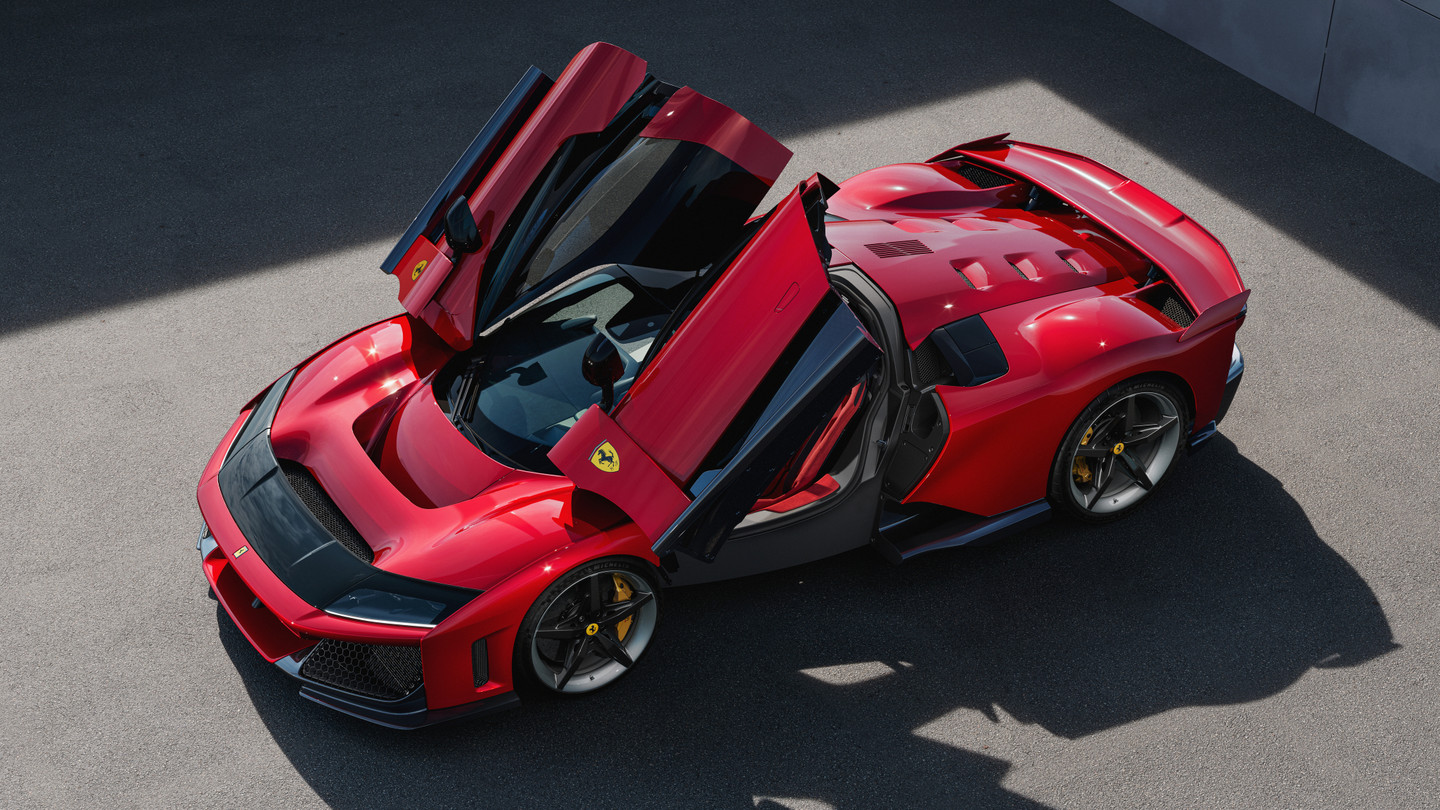

You can feel the pulse of F1 under your right foot: the new Ferrari F80 pairs a turbo V6 hybrid and electric drive to deliver staggering power while still behaving like a car you could drive each day. Expect a 199 mph top speed and race-derived tech tuned for road comfort, giving you supercar performance without sacrificing usable manners.
The cabin wraps that engineering in Italian luxury so you get both high-performance thrills and materials, ergonomics, and details that make time in the car enjoyable. This piece will unpack how Ferrari grafted F1 systems into a road-legal package and why that matters for your driving experience.
Ferrari F80: F1 Tech Meets Road-Ready Supercar
The F80 stitches race-derived engineering into a car you can drive on public roads. Expect a compact, high-rev V6 hybrid, massive downforce, active suspension, and sharp gearbox and brake hardware tuned for both track and street.
Hybrid Powertrain and V6 Innovation
Ferrari fits a 120° three-litre V6 at the heart of the F80, tuned to about 900 hp from the internal-combustion engine and roughly 300 hp from electric systems for a combined figure near 1,200 hp. The layout borrows architecture and components from the Le Mans-winning 499P and Ferrari’s F1 electric systems, including MGU-K-style concepts and in-house high-speed electric motors.
You get electric assistance on the front axle via two compact motors for torque vectoring and a rear MGU-style motor for drive and regeneration. The car uses electric turbo (e-turbo) technology to remove lag and keep the torque curve immediate. The power electronics run at 800 V, and a novel DC/DC converter supplies 48 V for e-turbos and active suspension while eliminating a separate 48 V battery to save weight.
F1-Inspired Aerodynamics and Downforce
Ferrari engineered the F80’s body around extreme aero: an active rear wing, rear diffuser, flat underbody, front triplane wing, and S‑duct collaborate to produce around 1,000 kg of downforce at roughly 250 km/h. Designers narrowed the cabin to reduce frontal area, improving drag and allowing more aggressive wing and undertray geometry without compromising road legality.
Active aero elements adjust continuously, prioritising stability and cornering grip when you push hard and lowering drag at high-speed straights. The result mirrors race-car airflow management but tuned to be usable on public roads, with component choices and materials derived from Maranello’s motorsport programs.
Active Suspension and Chassis
The F80 uses an active suspension system integrated with ride-height control and active dampers to produce ground-effect benefits and maintain compliance on uneven surfaces. Suspension control ties directly into torque-management and aero settings so the car can generate downforce actively while keeping tyre contact optimal.
Ferrari engineers reduced weight with a carbon-fibre chassis and lightweight components—titanium screws and optimised internals—while packaging the engine low to lower the centre of gravity. The result gives you a chassis that feels race-bred yet manageable at street speeds, with a manettino-style selector shaping behaviour across comfort and full-performance modes.
Performance Stats: Speed, Power, and Handling
Known production runs cap at 799 examples, making the F80 exclusive and collectible. Peak combined power sits around 1,200 hp, with the internal V6 revving toward 9,000 rpm and a dynamic limiter near 9,200 rpm. Top speed targets exceed 199 mph (around 320 km/h), while the aggressive aero and e-4WD layout prioritise lap-time capability and mid-corner stability.
You’ll find an eight-speed dual-clutch gearbox engineered for lightning shifts and driveline damping to handle high torque. Stopping power comes from motorsports-derived CCM-R brakes with Brembo calipers, and traction control integrates with the hybrid system for optimised boost and torque delivery.
Luxury Design and Everyday Usability
This car marries track-derived engineering with details that make daily driving comfortable. Expect bold exterior cues, a tight driver-centric cockpit, and materials chosen for both tactile quality and durability.
Distinctive Exterior and Interior Styling
You’ll notice the silhouette borrows racing lines without being courtly; the front splitter, S-Ducts, and active rear wing are functional and visually striking. The bodywork channels airflow much like the Ferrari F80 and elements from the 849 Testarossa concept, but kept road-legal and refined for street use.
Butterfly doors are an available option on some show cars in this segment; if offered here they would add drama and easier curbside entry in tight garages.
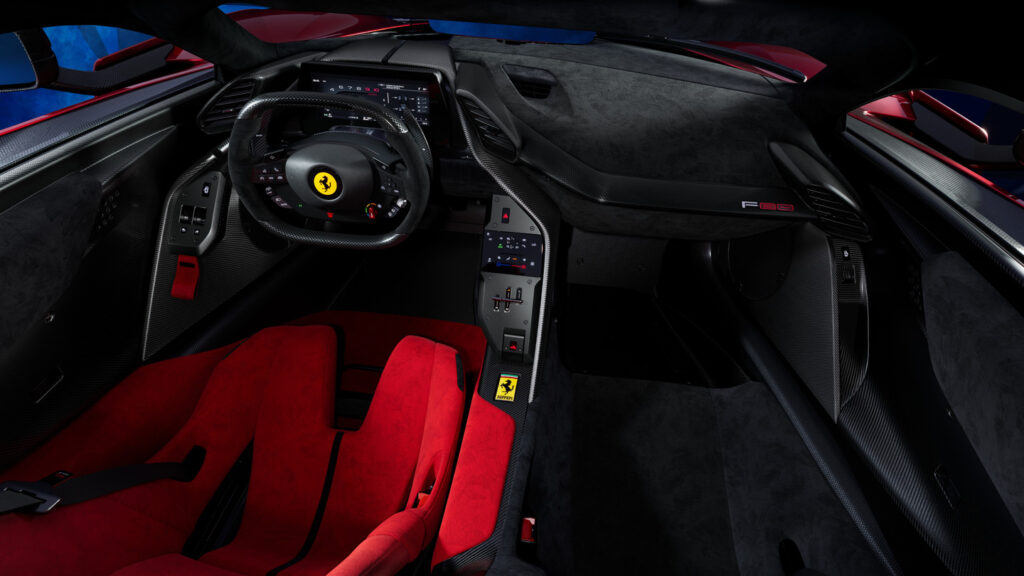
Inside, the cabin blends clean surfaces with exposed carbon-fiber sections inspired by modern Ferraris and contemporary hypercars like the Rimac Nevera. Controls sit low and tactile; vents and trim pieces follow simple, purposeful geometry. You get a look that reads aggressive from the outside but feels composed and intentional once you’re seated.
Driver-Focused 1+ Cabin Layout
The layout prioritizes you as the driver with a “1+” configuration that places the passenger slightly aft for better ergonomics and visibility. Steering wheel-mounted controls and a compact instrument binnacle keep information within your line of sight so you rarely take your hands off the wheel.
An adjustable driver seat, steering column, and pedal box allow custom fitment that’s crucial when switching from street driving to track days.
Tech integrates without clutter: a central touchscreen handles infotainment while driving modes and performance telemetry remain physical or within the driver display for instant access. The setup reflects lessons from MotoGP and F1 packaging—minimal distraction, maximal feedback—so you feel connected to the chassis at all speeds.
Materials, Comfort, and Customization
Materials mix full-grain leather, Alcantara, and exposed carbon fiber to balance luxury with weight savings. You can specify heated and ventilated seats with memory functions and contrast stitching that echoes exterior hues like Ferrari Luce finishes.
Sound insulation is tuned to reduce urban drone while preserving engine character; the result keeps the cabin pleasant on commutes but alive under hard acceleration.
Customization options cover trim inserts, wheel designs, and bespoke paint codes drawn from Ferrari’s heritage palette and modern inspirations. You’ll find storage solutions—lockable glovebox, shallow center tray, and under-seat pockets—useful for daily items. Practical touches like a soft-close glovebox and washable floor mats make ownership easier without diluting the car’s performance intent.
Links for further reading: learn about the SF90’s hybrid architecture on the Ferrari SF90 Stradale official page and see how Ferrari balances supercar utility in the Purosangue review.
More from Steel Horse Rides: