
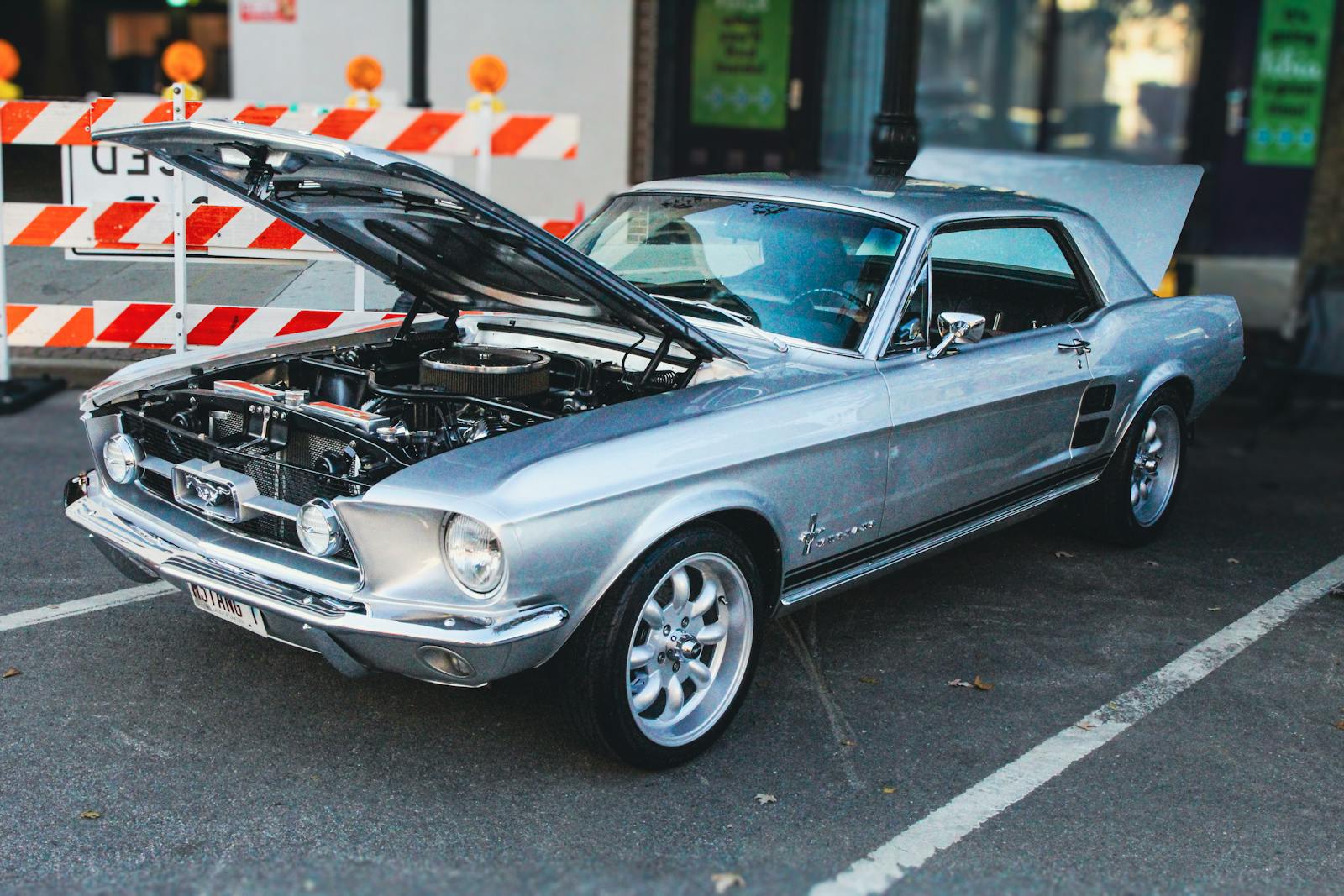

Ford’s 427 and 428 FE V8s came from the same basic big-block family, yet they ended up with very different personalities on the street and track. Small changes in bore, stroke, and intended use turned two closely related engines into distinct legends that still fuel arguments at cruise nights and auction blocks. Understanding how those details diverged explains why one became a racing icon while the other quietly powered everything from muscle cars to full-size family sedans.
From FE workhorse to racing weapon
Ford’s FE series started life as a versatile V8 architecture meant to cover a wide range of passenger cars and trucks, not as a pure racing platform. The family shared key dimensions like the 4.63-inch bore center spacing that later defined both the 427 and 428, which allowed engineers to scale displacement up and down without reinventing the block each time. Within that shared framework, the company could tailor specific versions for durability, low-end torque, or high-rpm power, depending on whether the engine was destined for a pickup, a Galaxie, or a purpose-built competition car.
As performance pressures mounted in the early 1960s, Ford began pushing the FE design toward the limits of what that architecture could handle. The 427 emerged as a heavily reworked evolution that prioritized strength and breathing at high engine speeds, while the 428 was developed as a larger displacement, more street-friendly option that still fit within the same basic casting envelope. That shared lineage is why enthusiasts often lump them together, but the engineering choices inside the block and heads show how far Ford was willing to stretch a common foundation in different directions.
Displacement games and the “427” badge
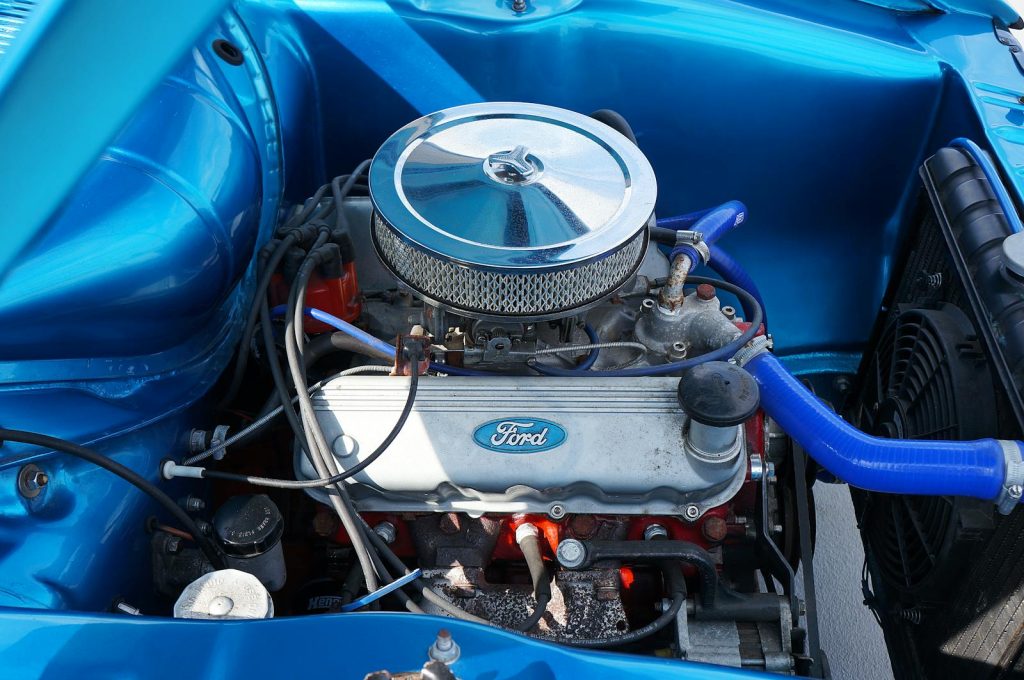
On paper, the difference between 427 and 428 cubic inches looks trivial, yet the way Ford arrived at those numbers reveals how marketing and racing rules shaped the FE line. When the 427 FE debuted for competition, NASCAR had a 427-cubic inch limit, so When the sanctioning body set that cap, Ford responded by effectively turning what had been a 426 into a “427” to meet the letter of the rulebook and the expectations of race fans. The badge on the fender therefore reflected not just displacement, but a direct conversation between engineers and regulators about how far they could push the big-block within the rules.
The 428, by contrast, was never primarily a homologation tool, even though it shared the same FE roots and the same 4.63-inch bore center spacing as the 427. It was conceived as a higher-displacement street engine that could deliver strong torque at lower rpm without the exotic internals or race-focused maintenance that the 427 demanded. That is why enthusiasts often talk about “what’s in a name” when comparing the two, since the 427’s label was tied closely to competition limits while the 428’s number simply reflected a practical bump in swept volume for everyday performance buyers.
Bore, stroke, and the math behind 427 vs 428
The most fundamental mechanical split between the two engines lies in how Ford balanced bore and stroke to reach their respective displacements. The 428 used a Bore of 4.132 inches and a Stroke of 3.980 inches, figures that gave it a slightly undersquare layout and helped emphasize torque over revs. In contrast, the 427 relied on a larger 4.23-inch bore with a shorter stroke, a combination that favored high-rpm breathing and allowed bigger valves and ports to feed the cylinders more efficiently. That is why period guidance from Ford cautioned against boring a 428 block out to the 427’s 4.23 dimension, since the casting was not designed for that level of overbore and durability would suffer.
These small numerical differences translated into very different personalities once the engines were installed in cars. The 428’s longer stroke and smaller bore made it smoother and more relaxed in everyday driving, ideal for heavy full-size models and luxury-leaning performance trims that needed effortless low-end pull. The 427’s big bore and shorter stroke, by contrast, produced an engine that came alive at higher rpm, which is exactly what racers wanted on long straights and high-banked ovals. Detailed breakdowns of the FE family’s specifications show how the 428, 4.132, 3.980, 427, and 4.23 figures defined the outer limits of the architecture and why Whereas the engineers treated each combination as a distinct tool rather than interchangeable variants.
Shared FE DNA, different engineering priorities
Despite those internal differences, both engines remained firmly rooted in the same FE DNA, which simplified production and allowed Ford to spread development costs across a wide range of models. The shared 4.63-inch bore center spacing meant that many external dimensions, mounting points, and accessory drives could be carried over, making it easier to drop either a 427 or 428 into existing chassis without major reengineering. That commonality also helped dealers and racers mix and match components, from intake manifolds to exhaust systems, even as the short blocks and internal hardware diverged.
Inside the engines, however, the priorities were clearly different. The 427 received heavy-duty internals, reinforced main webs, and high-flow cylinder heads that were optimized for sustained high-rpm operation, reflecting its role as a competition-focused powerplant. The 428, while still robust, was built with more conventional components and tuning that favored reliability and drivability over the extreme stresses of racing. Analyses that compare the two point out that even though they share the same 4.63-inch bore center spacing and belong to the same FE line, the 427 and 428 were engineered with distinct end users in mind, a contrast that writers like Don have highlighted when explaining how these engines evolved from a common starting point.
427: the FE that reshaped Ford’s racing image
In motorsport, the 427 quickly became the FE variant that defined Ford’s competitive ambitions. It was the engine that powered factory-backed efforts in stock car racing and drag strips, where its big-bore, short-stroke layout and reinforced block could withstand the brutal demands of sustained high rpm. The 427’s reputation grew as it delivered wins and headlines, turning what had started as a derivative of a workhorse V8 family into a symbol of the company’s determination to dominate on track.
On the street, however, the 427 enjoyed a more modest career, appearing in limited-production performance models and specialty builds rather than across the full lineup. It found a home in the Cobra, where its compact external dimensions and ferocious output transformed a lightweight British chassis into one of the era’s most feared sports cars. Historical accounts of the engine’s development describe how On the racing side it changed Blue Oval motorsports forever, even as its street presence remained relatively rare compared with more mainstream FE variants.
428: the quiet workhorse with muscle credentials
While the 427 grabbed the racing headlines, the 428 quietly became the FE that most buyers actually encountered in showrooms. Its combination of larger displacement, moderate compression, and street-oriented cam profiles made it ideal for full-size sedans, personal luxury coupes, and later muscle cars that needed strong torque without race-level maintenance. The engine’s smoother character and broader torque curve suited automatic transmissions and everyday driving, which is why it appeared in far more production vehicles than its high-strung sibling.
Enthusiasts often remember the 428 for its role in performance models that blended comfort with speed, where its relaxed nature at part throttle did not prevent it from delivering serious acceleration when prodded. Because it shared so much external hardware with other FE engines, it was relatively easy for Ford to package the 428 across different platforms and trim levels, from family-oriented cars to more aggressive packages. That ubiquity, combined with its forgiving manners, helped cement the 428’s reputation as the practical big-block choice even as the 427 remained the aspirational halo motor.
Thunderbolt, Cobra, and the cars that made the numbers famous
The 427’s legend is inseparable from the cars that carried it, and few are more emblematic than the Ford Fairlane Thunderbolt. Built as a limited-run drag racing special, the 1964 Ford Fairlane Thunderbolt 427ci V-8 used a stripped-down midsize body and a race-prepped FE to attack quarter-mile records, a combination that turned the car into an instant icon. Auction listings from venues like Mecum underscore how the Thunderbolt’s 427ci V-8 specification remains central to its value, since it represents one of the purest expressions of Ford’s factory-backed drag racing strategy.
At the same time, the 427’s presence in the Cobra gave it an international profile that extended beyond American muscle culture. Dropping a big-block FE into a lightweight roadster created a car that was as notorious for its raw performance as for its challenging manners, and that notoriety fed back into the engine’s mystique. Modern comparisons that look at Ford’s 427 vs 428 FE V8 engines often use the Thunderbolt and the Cobra as touchstones, illustrating how the same basic displacement could serve very different roles depending on whether it was tuned for the strip, the street, or a road course, as detailed in breakdowns of the Ford Fairlane Thunderbolt and related applications.
Why enthusiasts still argue 427 vs 428
Decades after these engines left production, debates about which is “better” remain a staple of enthusiast forums and car shows. Supporters of the 427 point to its direct racing pedigree, its high-rpm capability, and its association with halo cars as proof that it represents the pinnacle of FE development. They argue that the engine’s big-bore design, specialized internals, and limited production make it not only more desirable but also more historically significant, especially in the context of factory-backed competition programs.
Fans of the 428 counter that real-world performance and usability matter more than racing trophies, and on that score the longer-stroke FE often comes out ahead for street use. Its broader torque curve, smoother manners, and wider availability made it the engine that powered countless memorable drives, from long highway trips to impromptu stoplight sprints. Technical comparisons that ask what is the difference between the Ford 427 and Ford 428 emphasize that both share the same 4.63-inch bore center spacing and FE lineage, yet enthusiasts like Don highlight how those small internal changes created two distinct experiences that continue to divide opinion, as seen in detailed breakdowns of the 427 and 428 rivalry.
Legacy of small changes with big consequences
Looking back, the story of the 427 and 428 FE V8s shows how incremental engineering decisions can ripple outward into culture, competition, and collector values. A few thousandths of an inch in bore, a slightly longer stroke, or a different target rpm range were enough to turn one engine into a racing thoroughbred and the other into a dependable street powerhouse. Those choices shaped which cars became legends, which engines filled junkyards and swap meets, and which casting numbers collectors now chase with near-obsessive focus.
In the modern era, the two engines also serve as case studies in how manufacturers balance racing ambitions with mass-market realities. The 427’s role in motorsports and limited-production specials helped burnish Ford’s performance image, while the 428’s widespread use kept the FE architecture relevant for everyday buyers. Together, they demonstrate that within a single engine family, small changes in design and intent can produce dramatically different outcomes, a lesson that continues to inform how enthusiasts and historians interpret the evolution of American V8 performance.
More from Wilder Media Group: