
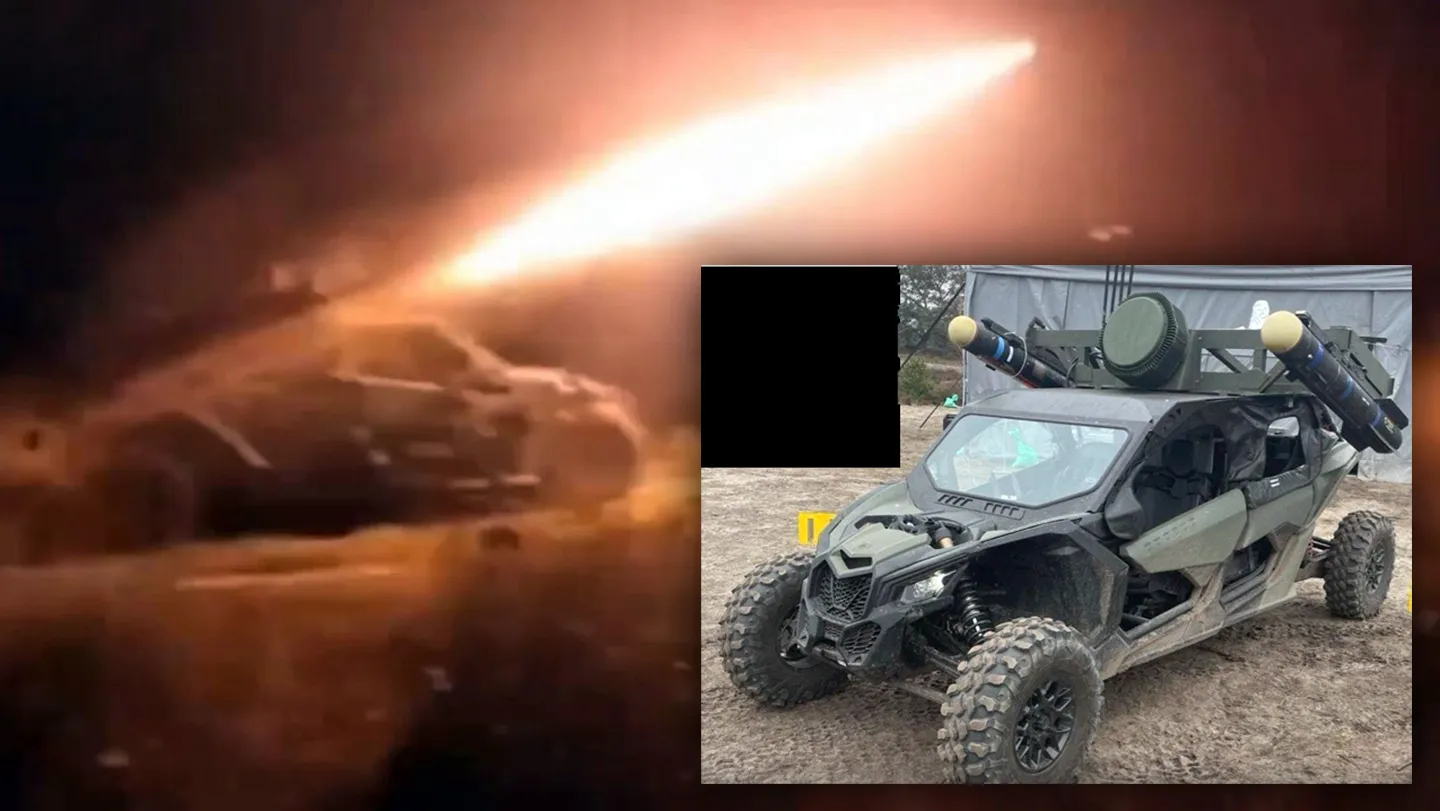

A low-slung off-road buggy carrying Hellfire-class missiles is now part of Ukraine’s answer to the drone threat, pairing commercial speed with heavyweight firepower. The vehicle, built on a Can-Am Maverick X3 chassis, reflects how Ukrainian forces are racing to field agile air defenses that can keep up with dispersed units and roaming quadcopters. Its arrival signals a shift toward compact, missile-armed platforms that can hunt drones from the front line instead of waiting for them over fixed sites.
The new system, known as Tempest, has moved from concept to operational use in a remarkably short time, with Ukrainian Air Force units already photographed training and deploying the buggy. By mounting radar, optics, and anti-air missiles on a civilian side-by-side, Ukrainian engineers and volunteers are trying to out-innovate Russian operators who rely heavily on small uncrewed aircraft for reconnaissance and attack. The result is a Hellfire-armed, drone-killing machine that looks more like a desert racer than a traditional surface-to-air launcher.
From Can-Am Maverick to Tempest Air Defense Buggy
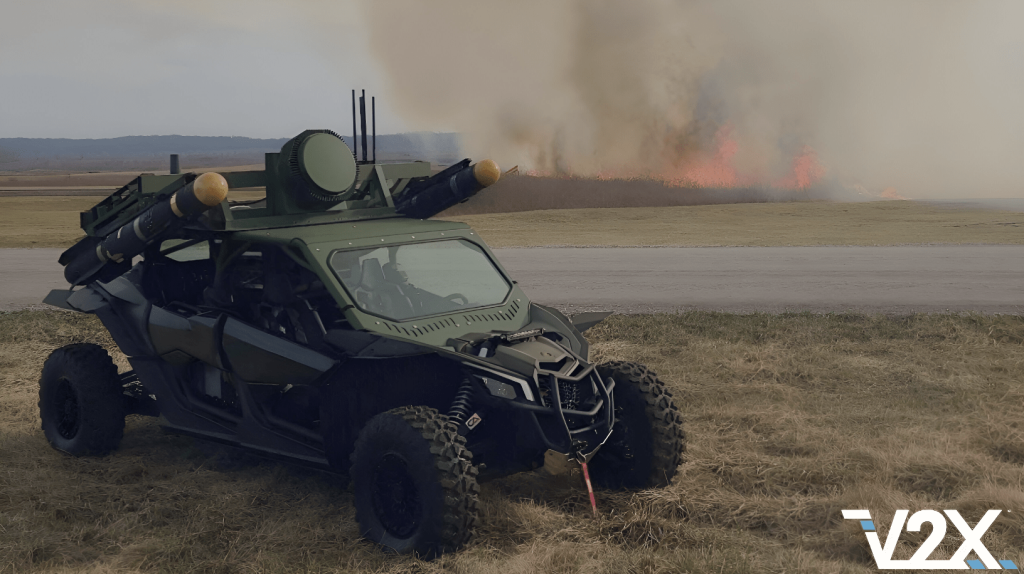
The heart of the new system is a commercial-standard Can-Am Maverick X3, a high-performance side-by-side that Ukrainian specialists have turned into a compact short-range air defense platform. Imagery shows the buggy carrying missile canisters and sensors while retaining the Maverick’s off-road suspension and speed, a combination that allows crews to sprint into firing positions, engage, and then relocate before counter-battery fire arrives, according to reporting on the Hellfire armed configuration. The choice of a widely available commercial platform also simplifies maintenance and replacement in a war where attrition of vehicles is constant.
New high-quality photos of the Tempest short-range air defense “buggy” in service with the Ukrainian Air Force show the system during delivery and setup, confirming that this is not a one-off prototype but a fielded asset. Those images highlight how the Tempest turret, sensors, and missile pack are integrated onto the Maverick frame while keeping the vehicle’s low silhouette, which is crucial when survivability and low visibility are critical on a battlefield saturated with surveillance drones, as detailed in reports on the Tempest air defense system. The result is a hybrid of civilian motorsport engineering and military-grade missile technology tailored to Ukraine’s front-line needs.
Tempest, Longbow Missiles, and Ukraine’s Drone War
Ukrainian troops have formally adopted the Tempest air defense system, with coverage noting that Dmytro Shumlianskyi has highlighted its role as a new tool for countering low-flying threats. The system is described as a short-range solution for Ukrainian Dro units that must defend themselves against loitering munitions and reconnaissance drones while maneuvering, a mission that favors light, mobile launchers over heavy tracked vehicles, according to accounts of Ukrainian troops integrating Tempest. References to “47” in that context underscore how closely observers are tracking each new air defense asset that reaches the front.
While the platform itself is intended to be affordable and flexible, Tempest relies on AGM-114L Longbow missiles, whose active radar seekers allow the buggy to fire and then immediately maneuver without requiring continuous target illumination. That fire-and-forget capability is particularly valuable in heavy warfare, where lingering in one place invites artillery or loitering munition strikes, as assessments of the AGM Longbow pairing with Tempest have noted. By combining Longbow guidance with a nimble chassis, Ukrainian operators gain a way to stalk drones and low-flying aircraft from unexpected angles, then disappear before the enemy can respond.
How the Drone-Killing Buggy Fits a Wider Battlefield Trend
Footage shared online of a V2X Tempest surface-to-air missile system in Ukrainian service, posted by a user identified as Physical-Cut-2334, shows the buggy tracking a target and firing a missile that climbs to meet and blow up the incoming threat. The clip, which circulated with the note “Please contact the moderators of this subreddit if you have any questions or concerns,” offers a rare look at the system in action and reinforces that this is an operational counter-drone tool rather than a static display, as seen in the Physical Cut footage. The engagement profile in that video, with a rapid launch and midair detonation, matches the kind of close-range defense Ukrainian units increasingly require.
The Tempest buggy also fits into a broader shift in how modern armies are responding to the growing threat posed by drones. The Army, for example, has been experimenting with launched effects and new projectiles fired from platforms like the Bradley Fighting Vehicle as part of a future family of systems designed to counter uncrewed aircraft, a trend documented in analysis of a mysterious 670 projectile. Even older armored vehicles, such as Iranian-modified BMP-2 variants like Zulfiqar, rely on stabilized cannons and a 7.62-mm PKT machine gun to protect against various effects on the battlefield, as described in technical notes on PKT armament. Against that backdrop, Ukraine’s Hellfire-armed Tempest buggy represents the cutting edge of a wider move toward lighter, more flexible, and more specialized anti-drone platforms that can survive and adapt in a sky crowded with hostile sensors and munitions.
More from Wilder Media Group: