
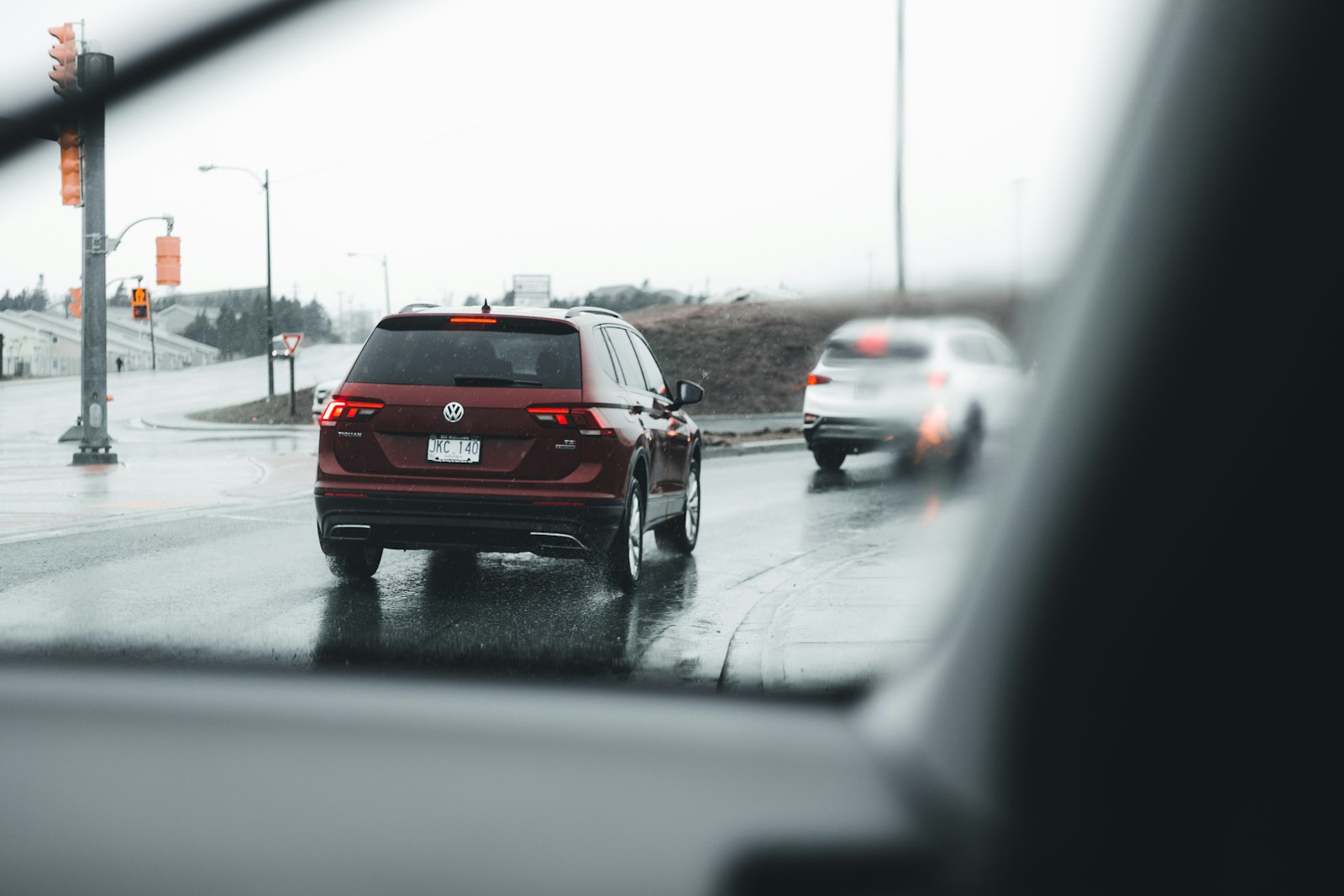

Every day on American roads, thousands of drivers yank the steering wheel back into their lane, stomp the brake pedal a half-second before impact, or swerve around a car that stopped while they were looking at a screen. These near misses almost never show up in police reports or federal crash databases. But safety researchers say they reveal the same underlying problem that killed 3,308 people in distraction-related crashes in 2022, according to the most recent finalized data from the National Highway Traffic Safety Administration: drivers are splitting their attention, and the margin for error is vanishing.
As of spring 2026, no federal agency systematically tracks near-miss events on public roads. But the pattern connecting close calls to actual crashes is well documented, and the evidence points in one direction: distraction, especially from phones, is a primary driver of both.
How a two-second glance becomes a near miss
The mechanics are simple and unforgiving. NHTSA states plainly that “you cannot drive safely unless the task of driving has your full attention” and classifies “any non-driving activity” as a potential distraction that raises crash risk. At highway speed, a car covers roughly 150 feet in two seconds. That is half a football field traveled with no one watching the road.
The largest naturalistic driving study ever conducted in the United States confirmed how quickly those seconds turn dangerous. The Second Strategic Highway Research Program, run by the Virginia Tech Transportation Institute and funded in part by the National Institutes of Health, placed cameras and sensors inside more than 3,500 vehicles driven by volunteers across the country. Researchers then analyzed the moments just before crashes and near-crashes. The results, summarized by NIH, showed that any activity that pulled a driver’s eyes from the road for more than two seconds significantly increased the odds of a crash or close call. Texting, dialing, and reaching for objects were among the riskiest behaviors recorded.
On the road, the sequence is familiar to almost anyone who commutes: a driver glances at a notification, the car ahead brakes, and the only thing separating a scare from a collision is whether the driver looks up in time.
Phones sit at the center of the problem
Cell phone use is the most studied and most common form of driver distraction. NHTSA’s 2022 crash data found that cell phone use was reported in a significant share of fatal distraction-related crashes, and the agency notes that the true number is likely higher because phone use is difficult to detect after a collision.
The AAA Foundation for Traffic Safety has tracked self-reported phone use behind the wheel for years. In its most recent survey data, a majority of drivers said they consider texting while driving unacceptable, yet a substantial percentage admitted to reading or sending messages behind the wheel within the previous 30 days. That gap between what drivers believe and what they actually do helps explain why close calls keep happening even as awareness campaigns multiply.
What makes phone use especially dangerous is that it combines all three recognized categories of distraction. Safety researchers and NHTSA break distraction into three types: visual (eyes off the road), manual (hands off the wheel), and cognitive (mind off the task of driving). Sending a text or scrolling a feed involves all three simultaneously. By the time a driver’s eyes return to the windshield, traffic conditions may have changed completely, and the correction, a hard brake, a sharp swerve, becomes the near miss that almost made the evening news.
Other distractions follow the same pattern. Eating, adjusting a navigation app, turning to talk to a passenger, or reaching for something on the floor all shift attention away from driving. But phone interaction remains the focus of most research because it is so pervasive and because it so reliably triggers the visual-manual-cognitive combination that the VTTI study linked to the highest crash risk.
The numbers behind the close calls
Near misses are, by nature, undercounted. No one files a police report for a scare. But the scale of distraction-related crashes offers a rough sense of how many close calls are happening underneath the official statistics.
NHTSA’s finalized 2022 data recorded 3,308 deaths in distraction-affected crashes. The agency also estimated that approximately 289,310 people were injured in such crashes that year. Those figures represent only the incidents severe enough to be reported and where distraction was identified as a factor, a bar that many crashes, let alone near misses, never clear.
The VTTI naturalistic driving study provides a closer look at the ratio. Researchers found that for every actual crash captured on camera, there were far more “near-crash” events, sudden evasive maneuvers triggered by the same distracted behaviors. That ratio suggests the real footprint of distracted driving on American roads is many times larger than crash statistics alone indicate.
Why younger drivers face extra risk
Drivers under 30 are disproportionately represented in distraction-related crashes, and the reasons go beyond stereotypes about screen addiction. Younger drivers have less experience reading traffic patterns, which means they have a smaller margin of error when their attention drifts. NHTSA data consistently shows that drivers aged 15 to 20 make up the largest proportion of drivers reported as distracted at the time of a fatal crash.
The VTTI study found a similar pattern among teen participants. Newly licensed drivers were more likely to engage in secondary tasks like texting and were less able to recover when those tasks pulled their attention at a critical moment. A near miss that an experienced driver might handle with a quick correction could overwhelm a newer driver’s ability to react, turning a close call into a crash.
Parents and driving instructors have a limited window to shape habits. Research from the AAA Foundation suggests that the first 12 to 18 months of solo driving carry the highest crash risk for teens, and that distraction is a leading contributing factor during that period. Building the habit of putting a phone out of reach before starting the car, rather than relying on willpower at 60 mph, is one of the most effective interventions safety experts recommend.
Turning near misses into a reason to change
A near miss can be a powerful motivator, but only if the driver recognizes it for what it is: evidence that something went wrong, not proof that everything turned out fine. Safety researchers call this “normalization of deviance,” the tendency to treat a close call as confirmation that risky behavior is manageable rather than as a warning that luck will eventually run out.
Several practical steps have strong support from NHTSA and the AAA Foundation:
- Stow the phone before driving. Place it in a bag, glove compartment, or use a “Do Not Disturb While Driving” mode. Eliminating the temptation is more reliable than resisting it.
- Set navigation and music before pulling away. Adjusting apps in motion recreates the same visual-manual-cognitive distraction as texting.
- Speak up as a passenger. AAA research shows that passengers who calmly point out distracted behavior can reduce risky driving, especially with teen drivers.
- Treat a near miss as a data point. If a hard brake or a swerve was caused by inattention, that is a signal to change the behavior, not a story to laugh off.
Distracted driving is not a new problem, but the sheer volume of screen-based temptation inside modern vehicles has made it more persistent and harder to avoid. The near misses piling up on American roads are not just scares. They are the early warning system for crashes that have not happened yet, and they will keep coming until drivers treat every trip as a task that demands full attention.
More from Wilder Media Group: