

The idea of a build‑your‑own electric truck has hovered at the edges of car culture for years, but the Slate EV turns that thought experiment into a production‑ready product. Instead of locking buyers into trim levels and option packs, the small pickup is designed so owners can swap body styles, add features and refresh the look over time. If it works at scale, the Slate Truck could push the auto industry toward a model where vehicles are platforms first and finished products second.
That shift would not just change how cars look. It could reshape how they are priced, insured, repaired and even how long they stay on the road by treating body panels and interior pieces as consumable accessories rather than permanent fixtures. The result is a vehicle that challenges assumptions about what an electric pickup should be and who gets to decide how it is configured.
The minimalist platform that invites modification
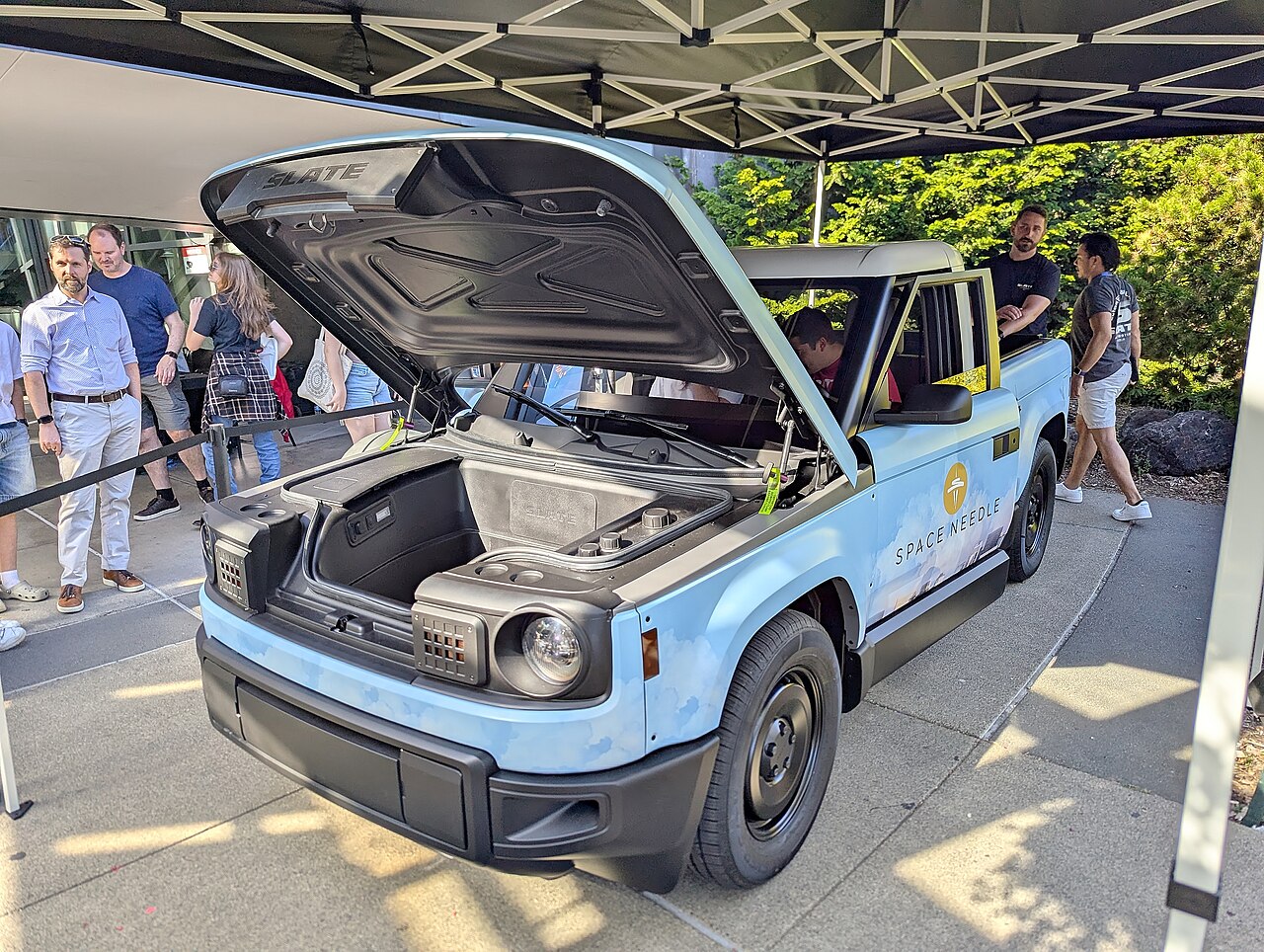
At the heart of the concept is the Slate Truck itself, an electric pickup truck made to accept multiple body configurations and accessories on a common chassis. The Slate Truck is presented as a back‑to‑basics machine, with a simple two‑seat cabin, exposed fasteners and an emphasis on utility rather than luxury. A Prototype Slate Truck has already been shown in public, including a display at the Space Needle, signaling that the brand wants the hardware to be seen as a tangible object rather than a distant promise.
The company leans into that stripped‑down philosophy by shipping every vehicle in a single core configuration, with a gray exterior and a very basic interior that prioritizes durability over ornament. Owners are expected to bring their own device for infotainment, with a tablet mount offered as an option rather than a built‑in screen. This approach reduces complexity and cost while turning the truck into a blank slate for customization, instead of a gadget‑heavy product that risks feeling dated within a few model years.
Radical customization and modular bodywork
The most disruptive part of the Slate vision is the way the truck treats bodywork as a modular kit. Reporting on Slate’s build‑your‑own electric pickup highlights how the body panels are designed to be swapped out by owners who want to change from a pickup bed to a more enclosed configuration or simply refresh the exterior. Advocates argue that this approach could reshape electric mobility by letting buyers reconfigure their vehicle over time instead of replacing it, and by making minor collision damage a matter of changing panels rather than requiring expensive body shop work, as outlined in coverage of individually customizable Slate concepts.
Official materials describe the truck as a radically simple electric pickup that can change in character, with messaging that leans on slogans like EVEN AN SUV and CUSTOMIZE IT, CHANGE IT, MAKE IT YOURS. The brand positions the Slate as a platform that can be configured as a work truck, an EVEN SUV‑style family hauler or something in between, all on the same underpinnings. That strategy invites third‑party designers and small shops to create their own panels and accessories, echoing the way PC builders treat cases and components as interchangeable parts rather than fixed elements.
Pricing, specs and the appeal of “just enough”
Affordability is central to the Slate pitch. Early coverage describes the truck as starting under $27,500, with one detailed look at the two‑seat electric truck citing a base price of $27,500 for a small pickup designed to be customized rather than optioned in the traditional way. That same analysis notes that the minimalist two‑seat layout and simple steel wheels are part of a strategy to keep the entry point low, framing the product as a tool for buyers who care more about function and flexibility than prestige, as seen in reports on a refreshingly simple two‑seat.
The powertrain follows the same philosophy of sufficiency over excess. The base Slate truck is described as using a single motor with rear‑wheel drive and a battery that delivers a 150-mile range from a 52.7-kWh pack, figures that align with a focus on urban and suburban duty cycles rather than long‑haul towing. Commentary around these specs notes that Slate’s leadership is undoubtedly aware of research showing that many truck buyers rarely use the full capability of larger pickups, yet the company is betting that a 150-mile range is enough for daily use when paired with fast charging that can bring the battery to 80 percent in around 30 minutes. For home charging, the truck uses a NACS port and can be plugged into a household outlet overnight, a detail highlighted in coverage of a customizable electric pickup.
From fleets to DIY builders, a new ownership model
While the Slate Truck is pitched to individual buyers who want to build the Slate they want, the modular design also targets commercial fleets that need simplicity and low total cost of ownership. Analysts examining a modular EV truck that promises simplicity, lower costs for fleets and consumers emphasize that a deliberately straightforward design can reduce downtime and make it easier to maintain a consistent fleet over many years. For operators, the ability to replace body modules or interiors without touching the core chassis could extend the useful life of each vehicle and lower depreciation, as discussed in coverage of a modular EV truck.
Enthusiasts and small businesses, meanwhile, see opportunity in the Slate platform as a canvas for aftermarket creativity. Design‑focused reviews describe Radical Customization and tell buyers that You Build the Slate You Want, contrasting Slate’s approach with traditional manufacturers that push fixed configurations and bundled upgrades. By shipping every truck in a single spec and encouraging owners to add vinyl wraps, modular racks or custom body kits, Slate aligns itself with DIY culture and maker communities. That ethos is echoed in a first‑look review that calls the 2027 Slate Truck a Pickup Ready for DIY Dreams and pegs its starting price at $27,000, reinforcing the idea that this EV is meant to be modified rather than admired in stock form.
Design simplicity, digital minimalism and cultural impact
Beyond hardware, the Slate concept challenges the digital direction of modern cars. Instead of a sprawling touchscreen and proprietary software, the truck expects drivers to bring their own smartphone or tablet, with a simple mount available for those who want it. Commentators who compare modular EVs to the PC revolution argue that this separation of vehicle and computing device mirrors the way desktop towers and laptops rely on user‑selected peripherals and software. One discussion framed the Slate as a Back to Basics, Car That Is Just What You Need, with voices like Cathy Gellis praising the idea of a vehicle that does not try to be a rolling entertainment system, as referenced in analysis of modular EVs and.
The restraint extends to the cabin and exterior finishes. A widely shared social post described the minimalist two‑seater as having no paint, no stereo and no touchscreen, with body panels made of durable materials that can be wrapped or replaced as tastes change. The same post said the vehicle was Slated for release in 2026 and suggested that this approach could set a new standard in personal transportation by treating the car as an evolving object rather than a fixed purchase. Enthusiasm around that Slated for release message hints at a cultural shift, where drivers expect to keep a core vehicle for a decade or more while refreshing its appearance and capabilities through modular upgrades.
More from Wilder Media Group: