


The United States is perfecting a new way to sink ships at sea, and it starts by blowing up its own. In a series of live‑fire trials, aging Navy hulls are being turned into test dummies for superfast, torpedo‑like weapons that promise to shatter enemy vessels in seconds. The result is a rare glimpse of how the Pentagon is rewriting maritime warfare for an era of long‑range precision strikes and contested oceans.
These dramatic sinkings are not stunts. They are carefully choreographed experiments that combine old warships, cutting‑edge guidance kits, and multinational exercises to prove that a relatively cheap bomb can do the work once reserved for heavyweight torpedoes. The spectacle of a U.S. ship disappearing beneath the waves is, in effect, a live demonstration of how vulnerable any surface fleet could be in the next major conflict.
From target hulks to live‑fire laboratories
For the Navy, deliberately sending an ex‑warship to the bottom is now a core training tool rather than an act of nostalgia. The service runs what it calls The SINKEX Program, which uses ex‑Navy vessels as targets for at‑sea live‑fire events that end with the hulks sinking in deep ocean waters after being pummeled by real weapons. Environmental rules are strict, so ships like the Navy’s ex‑Acadia are stripped of hazardous materials before they are towed to designated ranges and prepared for ocean disposal.
Once on station, these decommissioned hulls become full‑scale laboratories where crews can fire missiles, guns, and now air‑dropped precision weapons while sensors record every impact. A previous Sinking Exercise, or SINKEX, showed just how stubborn an old frigate can be, with the ship absorbing repeated hits before finally going under as observers watched the result. That kind of live‑fire punishment, captured in a widely shared video of a tough old Navy frigate, is exactly what planners want to see before betting future war plans on new munitions.
RIMPAC’s stage for superfast torpedoes
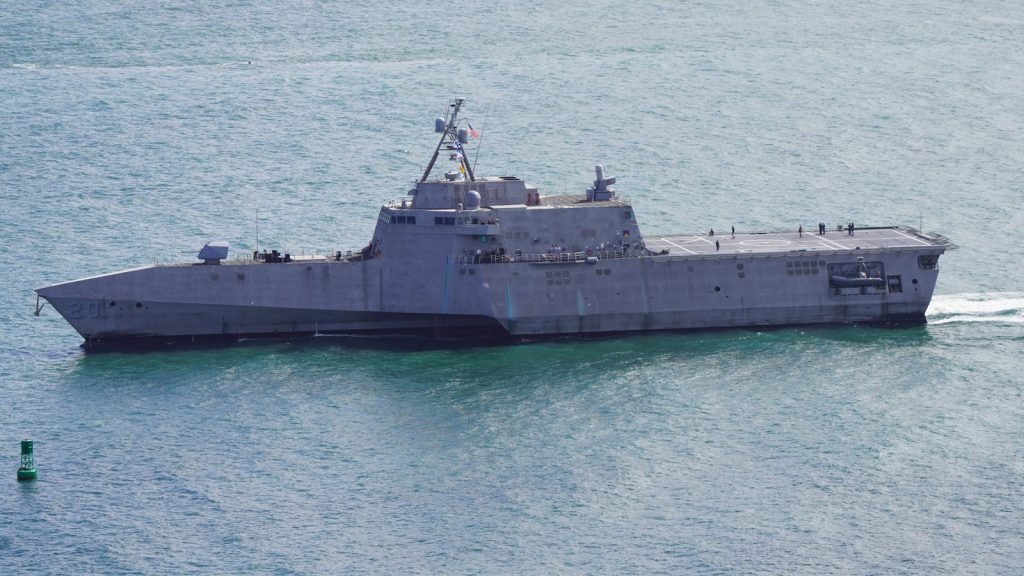
The most visible stage for these sinkings is Exercise Rim of the Pacific, better known as RIMPAC, the world’s largest international maritime drill. During RIMPAC 2024, ships and aircraft participating in the exercise conducted long‑planned live‑fire sinking events off the island of Kauai, turning retired vessels into targets for a mix of allied firepower. Navy planners used the Sinking Exercise format to test how combined forces could locate, strike, and sink a ship as part of a broader scenario in the central Pacific, as described in official RIMPAC news.
Those events are set to grow even more ambitious. U.S. 3rd Fleet has already framed RIMPAC 2026 as the largest‑ever iteration, with planners emphasizing that the 30th running of RIMPAC will be a milestone for combined maritime power in the Indo‑Pacific region. That planning guidance, laid out in a mid‑planning conference, signals that future SINKEX events will not just be about gunnery practice but also about integrating new maritime strike concepts into coalition operations.
QUICKSINK, the bomb that behaves like a torpedo
At the center of the latest sinkings is Quicksink, a guidance kit that turns a standard bomb into a torpedo‑like ship killer. The US Air Force has described Quicksink as a cheap bomb that can sink warships in about 20 seconds, using precision guidance to slam into a hull at the waterline and break a vessel’s structure in a way that mimics a heavyweight torpedo. In drills near Russia, The US Air Force highlighted how Quicksink offers a lower‑cost, easier‑to‑deploy alternative to advanced heavyweight torpedoes while still delivering catastrophic damage.
Technically, Quicksink is less a new explosive than a new way to deliver it. The system uses a modified, air‑delivered munition fitted with guidance and fuzing that allow it to home on a moving ship and detonate where it will do the most structural harm. Earlier testing showed that the weapon could literally break a vessel into two, with The US Air Force showcasing how a guided bomb, dropped from a tactical aircraft, could replicate the underwater shock effects of a submarine torpedo. That concept was highlighted in a detailed look at Quicksink testing, which underscored the appeal of pairing low‑cost munitions with smart targeting.
Norway’s cold seas and a stealth bomber proving ground
To move Quicksink from concept to combat‑credible tool, the US Air Force has been taking it to some of the most strategically sensitive waters on the map. In Northern Norway, a US strategic bomber of the type B‑2, accompanied by Norwegian F‑35s, tested a new American precision weapon by releasing a Quicksink toward a maritime target in the Norwegian Sea. That event, described as US and Norway Tested New American Precision Weapon in Northern Norway, underscored how closely allied air forces are working to validate the weapon in realistic Arctic conditions.
Another account of the same campaign stressed that the US and Norway tested a new American precision weapon in Northern Norway using a B‑2 bomber and Norwegian fighters to simulate a long‑range maritime strike. That reporting on how the US and Norway tested the system in the Norwegian Sea dovetails with a broader description of The QUICKSINK system as a significant advancement in maritime strike capabilities. Developed as a Joint Capabi effort, The QUICKSINK concept focuses on neutralizing surface vessels using modified, air‑delivered munitions, a point emphasized in an analysis of how The QUICKSINK system was tested with Norwegian allies in the Norwegian Sea.
From Gulf of Mexico trials to RIMPAC integration
Quicksink’s path to the fleet has also run through warmer waters. Over the Gulf of Mexico, the US and Norway conducted a maritime strike event that incorporated beyond‑line‑of‑sight communications and multi‑domain targeting to refine tactics for using the weapon against surface ships. That event, described as a US, Norway Test QUICKSINK maritime strike, highlighted how planners are experimenting with passing targeting data across platforms so that a bomber can hit a ship it cannot see directly, a concept detailed in coverage of the maritime strike event.
Those tactics are already bleeding into large‑scale exercises. During RIMPAC 2024, the Air Force Global Strike Command noted that, in partnership with the U.S. Navy, a U.S. Air Force B‑2 Spirit stealth bomber proved a low‑cost, air‑delivered maritime strike capability as part of multiple SINKEXs. That description of how the Navy and Air Force used the Spirit bomber in multiple SINKEXs shows Quicksink’s role as more than a lab project; it is becoming a centerpiece of how joint forces imagine stopping hostile ships far from friendly coasts.
The spectacle and strategy of sinking a U.S. ship
The public face of this evolution is the dramatic footage of a U.S. target ship being torn apart by a superfast strike. A widely viewed video titled “US Fires Superfast Torpedoes to Sink its Own Ship at Sea” shows how quickly a hulking vessel can succumb once a precision weapon finds its mark, with the narration noting that what remains of the hull may either be dismantled entirely or preserved for display as a historical exhibit after the test. That clip of the US fires superfast torpedoes scenario captures the visceral reality behind the technical language of “maritime strike capability.”
Behind the spectacle is a strategic message aimed at both allies and potential adversaries. By demonstrating that a relatively inexpensive, air‑dropped weapon can sink a large ship in seconds, the United States is signaling that any surface fleet operating within range of its bombers and fighters is at risk, even if submarines are not on the scene. The combination of SINKEX target hulks, RIMPAC’s multinational stage, and the maturing Quicksink system shows how quickly the line between a traditional torpedo attack and an air‑delivered strike is blurring, and why the image of a U.S. ship slipping beneath the waves is now a rehearsal for how future naval battles might actually unfold.
More from Wilder Media Group: