

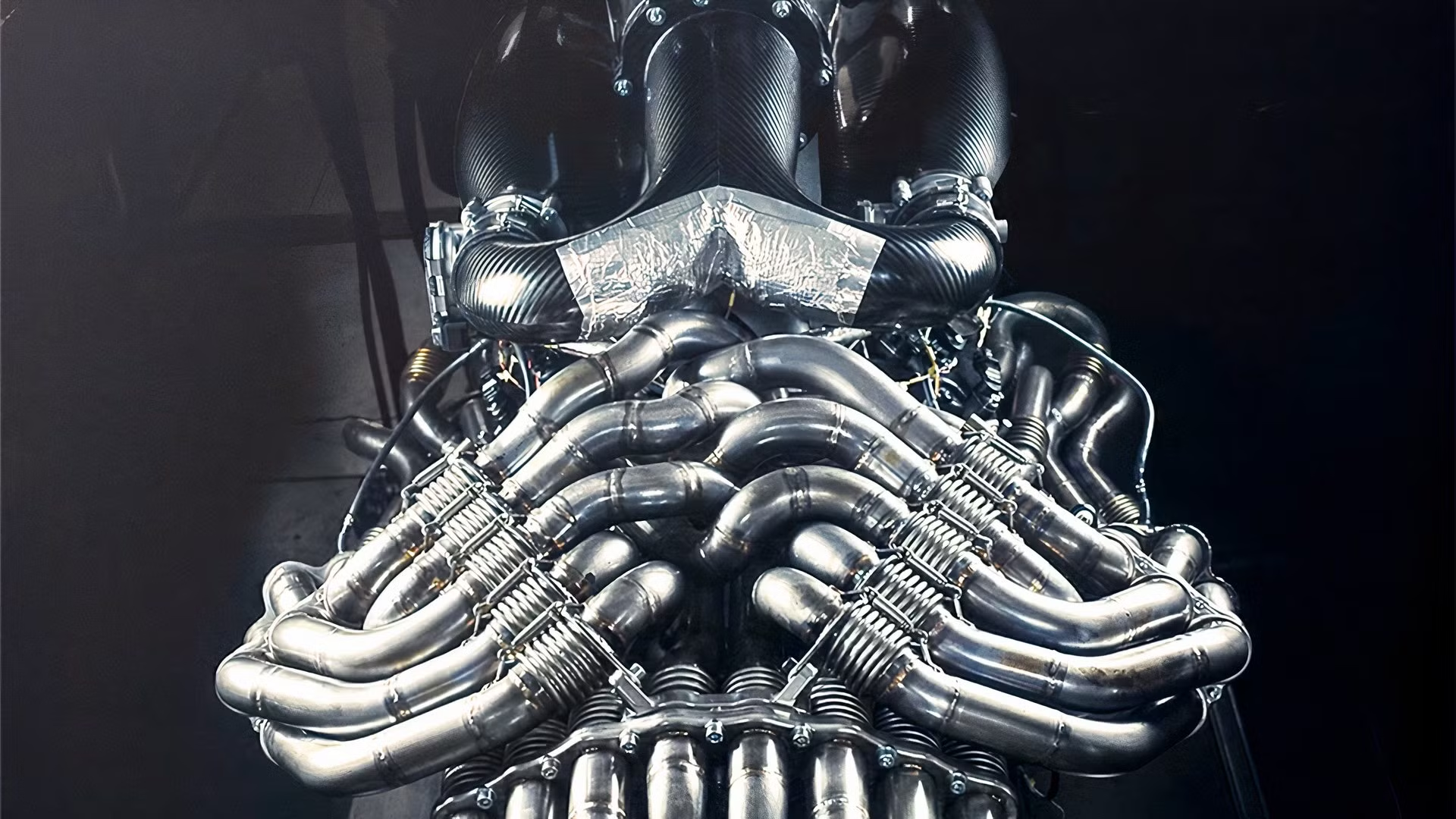
The latest De Tomaso V12 does not just rev high, it attacks the redline so violently that even seasoned track junkies are double checking the tach. Spinning to a wild 12,300 RPM, this engine turns mechanical motion into something that feels closer to a race broadcast than a road car. It is the kind of sound that makes even the most exotic supercar suddenly seem a little muted.
What makes this shrieking twelve so fascinating is how it lands in a moment when everyone keeps writing obituaries for internal combustion. Instead of quietly fading out, the V12 is going out like a rock guitarist smashing the amps, and the De Tomaso setup is only the loudest voice in a small but very serious choir of high revving lunatics.
The De Tomaso V12 That Wants To Live At 12,300 RPM
De Tomaso has never been shy about drama, and its latest V12 is pure theater. In a short clip shared in Feb, the company shows the engine ripping to a screaming 12,300 RPM, the kind of number that used to belong only to top tier race cars. The video racked up 105 thousand views and 652 comments in a hurry, a sign that enthusiasts instantly understood how wild it is to see a naturally aspirated twelve revving that high in an era obsessed with turbos and batteries, and the clip turned the De Tomaso name into a trending topic again as the needle swept past what most people think is mechanically reasonable.
The car wrapped around this powerplant, the De Tomaso P900, is built to make that soundtrack the main event. The V12 sits exposed under bodywork that barely bothers to hide the hardware, and the whole package is unapologetically focused on track work rather than daily driving. The engine is described as naturally aspirated and designed to chase that 12,300 RPM peak as often as possible, which explains why the brand is comfortable letting the world hear it uncorked in that Feb reel instead of saving the noise for private test sessions.
That same attitude carries into the way De Tomaso presents the P900 itself. The centerpiece is explicitly the V12, with the rest of the car shaped to serve airflow, cooling, and visibility of the mechanical bits rather than to chase a clean, minimalist silhouette. The bodywork is full of cutouts and vents that leave suspension and engine components on display, and the cabin is clearly secondary to the engine bay. In coverage of the project, the P900 is described as a machine where the naturally aspirated V12 is the star, spinning to its extreme redline while the bodywork avoids wasting any surface area on hiding those mechanical elements.
The Cosworth GMA Benchmark And The Race To 12,100 RPM
To understand just how outrageous the De Tomaso number is, it helps to look at the current production benchmark. Gordon Murray, the designer behind the McLaren F1, created Gordon Murray Automotive to build the T.50, and the heart of that car is a bespoke V12 developed with Cosworth. The official material on the T.50 describes a 3.9 liter naturally aspirated engine that revs to 12,100 RPM, a figure that makes it one of the highest spinning road car engines ever built and sets the tone for what a modern analog supercar can be when it is not chasing turbocharged torque.
The Cosworth GMA unit is not just about revs, it is about how quickly it gets there. Technical breakdowns of the powertrain describe the Cosworth GMA V12 as a 4.0 liter engine that delivers a specific output of 170 horsepower per liter, a staggering figure for a naturally aspirated road car. That same reporting calls the Cosworth GMA the pinnacle of naturally aspirated engines, and it is easy to see why when the numbers are laid out: the compact displacement, the sky high redline, and the way the engine is tuned to respond instantly to throttle inputs all combine to make every other supercar engine look lazy by comparison, which is exactly how one deep dive on the Cosworth GMA characterizes it.
The broader context around the T.50 only sharpens that point. Gordon Murray Automotive positions the car as a purist machine, with a central driving position, a manual gearbox, and a focus on low weight rather than headline grabbing power figures. Official specs highlight how the T.50 uses a big fan in the rear to manage airflow and downforce, a nod to Murray’s earlier Brabham fan car, and the engine is mounted as a structural element to keep mass in check. Enthusiast discussions of the project emphasize that the GMA T.50 V12 engine revs to 12,100 RPM and pairs that with serious horsepower and a 0 to 60 miles per hour sprint that keeps it competitive with far heavier, turbocharged rivals, as laid out in detailed tables of the GMA T.50 V12 engine, its horsepower, torque, and 0 to 60 M performance.
More from Wilder Media Group: