


Walmart opened its first “Auto Care Center of the Future” in Fayetteville, Arkansas, in October 2025, turning a single pilot location into a signal that the country’s largest retailer wants to own a much bigger slice of routine car maintenance. The revamped center features upgraded service bays, digital scheduling through the Walmart app, and contactless check-in that lets drivers approve work orders from their phones while they browse the grocery aisles, according to an exclusive Axios report on the launch.
The pilot is not a one-off experiment. Walmart already operates roughly 2,500 Auto Care Centers across the United States, and the Fayetteville redesign is meant to serve as a blueprint for modernizing that entire network. For the millions of households that already depend on Walmart for groceries, prescriptions, and back-to-school supplies, the bet is straightforward: keep the family car’s oil changes, tire rotations, and battery replacements under the same roof, at prices low enough to make a detour to Jiffy Lube or Valvoline feel like an unnecessary splurge.
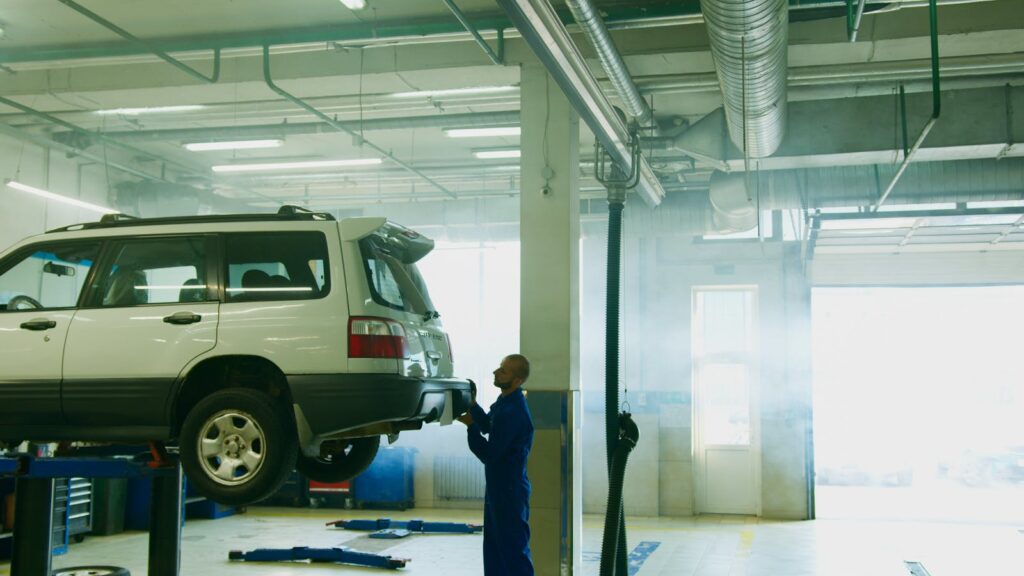
What the “Auto Care Center of the Future” actually changes
The Fayetteville location is designed to compress car maintenance into the rhythm of a normal shopping trip. Walmart described the format as part of a broader evolution of its auto services, with technicians equipped with updated tools and streamlined processes so that a standard oil change or tire rotation fits inside the window of a grocery run rather than eating up half a Saturday, according to the company’s corporate announcement.
The biggest visible change is digital. Customers can book appointments, check wait times, and track service progress directly in the Walmart app, which eliminates the old routine of dropping off a car and hovering near the service desk. Tracy Poulliot, a senior vice president overseeing the auto care business, said the goal is to “make customers’ lives easier so they can get time back for what matters most,” as she explained in a detailed overview of the strategy.
It is worth noting what Walmart Auto Care Centers do not handle. The service menu covers oil changes, tire installation and rotation, battery testing and replacement, wiper blades, and basic light and bulb swaps. Major mechanical work, engine diagnostics, brake jobs, and transmission repairs still require a dedicated garage or dealership. The play here is not to replace a full-service mechanic but to capture the high-frequency, lower-cost maintenance visits that keep older vehicles running between bigger fixes.
How Walmart’s pricing strategy undercuts the competition
Walmart’s auto care pricing follows the same everyday low pricing (EDLP) model the company uses across its stores. Rather than cycling through promotional discounts, Walmart holds prices at a consistent, below-market level on oil changes, tires, and parts. Analysts who track the retailer’s pricing approach note that EDLP is central to Walmart’s position as the most affordable large retail channel in the United States, and extending it to auto care puts direct pressure on quick-lube chains that often charge $20 to $40 more for a comparable synthetic oil change.
For context, a standard synthetic oil change at a Valvoline Instant Oil Change or a Take 5 location typically runs between $60 and $100 depending on the market. Walmart’s posted price for a similar service has historically sat closer to $40 to $55. That gap matters most to the drivers Walmart is targeting: owners of older, paid-off vehicles who are managing tight monthly budgets and looking for predictable costs rather than coupon hunting.
Walmart has also been bundling auto care into a wider set of convenience features inside its app. The company highlighted new functionality that lets customers manage car-related errands alongside grocery orders and product research, framing it as part of a series of in-store and digital changes rolled out over recent months, according to a Yahoo Finance report on the convenience upgrades. The intent is to make an oil change feel like one more line item on a shopping list, not a separate errand that requires a different app, a different location, and a different chunk of the day.
Fuel, convenience stores, and the bigger play for drivers
The auto center overhaul is one piece of a larger strategy to capture more of what drivers spend between the gas pump and the parking lot. Walmart has been expanding its own branded fuel and convenience store network, moving away from a legacy model that relied heavily on partner-operated locations. A past arrangement with Murphy USA resulted in more than a thousand convenience stores near Walmart parking lots, but the company has since shifted toward bringing more of that fuel and snack-stop experience under its own control, a transition detailed in a Retail Dive analysis of the c-store expansion.
Stitch those pieces together and the outline of a full car-ownership ecosystem starts to take shape: fuel up at a Walmart pump, grab a coffee from the adjacent convenience store, drop the car for a tire rotation, and finish the grocery list before the work is done. Walmart has even tested partnerships in the used-car space, though that effort remains smaller in scale. The common thread is using the gravitational pull of 4,700-plus U.S. stores to absorb errands that drivers currently scatter across half a dozen stops.
None of this makes Walmart a threat to a skilled independent mechanic or a dealership service department handling warranty work. But for the routine maintenance that keeps a 2015 Corolla or a 2012 F-150 on the road, the combination of low prices, app-based scheduling, and sheer geographic reach is difficult for smaller competitors to match. As of early 2026, the question is no longer whether Walmart is serious about auto care. It is how quickly the Fayetteville blueprint spreads to the rest of the network.
More from Wilder Media Group: