

A hand works a fingernail under the edge of a glossy red wrap on a car’s rear quarter, and a strip comes away to show black paint underneath. Over that shot, a narrator begins a story: “This dad found an abandoned Dodge because he wanted to give his daughter a car for the first time.”
The video was posted by @lopes66kkkj, an account with no name beyond its handle, under the caption “Reforming an abandoned Dodge.” It is an edited video: a third person voiceover laid over restoration footage. The account does not credit whoever shot the footage or did the work, and nothing on screen shows a dad, a daughter or the place where the car was supposedly found.
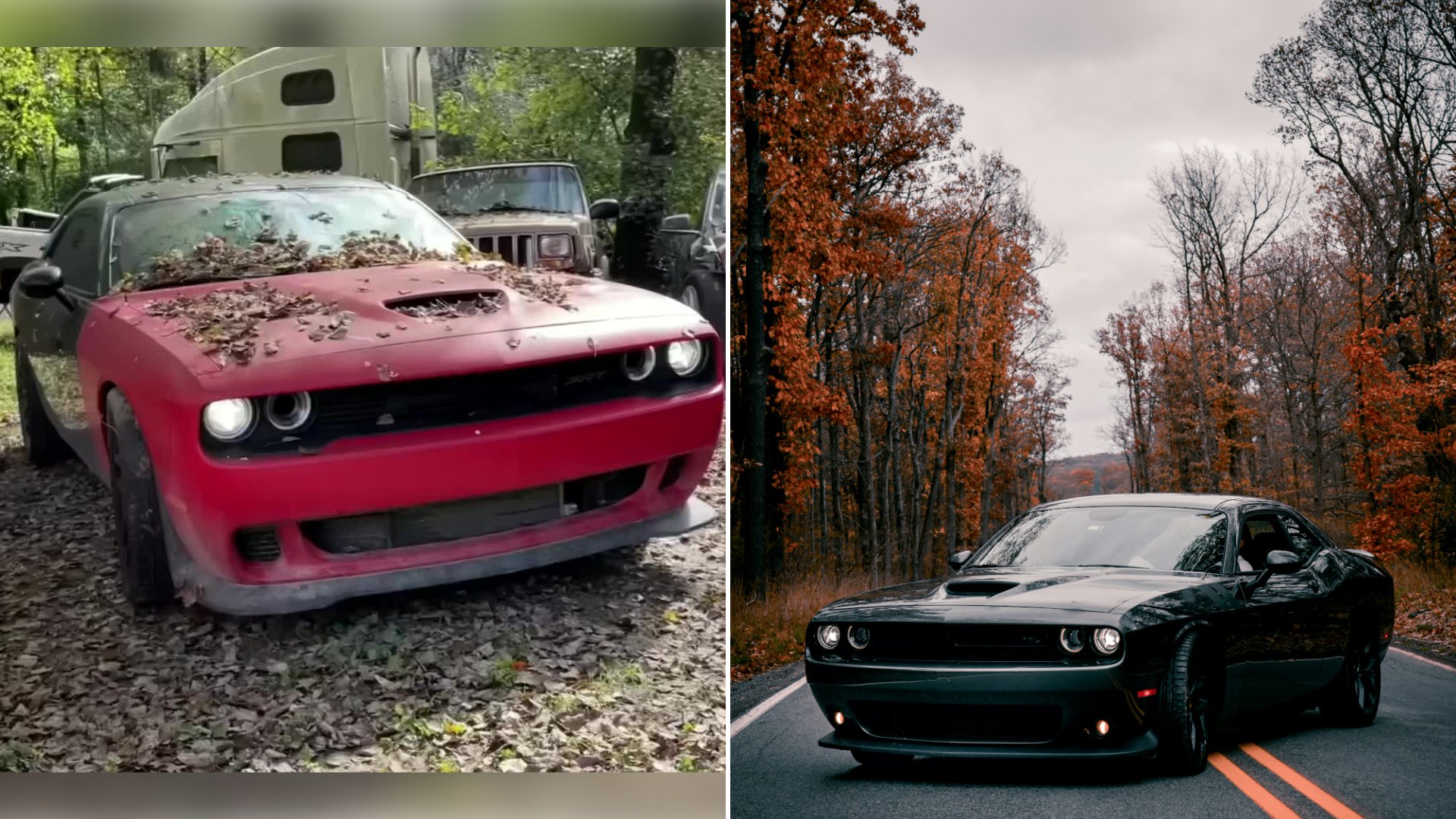
The narration tells a tidy story. According to the voiceover, the daughter’s friends all had cars “while she was always the only one who needed a ride,” the father “didn’t have enough money to buy her a brand new car,” and he found the Dodge “sitting behind an old building, covered in dirt and forgotten for years,” with a faded, cracked wrap, damaged panels and a broken bumper. It ends with him thinking about “the moment he would hand his daughter the keys.” That moment is not in the video.
What the footage does show is a real and fairly thorough refresh of a black Dodge Challenger, recognizable by its body shape, quad headlights and vented hood. The red wrap comes off in long sheets in a gravel driveway. Two young men scrub the bare black paint with wet rags and a bucket. The front bumper cover sits off the car on stands. One worker pulls a rubber seal out of the trunk opening. A bare panel gets sprayed from an aerosol can.
The second half moves into a paint booth with a grated floor. The car is masked in plastic sheeting, the hood scoop openings are taped off in yellow, and a painter in a coverall, black gloves and a respirator lays down color on the loose bumper and fenders with a gravity feed spray gun. The last shots are back outside: the Challenger reassembled in fresh black, the hood up over the engine, and a worker fitting a wheel at the front corner.
What the EPA Says About Spraying Paint in a Booth
The U.S. Environmental Protection Agency publishes guidance for automotive refinishing. In its best practices sheet for refinishers, the EPA calls isocyanates, the hardener in polyurethane clearcoats and many primers, “highly toxic materials,” and says it is “always better to spray inside a booth or prep station than in an open bay,” with a downdraft booth “the most effective at removing hazardous overspray.”
The same sheet says supplied air, positive pressure respirators are the protective choice, and that an air purifying respirator “will not provide adequate protection” unless a proper filter change schedule is set up and followed. It recommends nitrile or butyl rubber gloves rather than latex, chemical resistant paint suits to keep paint off the skin, and HVLP spray guns, which it says reach 60 to 70 percent transfer efficiency against 20 to 30 percent for conventional guns.
If You Are Taking On a Car Like This
- Pull the wrap first and inspect what is under it, as this crew does, before you price the paint job. A wrap can hide scratches, filler and damage that change the plan.
- Do the dirty prep work outside the booth: washing, scuffing and parts removal in the driveway, color only in a ventilated booth.
- If you spray two component primer or clear at home without a booth and supplied air, you are working outside what the EPA sheet describes as protective.
- If the car really was found sitting somewhere, sort the paperwork before the parts order. The Justice Department’s vehicle history system offers reports on title, odometer data and certain damage history for up to $4, and encourages an independent inspection before you buy.
More from Steel Horse Rides
- Owner Pays $6,500 for a 2009 Dodge Challenger R/T on Craigslist, Then Cuts Out the Factory Mufflers and Installs Cheap Amazon Coilovers He Guesses Are Already Too Low
- Owner Whose Garage Door Came Down on His Brand New Porsche 911 Hears a Body Shop Would Probably Charge Five Grand, Then Says a Driveway Repair Looks Like It Never Happened
- Owner of a Custom 1990 Honda Accord That Flooded in Storage Says Seeing It Dirty Is Depressing, Then Sees the Sonic Blue Paint and Interior After a Week of Detailing